Deposit Slip Template: What Information Should Be Included?
Disclosure: This article was published as part of a paid partnership with OnlineCheckWriter.com, a Zil Money platform. The author is an independent contributor.
A deposit slip template gives a business or account holder a structured way to record the money being deposited into a bank account.
A useful template should make the account clear, separate cash from checks, show the deposit total, and provide enough information to review the transaction later.
However, a generic template should not automatically be treated as a bank-approved form.
Financial institutions can have different deposit requirements.
What Does a Typical Deposit Slip Contain?
PNC describes deposit slips as forms commonly containing information such as the account holder’s name, account number, transaction date, check information, and deposit amount.
A practical template may therefore contain fields for:
the account name, account number, date, cash amount, individual checks, subtotal, cash received back where applicable, and final deposit.
The exact field names and layout can vary.
Use the requirements of the financial institution handling the deposit as the final authority.
Cash and Checks Should Be Separate
A deposit total may contain several types of funds.
The template should allow the depositor to distinguish cash from checks rather than entering only one unexplained total.
Bank Five Nine’s instructions tell depositors to enter cash separately and list deposited checks individually.
This helps both the bank and the account holder understand how the final amount was built.
For a business, it also provides a better reconciliation trail.
Include Space for Multiple Checks
A company may deposit several customer checks at once.
A useful deposit slip template should provide enough room to identify or list them.
When more items are involved than the slip can accommodate, follow the bank’s procedure for additional check listings or accompanying documentation.
Do not reduce the deposit to a single total if the institution requires individual items.
Templates Should Help With Arithmetic
A template can also make calculation easier.
The user can add cash and check amounts, create a subtotal, subtract any cash being received back, and arrive at the final deposit.
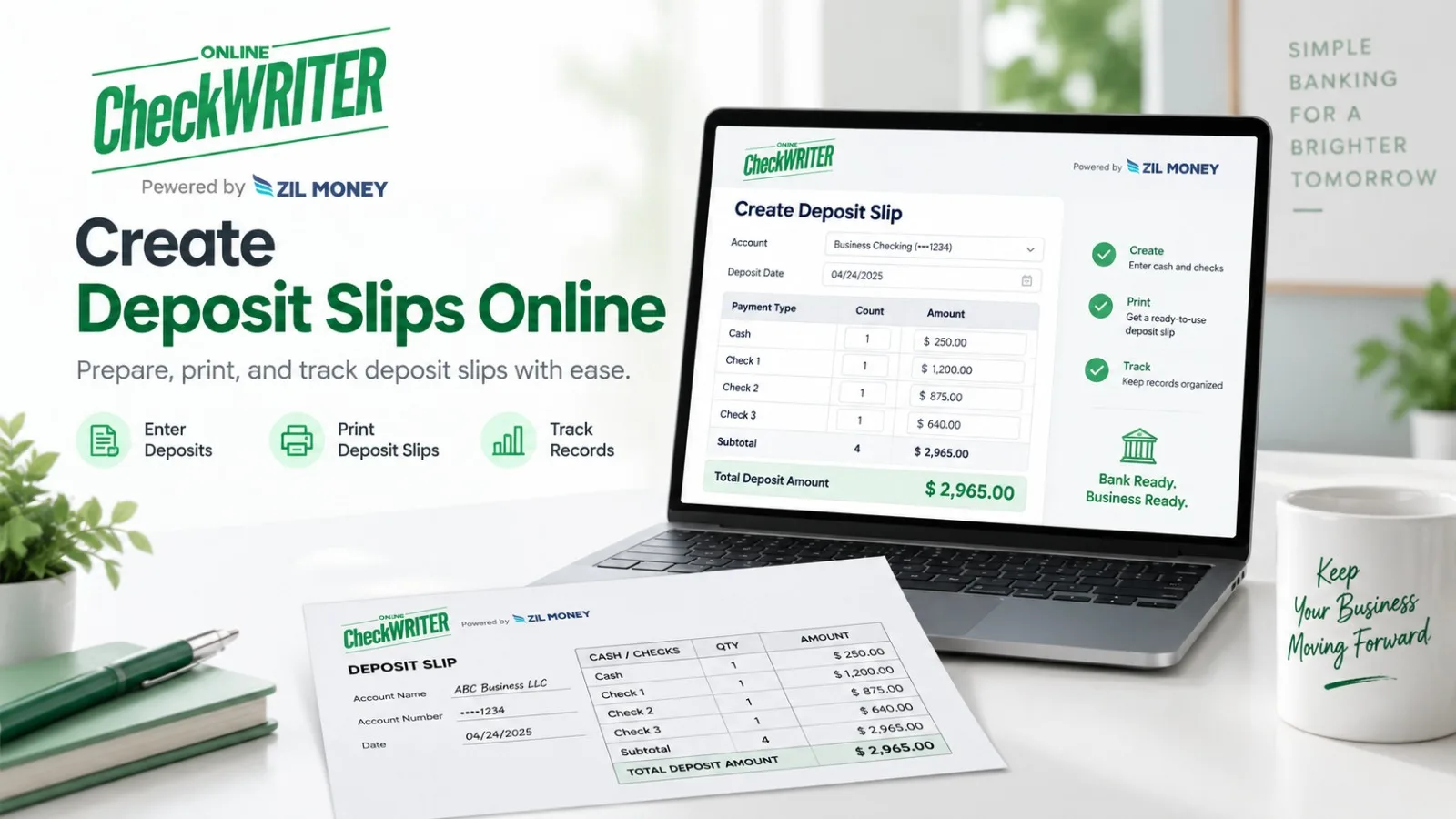
OnlineCheckWriter.com’s current deposit-slip workflow performs these calculations based on the amounts entered by the user.
This is one difference between a static Word or PDF template and a software-based generator.
A static document organizes information.
A generator can also calculate and retain it.
A Template Does Not Guarantee Acceptance
This is one of the most important compliance points.
Search results contain many generic deposit-slip templates in Word, Excel, and PDF formats.
A downloaded template may look like a bank deposit slip without being designed for the user’s particular financial institution.
The bank can determine what it accepts.
That is why businesses should verify a new template before depending on it for frequent branch deposits.
Business Records May Need More Than the Bank Slip
A bank deposit slip records what goes into the account.
The company’s accounting process may need more detail.
For example, the business may need to know which customer invoices correspond with each check or which retail location produced the day’s cash.
Those details do not necessarily belong on the bank deposit slip.
They may belong in the company’s accounting or deposit log.
Keep the bank form and internal accounting record connected without forcing both jobs onto one document.
Digital Templates Can Reduce Repeated Entry
Businesses that make frequent deposits may prefer software over repeatedly completing paper forms.
OnlineCheckWriter.com’s current product allows users to create deposit slips, calculate totals, save them, and review previous deposit-slip history.
That can be useful for repeated deposits into the same accounts.
The safest way to use a deposit slip template is therefore to treat it as a structured preparation tool.
Include accurate account and deposit information, check the total, and confirm that the financial institution accepts the format before building a recurring business process around it.
OnlineCheckWriter.com – powered by Zil Money, is a financial technology company, not a bank. Banking and money movement services are provided through partner financial institutions and licensed service providers. FDIC insurance coverage applies only to eligible deposit products and accounts, and is subject to applicable terms, conditions, limitations, and requirements. Additional information regarding partner institutions, products, and services is available in the applicable terms and agreements.