How videototranscript Helped Me Turn Webinars Into Searchable Notes
Our team records a lot of webinars and training sessions. For a long time those recordings just sat in a shared folder. Someone would say “wasn’t there a session about the new onboarding flow?” and we had no way to find it without watching twenty minutes of video. I finally decided to fix that by turning the recordings into text I could actually search.
The first thing I learned is that not every transcription method gives you the same result. I started with the automatic captions baked into our video host. They were acceptable for live reading but messy as a document, and I could not export them cleanly into our notes. I tried a general speech tool next, but it flattened every speaker into one block of text and dropped most of the product terms we rely on. That was the moment I started looking for a dedicated way to transcribe video to text instead of fighting a generic assistant.
Why We Needed to Transcribe Video to Text
The issue was never a lack of content. We had plenty. The issue was that the content was trapped inside video files nobody had time to rewatch. New hires needed the onboarding sessions. Support needed the product deep dives. Compliance needed the policy explainers. Every team kept asking the same question: which recording was that in?
When knowledge lives only inside video, it decays the day the recording ends. People leave, links rot, and the exact explanation everyone needs gets buried. Text changes that equation because text is searchable, copyable, and easy to maintain
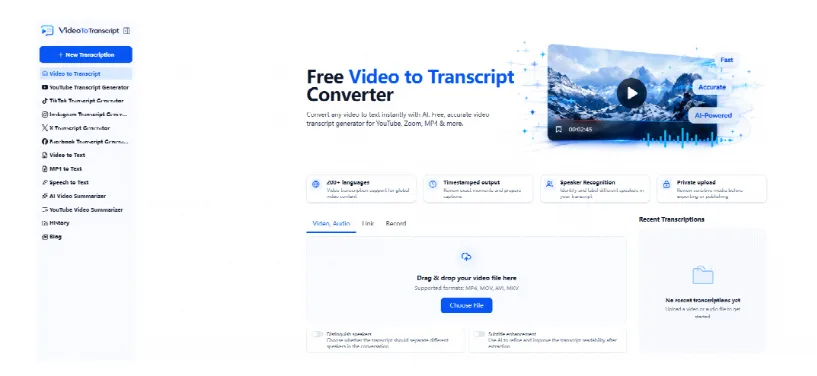
What changed when I started using videototranscript
The difference was immediate. Instead of one run-on paragraph, I got a transcript broken into timed segments, which made it easy to jump to the moment a specific process was explained. I could finally answer “which session was that in?” by searching instead of guessing.
Here is the workflow that ended up sticking with our team:
I upload the webinar file directly. The tool processes it without asking me to install anything, and it keeps the original timing so each line of text maps back to a moment in the video.
I search the transcript for keywords like “onboarding” or “refund policy”. What used to take a full rewatch now takes a few keystrokes.
I pull the relevant lines into our knowledge base. Because the text is clean, I can paste it straight into documentation without heavy editing.
The part that surprised me was how much duplicated content we had. Three different sessions all explained the same refund step in slightly different words. Once everything was text, those overlaps were obvious and we trimmed our training material down to one clear source.
Handling our own jargon
A transcription tool is only useful if it keeps the words that matter to us. Early on I was worried our product names and acronyms would come back garbled. They did not. videototranscript kept the specialized terms intact well enough that I rarely needed more than a quick pass to clean up formatting. For a business setting, that accuracy is the difference between a transcript you trust and one you have to rewrite from scratch.
The YouTube side of the work
Not everything we learn from lives on our own servers. A lot of the best talks in our industry are posted on YouTube. For those, I use a youtube transcript generator from decopy, which takes a video link and returns a full transcript without me downloading the file first. It fits the same notes folder, so my search tools treat our internal recordings and public talks as one library.
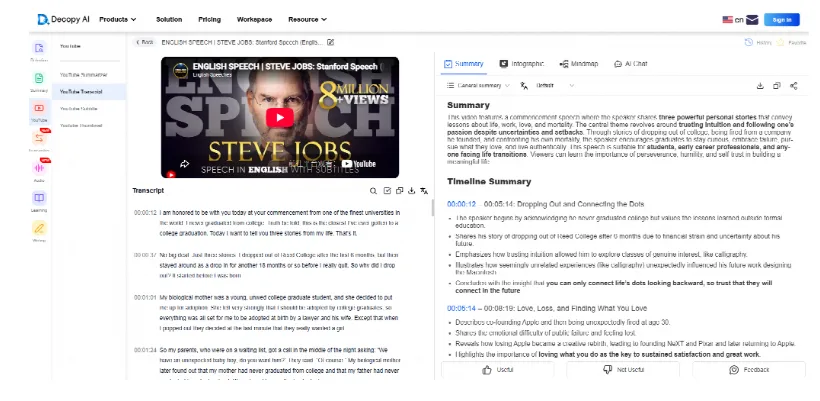
That combination covers almost everything. Internal recordings go through videototranscript, and public YouTube talks go through the youtube transcript generator. Both outputs land in the same place, which means I stopped thinking about where a fact came from and started thinking about whether it was worth keeping.
How I Measure the Value of Video to Text Notes
I track two simple things now. The first is how fast I can locate a fact that used to require a rewatch. The second is how often a transcript becomes a reusable doc instead of a one-time read. Both numbers have moved in the right direction since we started treating transcription as a default step rather than an afterthought.
What made this stick was not any single feature. It was the shift from “I have a video somewhere” to “I have searchable notes I can actually use”. Our onboarding docs got faster to write. Meeting recaps stopped depending on whoever happened to take notes by hand. And when a compliance question came up, I found the exact session and line in minutes instead of guessing.
If your team is sitting on a pile of recordings the way we were, the fix is simpler than it looks. Turn the videos into text, make that text searchable, and the knowledge you already paid for finally becomes usable. The tool that did it for us was videototranscript, paired with a youtube transcript generator for the talks we only have on YouTube.