Best Way to Pay Business Bills: Match the Method to the Payment
Disclosure: This article was published as part of a paid partnership with Zil Money. The author is an independent contributor.
There is no single best way to pay business bills.
The right method for a monthly software invoice may not be the right method for a contractor, landlord, equipment supplier, or time-sensitive vendor.
Businesses get a better result when they match the payment method to the recipient, deadline, cost, and information available.
ACH for Routine Business Payments
ACH can work well for vendors that accept bank-to-bank payments.
The ACH Network supports business payments, recurring transactions, payroll, and bill payments across U.S. financial institutions.
For recurring suppliers, ACH can reduce the need to create and mail paper checks.
The business still needs accurate payment information and should understand the provider’s timing, cutoff, and fee structure.
Checks Still Have a Place
Some vendors still request checks.
A check may be useful when the recipient does not want to share bank information or when an established business process already uses paper payments.
The company can print the check internally, use a mailing service, or use a digital-check workflow depending on what the recipient accepts.
Zil Money’s eCheck, for example, is delivered as a one-time printable PDF that the recipient can print and deposit. It is different from an ACH transfer.
Wire Transfers for Certain Time-Sensitive Payments
Wire transfers are another option when the payment needs a different settlement method.
Businesses should verify recipient information carefully because wire payments can involve different costs and processing conditions from ACH.
The appropriate method depends on the transaction and provider.
Credit Cards Can Be a Funding Source
Sometimes the vendor does not accept credit cards, but the business wants to use a card as the funding source.
Zil Money currently supports eligible card-funded business payments where the payer’s card is charged and the recipient can receive the payment through a supported method such as ACH, check, or wire.
This does not mean every business payment is eligible or that card funding is automatically the best choice.
A 2.9% standard credit-card processng fee currently applies to Zil Money credit-card payments, and additional delivery-method charges may apply depending on the transaction. Businesses should check the current fee schedule.
Bill Pay Can Bring the Methods Together
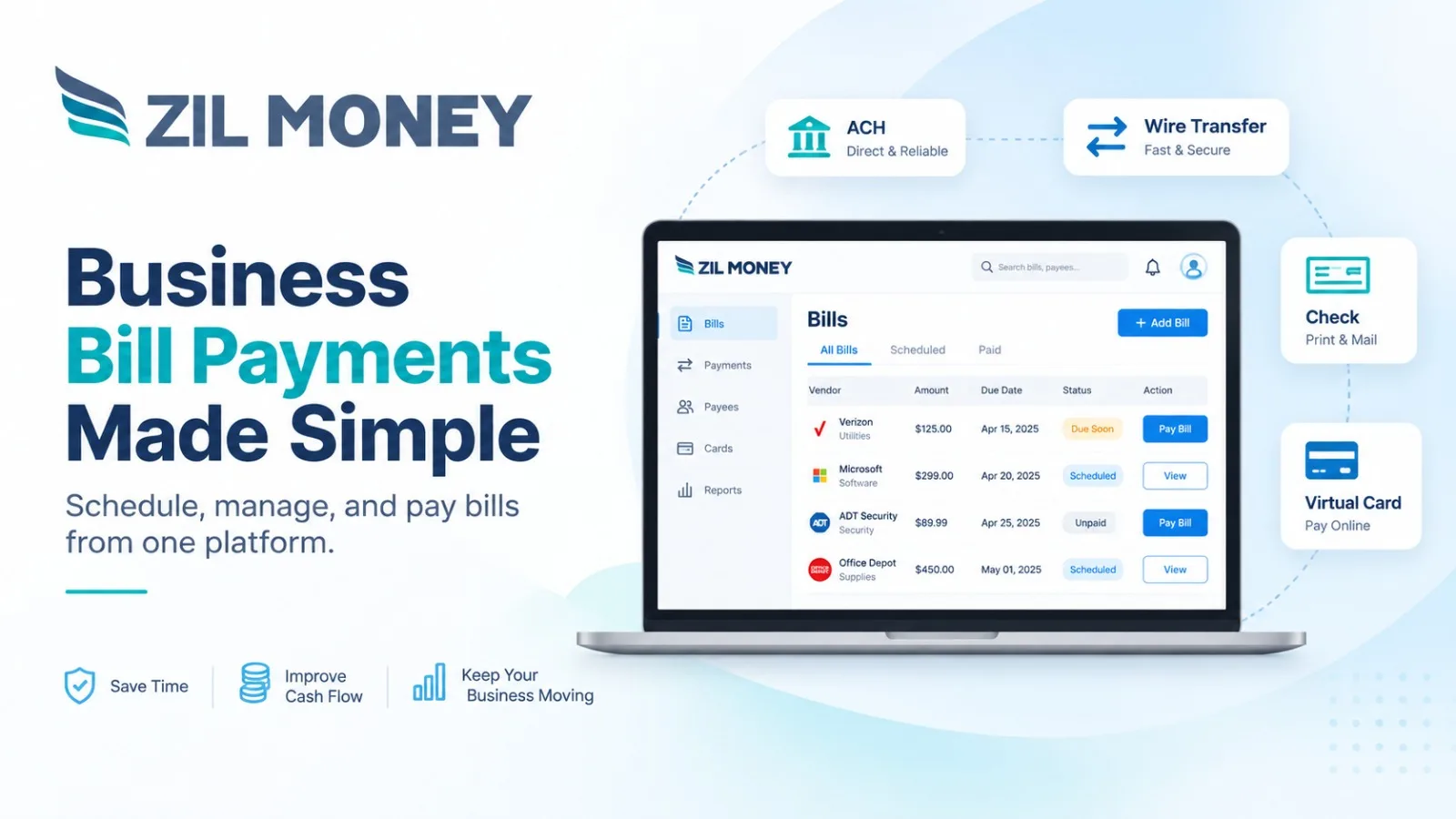
A bill-payment platform can help businesses organize due dates and choose from available payment methods without treating every bill as a separate workflow.
Zil Money’s current Bill Payment page describes scheduled business bills, wallet payments, and support for vendor invoices, rent, contractor payments, and other business expenses.
The important compliance point is not to promise that automation means a bill can “never” be late.
A payment can still be affected by insufficient funds, incorrect recipient data, weekends, provider processing, financial-institution reviews, or other conditions.
Scheduling reduces manual work. It does not remove every possible exception.
Use Four Questions to Choose
For every business bill, determine what the recipient accepts, when the payment needs to arrive, what the payment will cost, and what information or authorization is required.
A recurring vendor may fit ACH.
A supplier requesting paper may fit a mailed check.
A time-sensitive transaction may justify evaluating a wire or faster option.
An eligible payment may be funded by credit card when the business understands the processing cost and repayment obligation.
The best way to pay business bills is therefore not one payment method.
It is a repeatable process for selecting the right method for each payment while keeping approval, timing, cost, and accounting records under control.
Zil Money, is a financial technology company, not a bank. Banking and money movement services are provided through partner financial institutions and licensed service providers. FDIC insurance coverage applies only to eligible deposit products and accounts, and is subject to applicable terms, conditions, limitations, and requirements. Additional information regarding partner institutions, products, and services is available in the applicable terms and agreements.