Can a Hair Transplant Fix an M-Shaped Hairline?
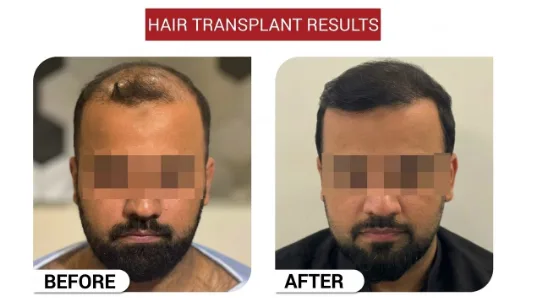
One of the most common patterns is the ‘M’ shaped line where the hair line drops at both sides and the middle line stays low and forward. This form of shape may grow naturally as you grow older, but can also be an early symptom of male or female pattern hair loss. If individuals believe that their hairline looks uneven or the front of the head seems broader due to a receding hairline, they can have a hair transplantation to replenish the hair lost in the receding regions and develop a more well-balanced line. If you want to know Can a Hair Transplant Fix an M-Shaped Hairline? Then read the blog.
What Is an M-Shaped Hairline?
When the hair on the left and right temples recedes more than the hair in the middle of the forehead, it creates an M shaped hairline. The leftover hairline will look like the letter “M” when seen from the front.
There are individuals that are genetically blessed with a mature M hairline and have minimal continuous hair loss. In other situations, the recession of the temples will slowly become more noticeable due to the so-called pattern hair loss or androgenetic alopecia.
Can a Hair Transplant Fix an M-Shaped Hairline?
Yes, a hair transplant in Islamabad is an option for fixing an M-shaped hairline in suitable candidates. In the process, healthy hair follicles are removed from a donor area typically on the back and sides of the scalp, and transplanted into the recessed temple areas.
The transplanted hair follicles may regenerate hair that grows naturally in the treated areas. The restored hair is also made from the patient’s own hair follicles so that the new hair can be styled to blend in with the existing hairline.
How Does Hair Transplantation Correct Temple Recession?
An M-shaped hairline is usually corrected by strategically placing grafts in the recessed portions of the temples and, when necessary, along the frontal hairline. The Hair Transplant Surgeon in Islamabad first assesses the current hairline and decides on the extent of hairline recession. Treatment may involve:
- Raising the recessed temple pillars
- Increasing density behind the new hairline
- Making both sides more symmetrical
- Mixing existing hair with the transplanted hair
- Saving donor hair in case of future hair loss
Best Hair Transplant for M-shaped Hairline:
There are several types of hair transplants that can be used to restore an M-shaped hair line. The two popular treatments that come to mind are FUE and FUT depending on the patient.
FUE Hair Transplant:
Follicular Unit Extraction (FUE) is a technique where the follicular units are individually extracted from the donor area and then transplanted into the recipient area. FUE offers exact control of graft placement which is beneficial for temple restoration. Each follicle can be placed in a natural direction and angle of hair growth.
FUT Hair Transplant:
In Follicular Unit Transplantation (FUT) a narrow strip of healthy hair follicles is removed from the donor area with its skin. The follicular units are then magnified and transplanted to the recipient area.
The right technique will vary based on various factors, including donor density, treatment area size, hair characteristics, prior hair transplant experience, and hair-loss history.
How Many Grafts Are Needed to Fix an M-Shaped Hairline?
The number of grafts needed for a hairline of “M” shape isn’t fixed. The requirement for grafts varies according to the depth and breadth of the recession in the temples, density desired, existing hairline, hair calibre, and supply of hair at the donor site, and the size of the area to be restored.
Good Candidate for M Shaped Hairline Transplantation:
Candidates must undergo a consultation to evaluate if they are candidates and they must have enough healthy donor hair and a clear hairline or areas of hairline recession. A hair transplant might be an option if:
- The temples have clearly shrunk
- Hairline has become M-shaped
- There are sufficient healthy follicles in the donor area.
- The pattern of hair loss can be evaluated and planned appropriately
- The scalp is good for hair transplant
- The patient’s expectations for density and outcome are realistic
How does an M-Shaped Hairline Hair Transplant work?
The process starts with a comprehensive consultation and evaluation of the hairline. The surgeon examines the donor and recipient site, and creates a unique plan. The donor and recipient areas are prepared on the day of treatment and local anaesthetic is usually administered to make the treatment comfortable.
The healthy follicular units are then excised from the donor area by the desired method. The grafts are meticulously prepared prior to being inserted into the temple and frontal regions. Surgeons are especially attentive to the direction, angle, density and distribution of hair. Single hair grafts can be especially helpful around the front line to help create a more natural transition.
Can an M-Shaped Hairline Return After a Hair Transplant?
Normally, the follicles that are transplanted are picked from a secure donor zone since they have greater resistance to pattern hair loss. The patient’s non-transplanted hair can, however, continue to thin. This is why long-term planning is crucial.
The surgeon should take into account appearances both post surgery and years after the surgery. Medical hair loss management may also be considered in selected patients to aid in maintaining existing hair.
Why Hairline Design Matters in M-Shaped Hair Restoration?
It is the hairline design that is one of the most crucial components to an M-shaped hair transplant. If the hairline is pushed too far forward, it will require many extra grafts and may not be suitable if there is continued natural hair loss. The carefully designed hair line takes into account facial proportions, age, donor availability, existing hair loss, and projected hair loss.
Final Thoughts!
The hairline can become recessed at the temples and front of the head, which can be corrected by a hair transplant. The procedure will succeed if the patients are selected properly, donor hair is sufficient, patients’ expectations are realistic, the hairline design is very careful and the placement of hair grafts is very precise. During a consultation at Best Hair Transplant Clinic in Islamabad, the surgeon can examine the hair and determine if a hair transplant will work for you and how many grafts will be needed to treat the person’s pattern of hair loss around the temples.