AI Search Is Picking Brand Winners, and Editorial Coverage Is Deciding Who
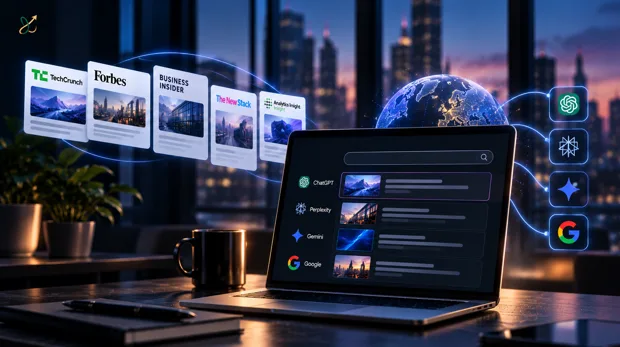
Open ChatGPT, Perplexity or Google’s AI Mode and ask for the best tool in your category. You won’t get ten blue links. You’ll get a short, confident answer naming two or three companies. So who decides which names make the cut? Increasingly, it isn’t the companies themselves. It’s the independent articles written about them, which is why editorial coverage has quietly become one of the biggest levers for AI search visibility.
In short: AI tools lean on independent, third-party sources when they recommend brands. A company’s own website helps, but outside articles that mention it in context seem to carry more weight. That’s good news for specialist SaaS and tech brands, because relevance often beats size.
Search isn’t a list of links anymore
Gartner predicted back in 2024 that traditional search engine volume would fall 25% by 2026 as AI chatbots and virtual agents take share. Whether or not that exact number lands, the shift is easy to spot in how people shop. Plenty of buyers now start with an AI assistant and only visit a vendor’s site after the shortlist is made.
Here’s the catch. A results page can show ten companies. An AI answer usually shows two or three. If you’re not named, you’re not part of the conversation.
Where do AI tools get their answers?
Tools with web access search for sources, build an answer and attach citations. OpenAI explains the idea on its ChatGPT search help page, which describes answers linking back to the web sources used.
The interesting part is what those sources turn out to be. A 2026 Muck Rack analysis, as reported by Backlinko, found that roughly 84% of AI search citations come from earned media, such as news coverage, reviews and forum discussion, rather than from brand-owned pages. Other studies land on different numbers, so treat the exact figure as a rough guide. The direction is the same everywhere: outside voices beat self-description.
Why independent articles beat your own website
Think about how you’d pick a plumber. A neighbour’s recommendation usually beats the plumber’s own ad. AI systems work in a similar way. Your website is a claim. An article from an independent publication is corroboration. When several credible outlets describe a company the same way, the AI has more reason to trust it.
You don’t have to be a giant to show up
Here’s the encouraging bit. A March 2026 report from Similarweb found that some specialist and support-led brands, including B&H, Adorama and iFixit in consumer electronics, showed more visibility in AI answers than their branded search demand would suggest. Similarweb read that as proof AI search is an opening for smaller players, not just the big names.
For technology companies, the takeaway is simple. Depth and relevance can make up for scale. A brand covered again and again in publications focused on its category can earn a spot in AI answers without being a household name.
What actually counts as editorial coverage?
Editorial coverage is content an independent publication chooses to publish, with your brand named in context. Think:
- Industry analysis that references your product or data
- Expert commentary quoted in news or trade articles
- Roundups and comparisons on relevant sites
- Features on a launch, a customer result or a market trend
What doesn’t count? A press release sitting alone on a wire, paid ads, and posts on your own blog. They have their place, but they don’t give search engines or AI tools an outside opinion to lean on.
Does it help Google rankings too?
Yes, and that’s the nice part. Google’s quality rater guidelines tell raters to check what independent sources say about a site’s reputation, and mentions from relevant publications are widely understood to help search engines work out which topics a brand belongs to. Coverage also tends to lift branded searches. Since AI Overviews and AI Mode draw on Google’s index, one set of third-party mentions supports classic SEO and AI search visibility at the same time.
How tech and SaaS brands are approaching it
Most start with a simple audit. Ask the questions your buyers ask in ChatGPT, Perplexity and Google AI Mode, then note which brands show up and which publications get cited. The outlets that keep appearing in your category are your targets.
Relevance is the filter that matters. An article that’s genuinely about your topic, with your company named as part of the explanation, beats a passing mention in a long list. Original data, a clear opinion on the category or a real customer outcome gives editors a reason to publish. And keep your company name and category wording consistent everywhere, so AI systems can connect the dots.
Providers such as Target2Links, which works on editorial placements for AI, SaaS and technology brands, are among those building services around this shift.
It’s not a one-and-done thing
PwC’s Strategy& has pointed out that different AI models favour different brands, and that model updates keep reshuffling recommendations. A brand named in one tool can be missing from another, and a spot you hold this quarter isn’t guaranteed next quarter. That’s why steady, recent coverage tends to count for more than one mention from long ago.
Mistakes that waste time
- Treating press releases as coverage. On their own, they rarely earn independent citations.
- Chasing volume. A few relevant placements usually beat dozens on unrelated sites.
- Ignoring crawlability. Pages that are blocked, buried or thin are unlikely to be picked up.
- Expecting instant results. Tools that browse the web can surface new articles quickly, but there’s no guaranteed timeline, and nobody controls what an AI system says.
FAQ
Does editorial coverage improve AI search visibility? Citation studies from 2026 suggest third-party coverage is a major factor in which brands get named. It’s correlation, not a guarantee, and results vary by platform and topic.
How is editorial coverage different from advertising? Advertising is paid for and controlled by the brand. Editorial coverage is chosen by a publication, which is why search engines and AI tools treat it as independent evidence.
How long does it take to see results? There’s no fixed timeline. Tools that browse the web can pick up new articles within days or weeks, while changes that depend on model training move more slowly.
The bottom line
AI search rewards brands that other people write about. Your own content still matters for accuracy and conversions, but it rarely builds credibility on its own. For technology, SaaS and AI companies, the practical move is a steady record of relevant, independent coverage, then checking how often AI tools actually name you.