How to Build a Resume When Your Experience Is Still Taking Shape
Building a resume is easier when you already have years of work history, several promotions, and a list of measurable accomplishments. It is more challenging when your experience is still developing. Students, recent graduates, and early-career professionals often assume a short work history means they have little to offer. In reality, the problem is usually not a lack of experience. It is failing to recognize which experiences are relevant and how to present them clearly.
A strong early-career resume should not imitate the resume of someone with 15 years of experience. Employers understand that students and recent graduates are still building their careers. What matters is whether the resume shows evidence of responsibility, practical skills, and the ability to contribute. That evidence can come from internships, coursework, campus organizations, volunteer work, part-time jobs, and independent projects.
Start by looking beyond formal employment.
One of the most common mistakes students make is assuming that only paid, professional jobs belong on a resume. That can leave the document looking much thinner than it should. Judge experience by what you actually did, not just the title attached to it.
A student who helped organize a campus event may have coordinated schedules, communicated with vendors, and handled last-minute problems. Someone who worked in retail may have trained new employees, resolved customer complaints, and managed transactions. A class project may have required research, data analysis, teamwork, and a formal presentation. These are all examples of work that can demonstrate useful skills
Before writing the resume, make a separate list of your experiences. Include jobs, internships, class projects, volunteer activities, student organizations, and anything else that required you to take responsibility. Then look at what each experience actually involved. This exercise often reveals useful material you would otherwise overlook.
The goal is not to exaggerate ordinary experience. It is to describe it accurately enough that an employer can understand its value. “Helped with events” is vague. “Coordinated registration and communicated with participating organizations for student events” gives the reader something concrete to evaluate.
Relevance is more important than filling the page.
A resume does not become stronger simply because it contains more information. For someone early in a career, relevance matters far more than volume. The strongest content helps an employer see a connection between your background and the role you are applying for.
Start by reading the job description carefully. Look for repeated skills, tools, and responsibilities. If an employer mentions research, Excel, and presentations, think about where you have already done those things. A semester project may be more relevant than an unrelated part-time job, even if the part-time job lasted longer.
This is also why you shouldn’t send the same resume to every employer without adjustment. The core document may stay the same, but the order and emphasis can change. A project might move higher on the page for one application, while a customer service role may deserve more attention for another.
The structure should support your strongest evidence. If education and projects are more relevant than employment, they may deserve more prominent placement. If you have strong technical skills, make them easy to find. The layout should make the reader’s job easier, not force them to search for useful information.
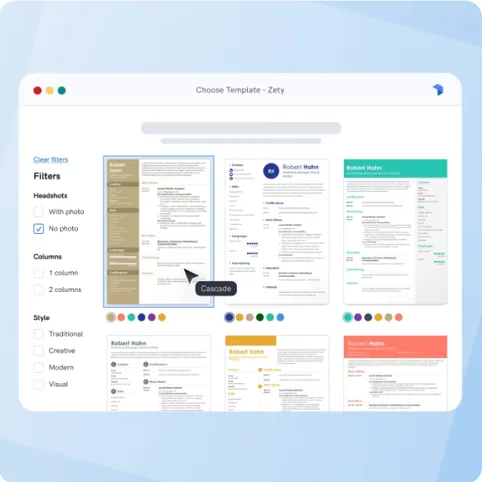
If organizing the document feels difficult, a resume builder by Zety can be a practical way to see how sections such as education, projects, skills and work history fit together. For students and early-career applicants, that kind of structure can be helpful when there is plenty of relevant experience but not always an obvious way to present it. The main benefit is having a clearer framework to work from while deciding which details deserve the most attention.
Write about what you did, not what you believe about yourself.
Early-career resumes often rely too heavily on personality words. Terms such as “motivated,” “organized,” “hardworking,” and “team player” sound positive, but they provide very little evidence on their own.
It is more effective to show those qualities through specific examples. Instead of calling yourself organized, describe how you coordinated schedules for a student organization. Instead of saying you have strong communication skills, mention that you presented research findings to a class, wrote articles for a campus publication, or handled customer questions in a part-time role.
Specific details also make experience easier to understand. Numbers can help when they are accurate, such as the number of people trained, events supported, articles published, or customers served. However, numbers should not be forced into every bullet. Clear descriptions of responsibility are often enough.
The same principle applies to projects. A project section can be especially valuable when formal work experience is limited. Journalism students can reference published articles, design students can include portfolio work, and computer science students can describe applications they built. A strong project shows you’ve applied a skill rather than simply listing it.
Do not dismiss experience because it seems ordinary.
Students often leave out jobs because they seem unrelated to the careers they want. A grocery store position, restaurant job, or campus office role may not match the industry directly, but it can still demonstrate reliability, communication, and judgment.
Part-time work can show that you managed responsibilities while attending school. Customer-facing positions can demonstrate patience and problem-solving. Training a new employee can show leadership even when your title never includes the word “manager.” The value depends on how you explain the experience.
At the same time, avoid inflating basic responsibilities. Employers can usually tell when simple tasks have been dressed up with exaggerated language. Clear descriptions are more convincing than complicated wording.
Keep the resume easy to update
An early-career resume should change frequently. New internships, stronger projects, and better skills should gradually replace older material. That process becomes much easier when you keep track of accomplishments as they happen instead of trying to remember everything months later.
Keep track of any notes related to projects you have worked on, techniques you have learned, roles you have undertaken, and achievements you can prove. You will be glad that you have all this when you start applying again for jobs.
A resume written when you are in the process of developing your experience should not pretend that it is already fully developed. It should represent the experience you already have in a clear and relevant way. Employers do not require many years of experience from those who are just entering their careers. What they look for is the experience you have gained so far.