What Is a Forward Deployed Engineer (FDE)? Role, Skills, Salary and the AI Boom
Forward Deployed Engineer postings have grown several hundred percent in a year, and the surge is tied directly to enterprise AI. This guide covers what the role is, why it is booming, how it relates to AI, and how to build a path into it.
| 729% | 5,330 | $173,816 | 1,165% |
| Indeed posting growth, Apr 2025 to Apr 2026 | FDE postings on Indeed, Apr 2026 | Median base salary (Bloomberry) | Year-over-year growth (Bloomberry) |
What Is a Forward Deployed Engineer?
A Forward Deployed Engineer is a software engineer who works directly with customers, embedded in their environment, to turn a product into a working solution for their real problems.
A traditional software engineer builds a product for many users. An FDE takes that product, goes where the customer is, and makes it work for this customer’s data, workflows, constraints, and goals. The word “forward” comes from military usage: personnel stationed close to the front line rather than back at headquarters.
An FDE sits at the intersection of three things:
- Engineering: writing production-quality code, building integrations, and debugging in messy environments.
- Consulting: understanding business problems, asking the right questions, and managing expectations.
- Product thinking: spotting patterns across customers and feeding them back to the core product team.
A Brief History of the FDE Role
The role is most closely associated with Palantir, which built its early business on sending engineers to work on-site with government and enterprise customers. Those engineers were not just supporting a finished product. They shaped how it was used in the field, and the lessons flowed back into the platform.
For years, the approach was seen as unusual. Most software companies preferred to scale through self-serve products and separate support teams. Then generative AI changed the picture.
Is the FDE Role Really Booming? The Numbers
Several trackers point in the same direction, though they measure different sources and time windows, so compare direction rather than adding the figures together.
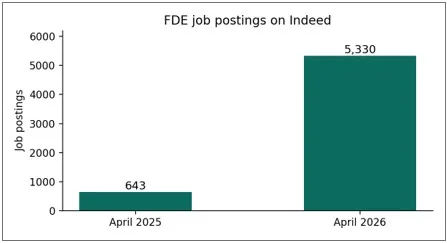
- Indeed data (reported by Business Insider): FDE postings rose from 643 in April 2025 to 5,330 in April 2026, a 729% year-over-year increase.
- Longer window: between January and September 2025, postings grew more than 800%.
- Bloomberry / Live Data Technologies: year-over-year growth reached 1,165%.
- Paraform’s platform: postings grew 350% from Q1 2025 to Q1 2026, after roughly 300% growth in 2024.
- Against the trend: this surge happened despite widespread layoffs across the technology sector.
Figure 1. FDE job postings on Indeed. Source: Indeed data via Business Insider.
Figure 2. Reported growth in FDE postings by source and period. Windows differ, so values are not directly comparable.
What it pays: Bloomberry puts the median base salary at $173,816, and Paraform’s hiring data puts the midpoint near $183,000. Founding FDE base pay can reach about $266,000, and staff or principal base pay up to about $288,000.
Who is hiring: OpenAI, Anthropic, Palantir, and Stripe are expanding enterprise AI operations, and Google Cloud has said it is ramping up hiring in this area. Consulting firms such as McKinsey and BCG use FDEs to bring new AI products to clients. One analysis counted 224 open FDE roles across 39 AI companies as of May 30, 2026.
How FDEs Are Tied to AI
The FDE boom is an AI story. Three connections explain it.
1. AI deployments fail without hands-on engineers
AI products behave differently from traditional software. A CRM works roughly the same way for every company, but an LLM assistant, agent, or retrieval pipeline depends heavily on a customer’s data, domain, edge cases, and tolerance for risk. The gap between an impressive demo and a reliable production system is large, and someone has to close it.
2. The skills are AI skills
Production AI engineering is now expected in FDE job descriptions: retrieval-augmented generation (RAG), evaluation frameworks, agent orchestration with tools such as LangGraph or CrewAI, vector databases, and observability platforms. Python is essential, TypeScript or JavaScript is strongly preferred, and SQL matters for data-heavy deployments.
3. AI companies are the biggest employers
Frontier labs and applied-AI startups hire FDEs to turn model capability into customer results, and the demand is spreading to enterprise software, data platforms, and consulting.
In one line: the more capable AI models become, the more companies need someone to make them work inside a specific business. That someone is the FDE.
Other forces add to the demand: messy enterprise data, the need for trust and change management, and faster product learning, because FDEs surface what customers actually need.
What Does an FDE Actually Do?
- Discovery: meeting stakeholders, mapping workflows, and identifying where AI can create measurable value.
- Scoping: turning a vague wish into a concrete, testable project.
- Prototyping: building a working proof of concept in days rather than months.
- Integration: connecting to the customer’s databases, APIs, identity systems, and internal tools.
- Evaluation: measuring quality with test sets, metrics, and human review.
- Deployment and iteration: shipping, monitoring behavior, and fixing what breaks.
- Feedback to product: documenting recurring gaps and proposing reusable components.
A good FDE spends as much time listening and clarifying as coding.
FDE vs. Similar Roles
| Role | Primary focus | Typical output |
| Software Engineer | Core product features for all customers | Shipped product code |
| Forward Deployed Engineer | Making the product work for specific customers | Custom solutions, integrations, deployments |
| Solutions / Sales Engineer | Pre-sales demos and technical validation | Demos, proofs of concept |
| Customer Success Manager | Adoption, retention, relationships | Healthy accounts |
| Solutions Architect | System architecture | Diagrams, designs, recommendations |
| Applied AI / ML Engineer | Building and tuning models | Models, pipelines, evaluations |
The clearest difference: an FDE writes real code in the customer’s environment and owns the outcome, while many adjacent roles advise, demo, or support.
Core Skills Every FDE Needs
Technical skills
- Programming fundamentals: Python is the common denominator, often alongside TypeScript or SQL.
- APIs and integrations: REST, authentication, webhooks, and third-party systems.
- Data skills: querying, cleaning, and transforming messy data.
- Cloud and deployment basics: containers, cloud services, logging, and monitoring.
- LLM and AI application skills: prompt design, RAG, agents and tool use, and evaluation.
If you are newer to the AI side, a structured starting point helps. Simplilearn SkillUp’s free AI courses are a good place to build working knowledge of LLMs, prompting, and AI applications before you apply them in customer settings.
Non-technical skills
- Communication: explaining tradeoffs to executives and engineers alike.
- Problem framing: finding the real problem behind the stated request.
- Ownership: treating the customer’s outcome as your own.
- Comfort with ambiguity: requirements are often incomplete and priorities shift.
- Resilience and empathy: customer environments are messy and stakeholders have their own pressures.
A Day in the Life: An Example Engagement
Imagine a mid-sized logistics company that wants to cut the time its operations team spends reading shipment exception emails.
- Week 1: the FDE shadows the team, learns how exceptions are classified, and collects sample emails.
- Week 2: they build a prototype that extracts key fields, classifies the exception, and drafts a response with an LLM.
- Week 3: they build an evaluation set from historical cases, find the model struggles with one carrier’s formatting, and adjust the pipeline.
- Week 4: they integrate with the ticketing tool, add human-in-the-loop approval, and set up monitoring.
- Ongoing: they review failures, expand coverage, and report patterns back to the product team.
It is engineering anchored in a business outcome, and every step involves customer judgment.
Pros and Cons of Being an FDE
Upsides
- Rapid learning across industries and problem types
- High visibility and direct, demonstrable impact
- Broad skills spanning code, communication, and strategy
- A strong springboard to product, founding, or leadership roles
Challenges
- Travel or on-site time at some companies
- Context-switching between customers
- Pressure when you are the face of delivery
- Work can feel less like pure engineering than a core product role
How to Become a Forward Deployed Engineer
- Build a solid engineering base. Get comfortable with Python, SQL, APIs, and version control.
- Learn modern AI fundamentals. Understand how LLMs work, where they fail, and how to build with them.
- Build real projects. Create end-to-end applications such as a document Q&A tool, a support triage agent, or a data-extraction pipeline, and document your tradeoffs.
- Practice customer-facing skills. Present your projects, write clear READMEs, and explain your work to non-technical audiences.
- Learn to evaluate. Show that you can measure quality, not just build demos.
- Target the right roles. Look at AI startups, data platforms, and enterprise AI teams, and search titles such as Solutions Engineer, Applied AI Engineer, and Deployment Engineer.
- Keep learning with structure. Fill gaps in programming, data, and cloud skills through the full catalog of free online courses
Common Interview Themes
- Coding and debugging: practical tasks rather than purely algorithmic puzzles.
- System design: integrating components, handling data flow, and thinking about reliability.
- Case rounds: “A customer wants X, but their data looks like Y. What do you do?”
- Communication exercises: explaining a technical concept to a non-technical stakeholder.
- Behavioral questions: handling conflict, ambiguity, and difficult stakeholders.
Where the FDE Role Is Headed
As AI systems become more capable and agentic, FDE work is likely to shift upward: less hand-written glue code, more designing workflows, setting guardrails, defining evaluations, and making sure systems are trustworthy in high-stakes settings. Knowing what to build, for whom, and how to verify it works becomes more valuable, not less.
Key Takeaways
- FDEs embed with customers to turn a product into a working, outcome-driven solution.
- Postings have grown several hundred percent in a year because AI deployment needs hands-on, customer-specific engineering.
- Success needs technical skill (Python, data, APIs, LLM applications) and soft skills (communication, ownership, problem framing).
- You can break in by building real projects, learning AI fundamentals, and practicing customer-facing communication.
FAQ
Is an FDE the same as a solutions engineer?
Not quite. Solutions engineers usually focus on pre-sales demos and validation, while FDEs build and deploy production solutions inside customer environments.
Do I need a computer science degree?
Many employers value demonstrable skills and projects, though a strong technical background helps.
Is the role only for AI companies?
No. It originated in data and defense software and exists across enterprise tech, but AI has accelerated demand.
Does an FDE have to travel?
It depends on the company and customer. Some roles involve frequent on-site work, while others are mostly remote.
What programming language should I learn first?
Python is the most practical starting point, with SQL a close second.
Sources: Indeed data via Business Insider, Bloomberry, Live Data Technologies, Paraform, and JobsByCulture analyses, 2025 to 2026. Figures use different windows and are not directly comparable.