Why Demand for Privacy-Focused Hosting Is Rising? Expert Guide
Not long ago, picking a web host meant comparing storage, bandwidth, and price, and not much else.
Then the headlines started arriving: leaked databases, surprise takedowns, and websites suspended before their owners even saw the complaint.
Suddenly, “where is my website actually hosted?” became a serious business question.
That shift explains why privacy-focused hosting has moved from a niche choice to a mainstream conversation.
This guide walks through what it is, why demand keeps growing, who relies on it, and what to look for before choosing a provider.
What Is Privacy-Focused Hosting?
Privacy-focused hosting is a type of web hosting built around minimal data collection, strong security, and favorable legal jurisdiction. It treats the confidentiality of a website and its owner as a core feature, not an add-on.
These providers typically operate data centers in countries with strong privacy protections and collect only the customer information they genuinely need.
Many also offer isolated environments, so one customer’s activity does not affect another’s.
How It Differs from Standard Hosting
Standard hosting is usually optimized for price and convenience. Privacy-focused hosting adds attention to where servers sit, which laws apply to them, and how a provider responds to legal requests.
What It Is Not
Privacy-focused hosting is not a license to host unlawful content. Reputable providers still enforce acceptable-use policies and cooperate with valid legal processes. The difference lies in how carefully claims are handled, not in ignoring the law.
Why Demand for Privacy-Focused Hosting Is Rising?
Several trends are pushing website owners to look beyond default hosting options. Together, they have turned privacy from a “nice to have” into a practical requirement for many online projects.
Growing Awareness of Data Privacy
Users and business owners are far more informed than they were a few years ago. People now ask who can access their data, where it is stored, and how long it is kept, and they expect clear answers from the companies they work with.
Constant Data Breaches and Security Concerns
Breaches of large platforms have made it obvious that no organization is automatically safe. Website owners increasingly want hosting that limits exposure through hardened infrastructure, careful access controls, and reliable backups.
Tighter and More Complex Regulation
Privacy laws such as the GDPR have changed how businesses think about data handling, and similar rules continue to appear around the world. Hosting in a jurisdiction with mature privacy law helps businesses show that they take compliance seriously.
Misuse of Takedown Notices
Copyright takedown systems exist for good reasons, but they can also be misused. Website owners sometimes face vague, mistaken, or bad-faith complaints that lead to sudden suspensions. A host with a fair, transparent process for reviewing claims gives site owners a chance to respond before they lose traffic and revenue.
A More Global and Remote Business World
Businesses now serve customers across many countries from a single website. Choosing a hosting location based on legal environment and network quality, not just proximity, has become a normal part of planning.
Who Is Choosing Privacy-Focused Hosting?
The audience is much broader than most people assume. It includes anyone whose website depends on stability, discretion, or fair handling of complaints.
Typical users include:
- Independent publishers and bloggers who cover sensitive or controversial subjects and want protection against unfounded complaints.
- Businesses and startups handling customer data that must stay protected.
- Developers and agencies hosting client projects that require dependable, isolated environments.
- Privacy-conscious individuals who simply prefer to share less personal information with their provider.
Practical Example
Imagine a small research publication that reviews products critically. One disgruntled company files a dubious complaint, and the host suspends the site immediately. With a privacy-focused provider that reviews claims properly, the publisher gets a fair process instead of an instant shutdown.
Why a VPS Suits Privacy-Focused Projects
Hosting type matters as much as hosting location. A Virtual Private Server (VPS) gives each customer a dedicated slice of server resources, which is a strong fit for privacy-minded projects.
On shared hosting, many websites sit on the same environment, so a neighbor’s problem can become your problem. A VPS reduces that risk because your resources and configuration are separated from other customers.
Greater Control and Isolation
With a VPS, you decide how the server is configured, which software runs on it, and how security is handled. That control makes it easier to apply your own security practices and meet specific compliance needs.
Room to Grow
A VPS also scales more smoothly than basic shared plans. As traffic grows, you can add resources without migrating to an entirely new setup.
What to Look For in a Privacy-Focused Hosting Provider?
Not every provider that claims to value privacy delivers on it. Checking a few fundamentals helps separate real protection from marketing.
Jurisdiction and Legal Environment
Ask where the data center is located and which laws govern it. Countries with strong privacy traditions and mature digital infrastructure are generally the safer choice.
Data Center Quality
Infrastructure standards directly affect reliability. A Tier III data center, for example, is designed with redundancy so that maintenance can happen without taking systems offline.
Transparent Policies
Read the terms of service, privacy policy, and acceptable-use policy. A trustworthy provider explains how it handles complaints, what data it stores, and what it expects from customers.
Security Features
Look for protections such as DDoS mitigation, firewalls, regular backups, and secure access options. These features matter just as much as location.
Reliable Support and Control Panel Options
When something goes wrong, responsive support makes all the difference. A familiar control panel also saves time, especially for teams managing several sites.
Choose QloudHost’s Offshore VPS Hosting for Privacy-Focused Projects
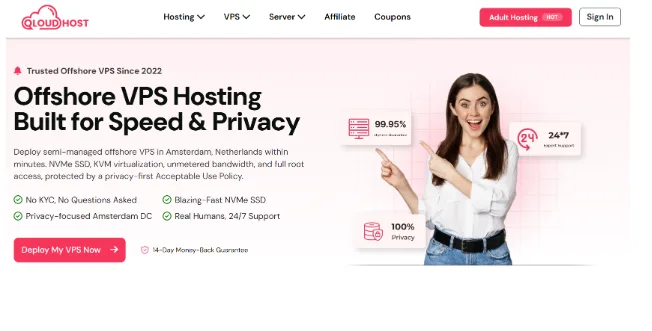
If you want privacy-focused infrastructure without piecing it together yourself, QloudHost offers a practical option. The company specializes in offshore and DMCA-secure web hosting, and operates its own Tier III data center in Amsterdam, Netherlands.
QloudHost’s Offshore VPS Hosting is built for website owners who want dedicated resources, strong infrastructure, and a provider that treats privacy as a core service. Here is an overview of what it brings:
- Amsterdam Tier III data center: Redundant infrastructure in the Netherlands, a region known for excellent connectivity and a mature legal and digital environment.
- Offshore VPS hosting: Isolated server resources with the control and flexibility that privacy-minded projects need.
- DMCA-secure hosting approach: Designed for site owners who want complaints handled carefully instead of facing automatic suspensions.
- Familiar control panel options: DirectAdmin comes as the default on hosting plans, with cPanel available on request for customers who prefer it.
QloudHost is a good fit for publishers, agencies, startups, and developers who want hosting that supports growth without compromising discretion. As with any provider, it is smart to review the acceptable-use policy and plan details before you commit, so the service matches your needs. To explore the options, visit QloudHost.
Frequently Asked Questions
Is privacy-focused hosting legal?
Yes. It is a legitimate service used by businesses, publishers, and individuals worldwide. Providers still require customers to follow applicable laws and their own acceptable-use policies.
What does “offshore hosting” actually mean?
Offshore hosting means your website is hosted in a country different from where you or your audience live. People usually choose it for the legal environment, privacy protections, or network quality of the hosting location.
Is a VPS better than shared hosting for privacy?
In most cases, yes. A VPS isolates your resources and configuration from other customers, which reduces shared-environment risks and gives you more control over security.
Does privacy-focused hosting slow down my website?
Not necessarily. Speed depends on the quality of the data center, network, and server resources. Well-connected locations such as Amsterdam offer strong performance to audiences in Europe and beyond.
How do I choose the right privacy-focused host?
Check the provider’s jurisdiction, data center standards, transparency of policies, security features, and support quality. Then match the plan to your site’s traffic and growth needs.
Conclusion
Demand for privacy-focused hosting is rising for good reasons: higher awareness of data protection, constant security concerns, evolving regulation, and the very real risk of unfair takedowns.
For many website owners, hosting is no longer just a technical decision. It is a risk-management decision.
The right provider combines favorable jurisdiction, solid infrastructure, clear policies, and dependable support.
If you are planning a project where reliability and discretion matter, taking time to evaluate your hosting options now will save you far bigger problems later.