FUE Explained: How to Read Hair Transplant Before-and-After Photos Honestly
Before-and-after photographs are often the first thing people look at when researching hair restoration. They can be informative, but they can also mislead, sometimes unintentionally. Understanding how follicular unit excision works, and how hair regrowth unfolds over time, makes it much easier to judge what a set of images actually shows.
How FUE Works
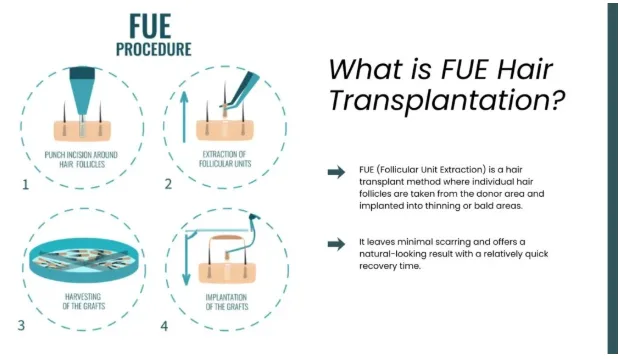
Follicular unit excision, usually shortened to FUE, is a method of moving hair from one part of the scalp to another. Hair grows naturally in small groups called follicular units, each containing one to four hairs. In FUE, these units are removed individually from the donor area, typically the back and sides of the head, using a small circular punch.
The extracted grafts are then placed into tiny incisions in the thinning or bald area. Donor follicles are chosen because they tend to be less affected by the hormone dihydrotestosterone (DHT), which drives common male pattern hair loss. Once relocated, they usually keep that characteristic and continue to grow.
FUE leaves small, scattered marks in the donor area rather than a single linear scar, which is one reason many patients prefer it. The procedure is carried out under local anaesthesia and normally takes most of a day, depending on the number of grafts. Patients researching FUE hair transplant in Turkey will find that the technique is widely offered there, but planning and medical oversight matter more than the location.
Why the Timeline Matters When Reading Results
A photograph is only meaningful if you know when it was taken. Hair growth after surgery follows a gradual sequence, and images taken at different points tell very different stories.
- First days: redness, small scabs and some swelling are common. Hair looks dense because the grafts are freshly placed.
- Weeks 2 to 8: many transplanted hairs shed. The follicles remain under the skin, but the area can look thinner than before.
- Months 3 to 4: fine new hairs typically start to emerge.
- Months 6 to 9: hairs thicken and density becomes more noticeable.
- Around 12 months: the result is usually assessed, although the crown may take longer.
An “after” picture taken on the day of surgery says little about the final outcome. Reliable galleries label the time since the procedure clearly.
Lighting, Angles and Styling
Small changes in photography can transform how hair appears. Overhead lighting reveals the scalp; soft, diffused light hides it. A wet scalp looks thinner than dry, styled hair. A camera held slightly below eye level shows less of the crown than one held above the head.
What to look for in a fair comparison
- the same angle and distance in both images
- similar lighting and background
- hair at a comparable length, without heavy styling products or fibres
- views of the front, top, crown and donor area, not only the hairline
Collections such as before and after results are most useful when read with these points in mind, and when each case states the approximate time since surgery.
Understanding Density and Coverage
Density refers to how many hairs grow in a given area, while coverage describes how full that area looks. The two are related but not identical. Thick, wavy or curly hair, and hair whose colour is close to the skin tone, can create the impression of fullness with fewer grafts. Fine, straight hair that contrasts with the scalp usually needs more.
Because donor hair is limited, surgeons generally distribute grafts to create the appearance of density where it matters most, often at the front. A result that looks full from the front may still be lighter at the crown, and that is frequently a deliberate planning choice rather than a flaw.
Keeping Expectations Realistic
No two scalps are the same, so another person’s photographs cannot predict your own outcome. Age, the pattern of loss, donor quality and the likelihood of future thinning all shape what is achievable. Many doctors also recommend medical treatment to protect existing hair, since a transplant does not stop ongoing loss. Information resources such as Turkey Hair Center, a Ministry of Health authorised health-tourism intermediary that connects patients with licensed hospitals and doctors in Turkey, can help with background reading, but personal suitability should always be assessed by a qualified doctor.
Conclusion
FUE is an established technique, and photographs can be a useful guide when they are read carefully. Check the timeline, compare like with like, and look beyond the hairline. Above all, treat any gallery as an illustration of possibilities rather than a promise, and discuss realistic goals with a qualified doctor.