Why Pairing Cavitation With Skin Firming Changes Body Contouring Results
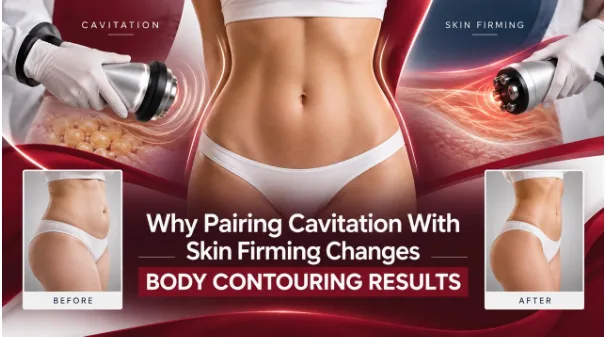
If you want a smoother, more sculpted silhouette, reducing fat and tightening skin are two different jobs, and treating them as one is where most home routines go wrong. Ultrasonic cavitation works on the fat layer, while firming treatments work on the skin that sits above it. When fat shrinks but the skin does not adapt, the result can look softer or looser than expected, which is exactly why so many regional slimming devices now combine cavitation with a firming function in the same handset instead of tackling fat alone.
Understanding what each function actually does, and where each one stops, is the fastest way to set realistic expectations and choose a device that matches your goal rather than the marketing on the box.
What ultrasonic cavitation actually targets
Ultrasonic cavitation, sometimes called ultrasonic lipolysis, is a non-invasive body contouring method. It uses low-frequency ultrasound waves to disrupt the walls of fat cells in a targeted area, releasing their contents so the body can clear them through the lymphatic system over the following days. Because there are no incisions, it is positioned as a gentler alternative to surgical fat removal, with the trade-off that the change is more gradual and usually more subtle.
The important limit is that cavitation is a contouring tool, not a weight-loss method. It is aimed at small, stubborn pockets of fat rather than large areas, and it works best for people who are already close to their target weight and want to refine specific zones such as the abdomen, hips, thighs, or upper arms. In one small clinical study, participants saw a reduction in treated fat after a series of sessions, with the treated area shrinking by roughly one to three centimeters, and without any overall weight loss. That distinction matters: cavitation reshapes an area, it does not lower the number on the scale.
Why reducing fat alone can leave skin looking loose
Skin has its own firmness, supported mainly by collagen in the deeper dermal layer. When fat volume under the skin drops, the skin above it does not automatically shrink to match, especially if collagen support has already weakened with age or after weight changes. This is the gap that catches people off guard. Some individuals notice loose skin, dimpling, or slight waviness in an area after fat reduction, and cavitation on its own does nothing to rebuild that structural support.
In practice, this means fat reduction and skin quality are separate outcomes. A treatment can succeed at reducing a bulge and still leave the surface looking less taut than hoped, because the two problems live in different layers of tissue.
How skin firming works
Firming treatments approach the problem from the skin side rather than the fat side. Radiofrequency, the most common firming technology in home and clinic devices, delivers controlled heat into the dermis. That heat is intended to stimulate collagen production over time, and collagen is the protein that gives skin its framework and firmness. The effect is gradual and cumulative rather than instant, which is why firming is described as a course of sessions rather than a single fix.
Evidence here is promising but still limited in scale. In one study, most participants who completed a course of several radiofrequency sessions reported an improvement in their body shape and were satisfied with the outcome. Results vary between individuals, and firming addresses skin laxity rather than removing fat, so it is not a substitute for cavitation when the underlying issue is volume.
Why combining the two makes sense
The logic of pairing cavitation with firming is straightforward once you see the layers involved. Cavitation reduces the fat that creates the bulge, and firming works on the skin so it can keep up with the smaller contour underneath. Used together, they aim at the two components of body shape that determine how a treated area actually looks: how much fat sits there and how well the skin holds its form.
This is also why a single device that offers both functions can be more practical than a fat-only tool. It lets you treat the fat layer and support the skin in the same routine, on the same area, instead of solving one problem and creating another. The table below summarizes where each function fits.
| Function | What it targets | What to expect |
| Ultrasonic cavitation | Fat cells in the deeper layer | Gradual reduction of small, localized fat pockets |
| Skin firming (radiofrequency) | Collagen in the dermis | Gradual tightening and improved skin firmness over a course of sessions |
| The two together | Fat volume and skin quality | Contour reduction supported by skin that adapts to the new shape |
Setting realistic expectations
Both functions reward patience and consistency. A typical session covers a target area for a set period, results build across several sessions, and staying hydrated helps the body clear the released fat. Neither cavitation nor firming replaces overall weight management, and both suit people who are near their goal weight and want to refine specific zones rather than lose significant mass.
These are body treatments, so a few safety points are worth keeping in mind:
- Common short-term effects include mild redness, warmth, or occasional bruising, which usually settle quickly.
- Cavitation and radiofrequency are generally avoided during pregnancy and are not appropriate over certain medical implants or specific health conditions.
- If you have a medical condition, or if an area does not respond as expected, checking with a qualified professional before continuing is the sensible step.
Approached this way, the combination of fat reduction and firming is less about chasing a single dramatic result and more about treating the two layers that shape an area, so the final contour looks smooth rather than merely smaller.