What Is Nano Tech Mitragynine? A Plain-English Guide to the Label
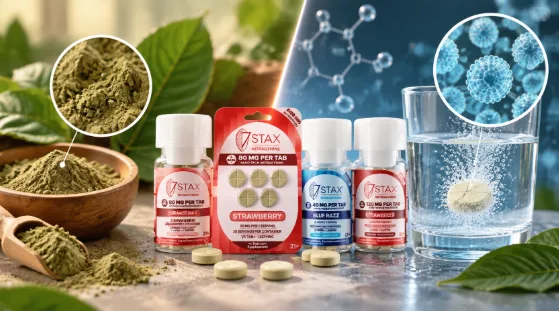
Product names in the kratom alkaloid market have become more technical, and “Nano Tech” is one of the terms that raises the most questions. The nano tech mitragynine tablets sold by 7Stax are a good example to work through, because their listings explain what the term means, what the tablets contain and where the lab reports sit. This guide covers what mitragynine is, what “nano” refers to in this context, what the other ingredients do, how the range is organized by strength, and which claims deserve a careful read.
Start With the Alkaloid: What Mitragynine Is
Mitragynine is the most abundant alkaloid in the leaves of Mitragyna speciosa, the Southeast Asian tree commonly known as kratom. On packaging it is often shortened to “MIT.”
It is a different compound from 7-hydroxymitragynine (7-OH), which occurs in the leaf only in small amounts. The two are related, and laboratory research indicates that some mitragynine can be converted to 7-OH in the body, but they are labeled, studied and regulated separately. That separation is the most important thing to understand before reading any Nano Tech label: these tablets are mitragynine products, not 7-OH products.
What “Nano Tech” Means on These Listings
The phrase sounds like a new ingredient, but the 7Stax listings say otherwise. Each Nano Tech product page carries a disclaimer stating that “Nano Tech” refers only to a particle size reduction process designed to improve dispersion and consistency. The same disclaimer states that the term does not indicate a proprietary blend, added compounds or a separate active ingredient.
In practical terms, that means:
- The active ingredient named on the label is mitragynine.
- “Nano” describes how the material was processed, specifically making the particles smaller.
- The term is not a separate compound and does not change mitragynine into anything else.
Reading that disclaimer is worth the extra few seconds, because it answers the question many shoppers have when they first see the name.
What Else Is in the Tablet
The same disclaimer lists the other ingredients, which are standard tablet excipients:
- Microcrystalline cellulose, a plant-derived filler and binder used widely in tablets.
- Dicalcium phosphate, a mineral filler that adds bulk.
- Silicon dioxide, a flow agent that helps powders move evenly through tablet machinery.
- Magnesium stearate, a lubricant that stops the mixture sticking to equipment.
- Food-grade colorants, which give each flavor its appearance.
None of these are active ingredients. They are the same kinds of materials found in many ordinary chewable and pressed tablets, and their job is to hold the tablet together and make it consistent.
The Range, Organized by Per-Tablet Strength
Like most tablet ranges, the Nano Tech listings lead with the pack total in the product title. Dividing by the count gives the per-tablet figure. Laid out that way, the range looks like this:
- 40mg per tablet: a 15-count pack (600mg total)
- 80mg per tablet: 1-count, 5-count (400mg) and 15-count (1,200mg) packs
- 120mg per tablet: 1-count, 5-count (600mg) and 15-count (1,800mg) packs
One point is easy to miss: the same total can describe different tablets. A 600mg 15-count holds 40mg tablets, while a 600mg 5-count holds 120mg tablets. Reading the title alone, the two packs look interchangeable.
Stock varies by strength and flavor, so not every combination is available at any given time.
About the Word “Raw”
Searches for terms like raw mit tabs are common, but “raw” is used loosely online. It can mean unflavored, unprocessed, minimally processed or simply “mitragynine only.” None of those meanings is a label standard.
The Nano Tech tablets are formulated chewable tablets. They contain mitragynine along with the excipients listed above and flavoring, and the mitragynine has been through the particle size reduction process the listings describe. Whatever a search term suggests, the label and the lab report are the reliable descriptions of what a tablet contains.
What the Listings Say About Absorption
The product descriptions also include statements about absorption. These have not been evaluated by the FDA, and the listings do not cite published studies for them.
Particle size reduction is a real manufacturing technique used across many industries, including food and pharmaceuticals, but what any specific process does for any specific product can only be shown by testing that product. For readers comparing labels, the most dependable information is the measurable kind: the alkaloid name, the amount per tablet and the batch-level lab results.
Nano Tech vs 7-OH Tablets at the Same Number
7Stax sells two tablet lines that share milligram figures. Shoppers searching for stax kratom 80 mg can come across both the 80mg 7-OH tablets and the 80mg Nano Tech mitragynine tablets. The figures match, but the compounds do not:
- The 80mg 7-OH tablets list 80mg of 7-hydroxymitragynine per tablet.
- The 80mg Nano Tech tablets list 80mg of mitragynine per tablet.
Because the active ingredients differ, the two products are not comparable on milligrams alone. They are also treated differently in the pending federal proposal, as covered below.
Lab Reports for the Nano Tech Range
The listings link to certificates of analysis (COAs) hosted externally. The reports are grouped by strength, with separate folders for the 40mg, 80mg and 120mg MIT tablets, kept apart from the folders for the 7-OH tablet strengths.
When reading a Nano Tech COA, check that:
- The product and strength match the pack in hand.
- The batch or lot number matches the number printed on the packaging.
- The mitragynine result is close to the labeled amount per tablet.
- The 7-OH result is reported, so you can see whether any is present.
- Contaminant testing covers heavy metals and microbial results.
- The testing lab is named, with a report date that fits the batch.
Where Mitragynine Stands Legally
Mitragynine and kratom leaf are not themselves scheduled by the 2026 federal actions. Those actions cover three lab-derived compounds placed in temporary Schedule I on August 26, 2026 (mitragynine pseudoindoxyl, MGM-15 and MGM-16), and 7-OH above a proposed threshold, for which no temporary scheduling order had been published as of early October 2026. The proposed 7-OH order would reach a mitragynine product only if its 7-OH content exceeded that threshold.
That federal position does not settle the question everywhere. Several states and some cities and counties restrict kratom products, and 7Stax lists states and localities it does not ship to. Anyone researching these products should check the rules where they live.
Quick Label Checklist for Nano Tech Tablets
- Confirm the active ingredient is mitragynine.
- Divide the pack total by the count to get the per-tablet amount.
- Read the “Nano Tech” disclaimer and the excipient list.
- Note that processing statements have not been evaluated by the FDA.
- Match the batch number to the COA.
- Check state and local rules.
Frequently Asked Questions
Is Nano Tech a type of kratom?
No. It is the brand’s name for a particle size reduction process applied to mitragynine. The listings state it is not a separate active ingredient.
Do Nano Tech tablets contain 7-OH?
They are labeled for mitragynine, not 7-OH. The lab report is the place to check whether any 7-OH was detected in a batch.
Is a Nano Tech tablet a proprietary blend?
The disclaimer states that the term “Nano Tech” does not indicate a proprietary blend. It names mitragynine as the active ingredient and lists the excipients.
Have the absorption statements been evaluated?
No. They are manufacturer statements that have not been evaluated by the FDA.