Why Free AI Tools Matter and How Better Discovery Makes Them More Useful
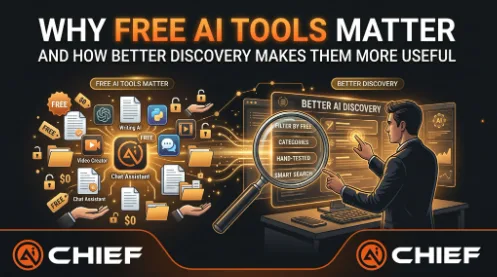
TL;DR: Free AI tools give students, creators, freelancers, businesses, and everyday users an affordable way to experiment with artificial intelligence. But free access can come with limits involving usage, models, privacy, watermarks, or commercial rights. As the number of AI tools grows, platforms such as AIChief can help users discover, compare, and evaluate the right tools without wasting time or money.
Free AI Tools Are More Than a Budget Option
Artificial intelligence is becoming part of everyday digital work, but not everyone wants to commit to another paid subscription simply to find out whether a tool is useful. This is where free AI tools have an important role.
A student might want help researching a topic or organizing notes. A freelancer could be looking for an image generator, writing assistant, or transcription service. A small business may want to experiment with AI-powered marketing, customer support, or productivity tools before spending money on a dedicated platform.
Free access gives these users an opportunity to experiment first.
That matters because AI is not a single type of technology. There are tools for writing, coding, image generation, video, audio, research, presentations, automation, education, design, and many other tasks. A person may understand that they want to use AI but still have no idea which type of tool is appropriate for the job.
Free tools lower the financial barrier, while good discovery helps lower the research barrier.
The Word “Free” Needs More Attention
Although free AI tools can be extremely useful, users should not assume that every free service offers the same experience.
Some platforms provide a limited number of prompts or generations. Others restrict access to their more advanced models. Image and video tools may provide limited credits, lower resolutions, or watermarked results. Some services allow free personal use but place restrictions on commercial projects.
These differences can make a major difference to the actual usefulness of a tool.
Privacy is another consideration. Users should understand what happens when they upload documents, images, audio, source code, or other information to a free AI service. The absence of a subscription fee does not automatically mean that the service is suitable for sensitive or confidential information.
For this reason, evaluating a free AI tool should involve more than asking, “Does it cost anything?”
A better question is: What can I actually do with it for free, and under what conditions?
The AI Market Has a Discovery Problem
The growing number of AI tools is creating an interesting challenge. Finding an AI product is relatively easy; finding the right one can be much harder.
Consider someone searching for a free AI video generator. A typical search may return dozens of platforms, each making different claims about features, quality, credits, models, and pricing. The user then has to visit multiple websites, understand different plans, test several tools, and determine which one actually fits the intended workflow.
The same problem exists for AI writing, coding, image generation, research, presentations, voice generation, and automation.
This is where an AI tools directory can become useful. Instead of treating every AI product as an isolated website, a directory organizes tools around categories and use cases, making it easier to explore alternatives.
The value is not simply having a large list. The value is reducing the amount of work required to make a sensible choice.
Why AIChief Can Make Free AI Discovery Easier
AIChief is positioned as an AI discovery platform designed to help users navigate this increasingly crowded market. Its directory includes more than 12,000 AI tools across hundreds of categories, giving users a broad starting point when searching for software for a particular task.
For people specifically looking for free AI tools, this kind of organization can be useful because it allows them to research options before immediately signing up for multiple paid services.
AIChief also goes beyond basic tool listings. Reviews, comparisons, tutorials, and use-case content can provide additional context around how different AI products work and where they may fit into a user’s workflow.
That distinction is important. A directory that only provides names and links can help users discover products, but a stronger discovery platform can help them understand their choices.
For example, someone looking for an AI writing tool may not simply need the most popular option. They may need something suitable for long-form writing, research, marketing, academic work, or a specific workflow. Similarly, a creator searching for an image generator may care about style, generation limits, commercial rights, editing features, or output quality.
Better discovery helps users look beyond popularity and focus on suitability.
Free Tools Can Help People Learn AI
There is also a broader reason free AI tools matter: they make experimentation easier.
AI skills are becoming increasingly practical across different types of work, but people do not necessarily learn those skills by reading about AI alone. They learn by using it, testing prompts, comparing outputs, making mistakes, and understanding where the technology performs well and where it does not.
Free tools make this process more accessible.
A student can experiment with research or study tools. A designer can explore image-generation workflows. A developer can test coding assistants. A content creator can experiment with video, audio, or writing tools. A small business can investigate automation without immediately investing in a large software stack.
This experimentation can help users become more informed about AI before they decide which tools deserve a permanent place in their workflow.
At the same time, free access should encourage experimentation, not blind trust. AI-generated information still needs to be checked, and users should understand the limitations of the tools they rely on.
The Cheapest Tool Is Not Always the Most Valuable
Price is only one part of the decision.
A free AI tool can still cost users time if it is difficult to operate, produces inconsistent results, places restrictive limits on usage, or requires several other services to complete a task.
There is also the growing problem of subscription overload. Someone trying to build an AI-powered workflow might end up paying separately for writing, images, video, transcription, research, automation, and other capabilities.
Free tools can help reduce that pressure by allowing users to test alternatives before committing financially. But discovery can make that process even more efficient by helping users identify overlapping products and understand which tools actually match their requirements.
The objective should not be to collect the largest possible number of AI tools. It should be to find the tools that provide meaningful value.
Free Does Not Mean Risk-Free
Accessibility should always be balanced with responsible use.
Before relying on an AI service, users should consider privacy, security, data handling, copyright, output ownership, and commercial-use conditions. These factors become especially important when AI is being used for professional work or when sensitive information is involved.
An AI directory cannot replace that judgment, but it can make the research process easier. Instead of choosing a tool solely because it appeared at the top of a search result, users can investigate different options and compare them before making a decision.
This is increasingly important as AI becomes more specialized. The question is no longer simply whether an AI tool exists. It is whether that particular tool is appropriate for a particular person, task, budget, and workflow.
Better Discovery Is the Next Step
Free AI tools have helped make artificial intelligence more accessible by giving people a way to experiment without immediately paying for premium software. But accessibility creates another challenge: with more options available, choosing between them becomes harder.
That makes AI discovery increasingly important.
Platforms such as AIChief can serve as a bridge between users and the expanding AI market by bringing tools together in one place and adding useful context through categories, reviews, comparisons, tutorials, and use cases.
For someone searching for free AI tools, that can mean less time jumping between unrelated websites and more time actually testing solutions that fit their needs.
The future of AI discovery is unlikely to be about simply finding more tools. It will be about finding the right tools faster. Free access gives users the opportunity to experiment, while better discovery helps them decide which experiments are actually worth continuing.