Hot Rolled High-Tensile Steel Supply Supports Indonesia’s Construction Sector
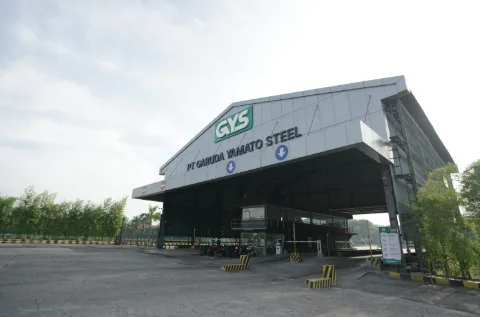
Infrastructure development and building construction require hot rolled structural steel with mechanical properties, chemical composition, and dimensions that meet engineering requirements. These materials are widely used in industrial facilities, commercial buildings, factories, warehouses, bridges, and other infrastructure projects that rely on structural steel systems.
This demand places greater attention on section manufacturers and steel suppliers involved in the construction supply chain. Contractors and fabricators planning to buy steel need to review dimensions, grades, mechanical properties, chemical composition, applicable standards, documentation and delivery schedules before fabrication begins.
PT Garuda Yamato Steel (GYS) is a steel manufacturer based in Cikarang, Bekasi, West Java, producing hot rolled structural steel sections for construction and infrastructure projects in Indonesia.
GYS manufactures a range of hot rolled sections, including H-Beam, IWF or WF, U Channel, and Equal Angle. During the hot rolling process, heated steel is passed through a series of rolling stands to form the required profile and dimensions. Production and quality controls are applied to ensure the finished products meet specified mechanical properties and chemical composition requirements.
The company also produces high-tensile IWF and H-Beam for projects that require higher strength and specific performance requirements. In Indonesia, GYS high-tensile products are widely recognized through its “Tahan Gempa Plus” positioning, which emphasizes strength, ductility, weldability, consistent mechanical properties, and controlled chemical composition for structural applications.
Each hot rolled section serves a different function within a structural system. H-Beam and IWF sections may be used as beams or columns depending on the structural design, while U Channel and Equal Angle sections are commonly used for secondary framing, bracing, supports, and connection details.
Profile selection therefore cannot be based on nominal size alone. Project teams need to examine H-beam sizes, flange width, web thickness, flange thickness, weight per meter, grade, standard length and applicable product standards, usually listed in a steel profile table. Profiles with similar dimensions may have different weights and structural characteristics.
PT Garuda Yamato Steel (GYS) operates an end-to-end steel manufacturing process that starts from scrap and continues through steelmaking, casting, and hot rolling. Unlike a conventional rolling mill that processes externally sourced semi-finished products, GYS produces its own semi-finished goods with Electric Arc Furnace (EAF). Scrap is melted and refined in the EAF to achieve the required chemical composition and steel quality, before the molten steel is continuously cast into semi-finished products such as billets, blooms, and beam blanks.
The semi-finished products are then reheated and processed through the rolling mill, where they pass through a series of rolling stands to form hot rolled structural steel sections, including H-Beam, IWF or WF, U Channel, and Equal Angle. The rolling process allows GYS to produce a wide range of product sizes and dimensions to meet different structural requirements and applications. The products then undergo controlled cooling, straightening, cutting, inspection, and final preparation before being stored and distributed to customers.
By using scrap as a key raw material in the EAF steelmaking process, GYS supports circular-economy principles by returning recyclable steel into the production cycle and converting it into new structural steel products.
Quality control is applied throughout the manufacturing process to verify both chemical composition and mechanical properties, including yield strength, tensile strength, and elongation, as well as dimensional tolerance, surface condition, and product traceability in accordance with applicable standards and project requirements..
Tony Taniwan, President Director of PT Garuda Yamato Steel, said that supplying structural steel is not only about meeting volume requirements, but also about ensuring that the material performs reliably throughout the construction value chain.
“In construction, the quality of steel affects much more than the material itself. It influences fabrication, welding, erection, structural performance, project efficiency, and ultimately the reliability of the finished structure. That is why consistency in chemical composition, mechanical properties, dimensions, traceability, and technical documentation must be controlled from the steelmaking process through to the final product,” Tony said.
High-tensile structural steel can improve material efficiency by providing higher strength, with the potential to reduce steel weight, optimize member sizes, and lower overall project costs when applied appropriately in the structural design. GYS offers high-tensile IWF and H-Beam products under the “Baja Tahan Gempa Plus” positioning, with controlled chemical composition and reliable mechanical properties that support strength, ductility, weldability, and consistent quality.
The potential cost saving should still be evaluated as part of the overall structural design, as member dimensions, unsupported length, connections, bracing, welding, fabrication, installation, and applicable design standards all influence the final steel quantity, construction efficiency, and structural performance.
GYS operates a Steel Service Center for many processes including CNC drilling, cutting, sawing and straightening. Large projects generally need to coordinate production, processing and delivery with fabrication and erection schedules, and buyers with confirmed volumes may buy steel directly from the mill, while smaller or urgent requirements may instead be sourced through distributors holding local inventory.
Domestic production can therefore provide another source of structural steel for construction projects. Marketing phrases such as the largest steel mill in Indonesia, the best steel mill in Indonesia, or a steel mill with the best quality in Indonesia should be checked against measurable capacity and certification records, while final material selection remains dependent on engineering calculations, technical requirements and applicable standards.
Contact: 62 21 890-0222
PT Garuda Yamato Steel
Website: https://www.garudayamatosteel.com/
Email: [email protected]
Indonesia