AI Detector Accuracy: What Detection Scores Really Tell You
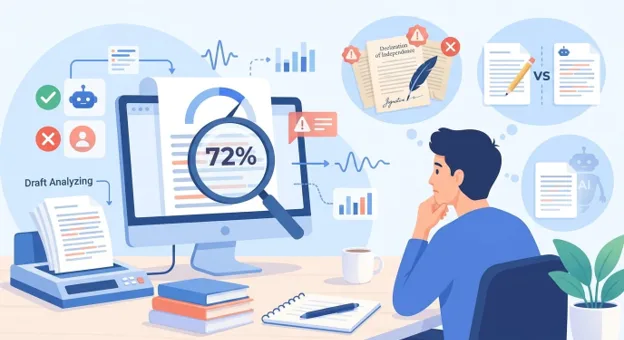
AI detectors are increasingly used in education, publishing, recruitment, and content review. They promise to help people identify writing that may have been generated by artificial intelligence. But what does an AI detector actually measure, and how much confidence should you place in its results?
The answer is more complicated than a percentage on a screen might suggest. A detection score is an estimate produced by a particular system, not direct evidence of who wrote a passage. Understanding that distinction is essential before using an AI detector to make decisions about someone’s work.
How AI Detectors Analyze Writing
AI detectors examine text for patterns that their models associate with AI-generated content. Depending on the product, they may use statistical features, linguistic patterns, trained classifiers, or other detection methods.
Some systems examine how predictable a sequence of words is. Others consider sentence structure, vocabulary, repetition, and broader patterns across a document. The methods vary, so two detectors can assess the same passage and reach different conclusions.
A detector does not observe the writing process itself. Unless additional evidence is available, it cannot directly determine whether a person typed every sentence, used an AI assistant for brainstorming, or revised a machine-generated draft.
For a more detailed explanation of the methods involved, this guide covers how AI detectors work and their limitations.
What Does an AI Detector Score Mean?
One of the most confusing aspects of AI detection is the score displayed in the results.
A tool might report that a passage is highly likely to be AI-generated or assign a percentage to the amount of text it identifies as AI-like. The exact interpretation depends on the product.
A score of 80%, for example, should not automatically be interpreted as an 80% probability that a particular person used AI. Nor does it necessarily mean that 80% of the document was written by a machine. Some products report estimates of the likelihood that text was AI-generated, while others highlight portions of a document or provide different types of classifications.
Before interpreting a score, check the tool’s documentation to understand what the number represents.
It is also important to distinguish between a detector’s classification and the evidence needed to establish authorship. A statistical estimate cannot, on its own, establish who wrote a document or how it was produced.
False Positives: When Human Writing Is Flagged
A false positive occurs when a detector identifies human-written text as AI-generated.
This matters because human writing does not follow one universal pattern. Some people write in short, direct sentences. Others use formal language, consistent grammar, or highly structured paragraphs. These characteristics can overlap with patterns that certain detection systems associate with AI-generated text.
Research has demonstrated that this is more than a theoretical concern. A Stanford-led study tested seven commercial detectors on a specific collection of essays written by non-native English speakers and found that the systems frequently misclassified those essays as AI-generated. The result applied to the particular sample and tools examined, not to every writer or detector.
Historical and formal writing has also produced surprising results in reported experiments. The Declaration of Independence, for example, has received high AI-generated scores from some detection tools despite being written long before modern generative AI existed.
These examples show why detection results require context. A high score should prompt further examination rather than an automatic accusation.
For more on this issue, read this explanation of why AI detectors sometimes flag human-written text.
False Negatives: When AI-Written Text Is Missed
False positives are only one side of the reliability problem. A false negative occurs when AI-generated text is classified as human-written or is not flagged by a detection system.
This can happen for several reasons. The detector may not recognize the particular model’s output, the text may have been substantially edited, or the passage may lack the patterns the system relies on. Different detection methods also have different strengths and limitations.
As a result, a low AI score does not prove that the text was written entirely by a person. It simply means the tool did not identify enough of the patterns it uses to classify the passage as AI-generated.
This distinction becomes particularly important when people use detectors to evaluate work under strict rules. Neither a high score nor a low score should be treated as conclusive evidence without considering other information.
Why Detector Accuracy Varies
AI detection is not a single standardized test in which every product measures the same thing under identical conditions.
Several factors can influence results.
The type of text. Academic essays, product descriptions, technical documentation, and informal messages have different writing conventions. A detector that performs well on one type of content may behave differently on another.
The language and writing style. A model trained or tested primarily on certain writing samples may not perform equally well on every language, dialect, or writing style.
The amount of text. Short passages provide less material for a system to analyze. A brief paragraph may produce less reliable results than a longer document, although performance still depends on the particular tool.
The AI model involved. Different language models produce different kinds of text. A detector’s performance against one model does not guarantee equivalent performance against another.
The testing method. Accuracy claims depend on which samples were used, how the samples were labeled, what threshold was selected, and how false positives and false negatives were counted.
These variables make broad claims about detector accuracy difficult to compare. A vendor’s reported performance should be evaluated in light of the conditions under which it was measured.
Can You Trust AI Detectors for Academic or Professional Decisions?
AI detectors can provide useful information in some situations, but their limitations make them unsuitable as the sole basis for consequential decisions.
In education, a detection result might prompt an instructor to review a student’s work more closely. However, the score should not replace a fair process that considers the assignment, the student’s explanation, available drafts, and the institution’s rules.
In publishing, an editor might use detection software as one part of a broader content-review process. Yet a detector cannot establish whether an article contains original reporting, accurate information, or properly attributed material.
Employers and businesses face similar considerations. If a company has rules governing AI use, those rules should define acceptable practices and review procedures rather than relying entirely on an automated score.
A responsible process distinguishes between a signal that warrants further investigation and evidence strong enough to support a conclusion.
What to Do When a Result Is Questioned
If your writing receives an unexpected AI detection result, avoid assuming that the score tells the complete story.
Start by checking what the tool actually reports. Determine whether it classifies the whole document, highlights particular passages, or provides a different type of estimate.
Next, review the writing process. Saved drafts, outlines, notes, and version history may help explain how the document developed. Sources, research notes, and earlier revisions can also provide useful context.
If the result is being used to evaluate your work, ask how the score is interpreted and whether other evidence is considered. Follow the relevant academic, workplace, or publishing policy, and use the established process to challenge an inaccurate assessment.
The objective should be to evaluate the work fairly, not to treat a software result as an unquestionable verdict.
How to Evaluate an AI Detector Before Using It
If you are choosing a detection tool, look beyond its headline accuracy claim.
- Review the methodology. Does the provider explain what its scores mean and how the system was tested?
- Check the limitations. Look for information about supported languages, document lengths, and content types.
- Look for independent evaluations. Vendor testing can be informative, but independent research may reveal limitations that are not obvious from marketing claims.
- Understand the consequences. Consider what happens when the tool makes an incorrect classification and whether human review is available.
- Protect sensitive material. Before uploading documents, examine the service’s privacy and data-handling policies.
- Test it against your use case. Performance on one kind of writing should not be assumed to apply to all your documents.
A tool that provides clear documentation and communicates uncertainty responsibly may be more useful than one that promises near-perfect results without explaining the conditions behind its claims.
Final Thoughts
AI detectors can help identify patterns associated with machine-generated writing, but they cannot independently establish authorship. Their results depend on the system, the text, and the conditions under which the detection takes place.
False positives can affect human writers, while false negatives can allow AI-generated text to go unrecognized. These limitations make context, transparency, and human judgment essential.
Use detection scores as one source of information, not as a final verdict. Whether you are reviewing a student’s assignment, assessing a submitted article, or selecting software for your organization, the most reliable decisions combine appropriate tools with evidence and a fair review process.