De-AI Your Writing: The Editing Checklist Professional Editors Use
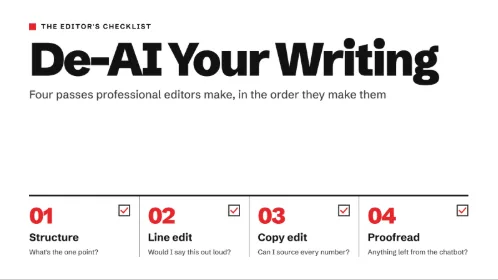
Hand a draft to a professional editor, and they won’t read it once. They’ll read it four times, and each time they’ll be looking for something different. The first read is about whether the piece works at all. The last one is about commas.
Most people who set out to de-AI their writing do it the other way around. They start with word swaps, fix a few phrases, and call it done, while the bigger problems sit untouched: a piece with no clear point, sections that repeat each other, and claims nobody checked. If you’ve ever searched “de-AI my writing” after rereading a draft that felt hollow, the fix is usually a better editing process. A tool that can de-AI text like UnAIMyText’s humanizer will handle a lot of the rhythm and phrasing work for you. This checklist covers everything around it, in the order editors do it.
Why Editors Work in Passes
Publishing has long split editing into levels. A structural (or developmental) edit asks whether the piece is built right. A line edit works on voice and flow, sentence by sentence. A copy edit checks accuracy and consistency. A proofread catches the small errors left at the end. Each level needs a different kind of attention, and trying to do all four at once means you do none of them well.
This matters more with AI drafts, because their problems are spread across every level. The structure is generic, the sentences share the same rhythm, the facts may be invented, and the formatting has its own habits. A one-pass edit catches the surface and misses the rest.
It’s also why experienced editors don’t edit to an AI detector score.
A score tells you how a statistical model reads the text, and even the detector’s makers say its results shouldn’t be treated as a final judgment. A piece can pass every one of them and still be dull, wrong, or pointless. The checklist below is built around the reader instead.
The Case for a Slower Edit
If editing AI drafts carefully sounds like overkill, consider how much unedited AI writing is already out there. Originality.ai sampled 5,000 public LinkedIn posts of 100 words or more and found that 81% were likely AI-generated, up from roughly half in late 2024. Detectors make mistakes, so treat the exact figure with care, but the direction is clear. Readers are swimming in AI-sounding text, and anything that reads differently stands out.
Search results tell a similar story. Semrush analyzed 42,000 blog pages ranking in Google’s top ten and found that human-written content held the number-one spot 80% of the time, compared with 9% for purely AI-generated pages. In the same study’s survey, 70% of SEO teams named speed as AI’s main benefit, but only 19% said it improved content quality.
Marketers have adjusted. According to Ahrefs’ 2026 survey, 89% of marketers now check AI output manually, up from 80% a year earlier. The useful question now is how to edit AI drafts well, and that is what the four passes below are for.
Pass 1: Structure
This is the big-picture read. Don’t fix a single sentence yet. Read the whole piece through once and answer these questions:
- Can you state the main point of the piece in one sentence? If you can’t, the reader won’t be able to either.
- Does the opening get to that point quickly, or does it spend a paragraph setting the scene?
- Do any two sections make the same argument in different words? AI drafts often do this. Merge them.
- Is every section roughly the same length? That’s an AI pattern. Some points deserve a paragraph, and some deserve a page.
- Is there anything here that only you, or your company, could have written? A result, an example, a mistake, an opinion?
- Does the ending add something, or does it summarize what the reader just read?
If the answer to the fifth question is no, stop editing and go find that material. No amount of line editing will fix a piece that says what every other article on the topic says.
Pass 2: Line Edit
Now work through the piece paragraph by paragraph. This is where most de-AI writing advice lives, and it’s the pass where tools built to de-AI text save the most time.
- Do sentence lengths vary within each paragraph? Read three sentences in a row. If they’re all about the same length, break one up or combine two.
- Have you cut the stock vocabulary? Words like “delve,” “crucial,” “seamless,” “leverage,” and “foster” rarely survive a professional line edit.
- Are transitions doing real work? Delete “Moreover” and “Furthermore” and see whether the paragraph still makes sense. It usually does.
- Does every list of three earn its third item?
- Does the piece sound like one person throughout, or does the tone shift between sections?
- Would you say each sentence out loud to a colleague? If not, rewrite it the way you would say it.
Pass 3: Copy Edit
This pass is about accuracy. It’s the least glamorous and the most important for AI drafts, because language models produce confident sentences whether or not they are true.
- Is every statistic traceable to a source you have opened yourself? Search for the exact number. If you can’t find it, remove it.
- Do quotes match the original wording, and are they attributed to the right person?
- Are names, product names, dates, and prices correct and spelled consistently?
- Have hedges like “may,” “some,” and “in early tests” survived, or did the draft turn them into certainties?
- Do links go where the text says they go?
- Is the style consistent: one spelling variety, one way of writing numbers, one capitalization style for headings?
Editors at good publications treat an unsourced number as an error. Treat AI-generated figures the same way.
Pass 4: Proofread
The last read is for the small things, including a few formatting habits that mark a piece as machine-made even when the words are fine.
- Is there leftover chatbot text, such as “Certainly!”, “I hope this helps,” or “As of my last update”?
- Is bold text used sparingly, or is every other phrase highlighted?
- Do the headings follow the publication’s style, and are they consistent with each other?
- How many dashes and colons are carrying the sentences? A heavy pattern of either is a common tell.
- Are there emoji, decorative symbols, or hashtags that don’t fit where the piece will be published?
- Did you read it out loud, start to finish, one final time?
If You Only Have Ten Minutes
Do two things. First, answer the structure question: can you say the main point in one sentence, and does the piece contain anything only you could have written? Second, check every number and name against a real source. Those two steps catch the problems readers and editors notice most, and they’re the ones no tool can do for you. The line edit and proofreading matter too, but they are the easier jobs to hand off. When you de-AI your writing in this order, the time you spend goes where it makes the biggest difference.