How AI-Powered Video Marketing Is Transforming Digital Branding
Video marketing has become an essential part of modern digital marketing. Businesses use videos to introduce products, explain services, connect with audiences, and build recognizable brands across multiple platforms. As online competition increases, companies are looking for creative ways to produce engaging content without spending excessive time or money. Artificial intelligence is helping make this possible by simplifying video production and opening new opportunities for marketers, entrepreneurs, and content creators.
From automated editing to personalized advertisements, AI-powered tools are changing how businesses approach visual communication. These technologies allow even small businesses to create professional-looking videos that capture attention and communicate their message effectively.
Why Video Marketing Matters in the Digital Age
Consumers encounter countless advertisements, social media posts, and promotional messages every day. Capturing their attention requires content that is relevant, visually appealing, and easy to understand. Video combines movement, sound, storytelling, and visual elements to deliver information in an engaging format.
Businesses can use video marketing to demonstrate products, share customer experiences, explain complicated concepts, and introduce their teams. Short videos are particularly useful on platforms such as Instagram, TikTok, YouTube Shorts, and Facebook, where audiences often scroll quickly through their feeds.
Video content can also support search engine optimization. Helpful videos may encourage visitors to spend more time exploring a website, provide additional information about a product, and help businesses reach audiences through video search results. However, performance depends on the quality and relevance of the content rather than the format alone.
The Growing Role of Artificial Intelligence in Video Creation
Traditional video production can require cameras, editing software, animation skills, and considerable time. AI tools simplify several of these tasks by automating repetitive work and helping users develop creative assets more efficiently.
Depending on the platform, AI-powered video tools can generate scripts, create subtitles, remove backgrounds, produce voiceovers, suggest edits, and transform written prompts into visual scenes. Some applications also help users create animated graphics and branded introductions.
These capabilities make video production more accessible to startups, independent creators, and marketing teams with limited resources. Instead of managing every technical detail manually, creators can focus more attention on their audience, messaging, and creative direction.
AI does not eliminate the need for human judgment. Reviewing generated content, checking factual accuracy, maintaining brand consistency, and ensuring that the final video meets audience expectations remain important parts of the process.
Building a Recognizable Brand Through Animation
Brand recognition is an important objective of digital marketing. When viewers repeatedly encounter consistent visual elements, they can become more familiar with a business and its identity. Logos, colors, typography, and animation styles all contribute to this recognition.
Animated logos are particularly useful because they introduce movement into an otherwise static brand symbol. A simple animation might reveal a logo gradually, transform a graphic into its final shape, or combine typography with a subtle motion effect.
Businesses can use animated logos in video introductions, promotional advertisements, product demonstrations, online presentations, and social media content. When used consistently, these short sequences can help establish a recognizable visual identity.
AI-assisted animation tools make this process more accessible by helping users explore different animation styles without necessarily having advanced motion-design skills.
How Logo Animation AI Can Support Marketing Campaigns
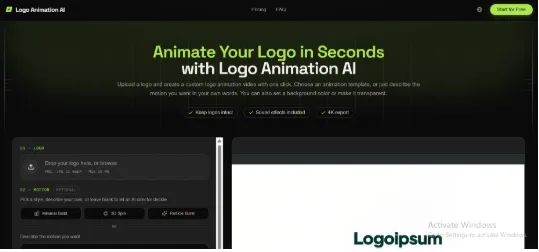
For businesses that want to improve their video branding, Logo Animation AI can be a useful addition to the creative toolkit. AI-assisted logo animation can help marketers explore motion effects, develop branded video openings, and create visual assets for different digital channels.
For example, a technology startup might use a clean, futuristic animation in its product demonstrations, while a lifestyle brand could choose softer transitions and more expressive movement. A marketing agency might develop several versions of an animated logo to match the tone and format of different client campaigns.
The main advantage is flexibility. Rather than relying on a single static graphic, businesses can experiment with movement, pacing, and presentation to find a style that supports their brand identity.
Before selecting an AI-generated animation, marketers should ensure that the final design preserves the original logo’s proportions, colors, typography, and recognizable features. They should also review the tool’s licensing terms to understand how generated assets can be used commercially.
Creating Short Videos That Capture Attention
Short-form video has become an important format for digital advertising and organic social media content. Its effectiveness often depends on delivering a clear message quickly.
AI tools can help creators turn longer material into shorter clips, generate captions, identify potential highlights, and adapt content for different aspect ratios. These features can reduce editing time and make it easier to maintain a consistent publishing schedule.
However, automation alone does not guarantee engagement. A successful short video generally needs a strong opening, a focused message, and a clear reason for viewers to continue watching.
For example, a business promoting a productivity application could begin with a common workplace challenge, demonstrate how the application addresses it, and finish with a straightforward call to action. An animated brand logo can reinforce recognition without distracting from the main message.
Personalization and Audience Engagement
One of AI’s most promising applications in digital marketing is content personalization. Different audiences may respond to different examples, messages, and creative styles.
AI-assisted workflows can help marketers prepare variations of a campaign for different customer groups. A software company, for instance, might create one video emphasizing time savings for small-business owners and another highlighting collaboration features for larger organizations.
Personalization should remain relevant and respectful. Businesses need to handle customer information responsibly, avoid unsupported assumptions, and comply with applicable privacy requirements.
The objective is to make content more useful to viewers, not simply to produce a larger number of advertisements.
Improving Brand Consistency Across Platforms
Businesses often publish content across websites, email campaigns, social media accounts, and digital advertising networks. Maintaining a consistent identity across these channels can become challenging, especially when multiple people contribute to production.
AI tools can help standardize certain elements of the workflow, including subtitle styles, visual templates, background treatments, and branded introductions.
A company can establish guidelines for logo placement, color palettes, typography, animation duration, and voiceover style. These guidelines provide a foundation for creating recognizable content while allowing enough flexibility to suit different platforms.
Consistency is especially valuable when videos are produced frequently. It helps audiences associate repeated visual elements with the same business without making every campaign look identical.
Measuring the Performance of Video Marketing
Creating a visually appealing video is only one part of an effective marketing strategy. Businesses also need to evaluate whether their content supports meaningful objectives.
Useful metrics include view duration, audience retention, click-through rate, engagement, website visits, leads, and conversions. The most relevant measures depend on the campaign’s purpose.
For example, an awareness campaign may prioritize reach and video completion rates, while a product demonstration designed to generate sales may focus on qualified website traffic and purchases.
Marketers can compare different introductions, calls to action, video lengths, and visual approaches to understand what resonates with their audience. AI analytics features may help identify patterns, but results should be interpreted in the context of campaign goals and audience behavior.
Practical Tips for Using AI Video Tools
Businesses can improve their results by following a few practical principles.
Start with a clear objective. Determine whether the video is intended to educate, entertain, build awareness, generate leads, or support sales.
Develop a simple script. A clear structure helps prevent unnecessary scenes and keeps the message focused.
Protect your brand identity. Use approved logos, fonts, colors, and messaging. Review AI-generated graphics carefully for distortions and inconsistencies.
Choose the right format. Vertical video may work well for mobile-first social platforms, while horizontal video is often suitable for websites, presentations, and traditional video channels.
Review every final export. Check audio levels, subtitles, transitions, spelling, image quality, and visual continuity before publishing.
Track results and improve. Use campaign data to identify what works, then refine future videos based on evidence rather than assumptions.
Balancing Automation With Human Creativity
Although AI can accelerate production, human creativity remains essential to effective communication. Audiences respond to relevant stories, useful information, authentic experiences, and messages that address real needs.
Overusing automated templates can make content feel repetitive or generic. Similarly, excessive effects can distract viewers from the product or message.
The strongest approach combines AI’s speed with human direction. Marketers can use automation to handle time-consuming tasks while applying their own judgment to storytelling, brand positioning, and audience relationships.
Businesses should also verify the accuracy of AI-generated claims, respect copyright and licensing requirements, and disclose synthetic content when appropriate or legally required.
The Future of AI in Digital Marketing
AI-powered video production is likely to become increasingly integrated into everyday marketing workflows. Improvements in generative video, editing automation, personalization, and animation may allow businesses to produce more varied content with fewer technical barriers.
At the same time, the growing volume of automatically generated content will make originality and trust more important. Brands that understand their audiences and communicate clear value will have stronger foundations than those that rely solely on production speed.
Companies should therefore evaluate new tools according to their practical benefits, reliability, costs, privacy protections, and suitability for their existing workflows.
Conclusion
AI is changing video marketing by making content creation more accessible, flexible, and efficient. Businesses can use these tools to develop promotional videos, improve visual storytelling, create animated brand elements, and adapt campaigns for different audiences.
Logo animation is one example of how AI-assisted production can support a broader branding strategy. When combined with clear messaging, consistent design, and thoughtful distribution, it can help businesses present a more recognizable identity across digital channels.
Ultimately, effective video marketing depends on more than technology. The best results come from understanding the audience, communicating a useful message, maintaining brand consistency, and measuring performance. AI can support each of these activities, but a well-planned strategy and genuine creativity remain the foundation of successful digital marketing.