Selling Across Borders: What High-Risk Businesses Need to Know About Payments in the US, Canada, UK and EU
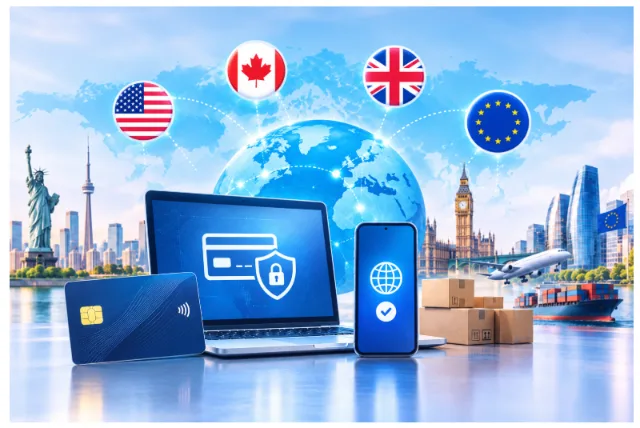
High-risk businesses selling into the US, Canada, the UK and the EU need a merchant account approved for each market, a plan for Strong Customer Authentication and 3D Secure 2 where it applies, and documented fraud and refund controls before cross-border payment processing can run smoothly. Expanding into international markets requires businesses to navigate different payment rules, fraud controls and merchant-account requirements. For high-risk sellers, these challenges can be more complex because payment providers closely assess chargeback exposure, business models and regulatory compliance before approving transactions.
How do payment rules differ between the US, Canada, the UK and the EU?
In the United States and Canada, payment acceptance depends on factors including card-network rules, fraud prevention, local requirements and the merchant’s agreement with its payment provider. Address verification, transaction monitoring and clear refund policies can help businesses manage payment risks. In the US, no regulation mandates strong customer authentication for card payments, so address verification, card security codes and fraud screening carry more of the load. In Canada, the Code of Conduct for the Payment Card Industry in Canada sets standards for how payment providers treat merchants, including clear fee disclosure and advance notice of changes.
The United Kingdom and European Union have additional requirements for Strong Customer Authentication (SCA) under the EU’s second Payment Services Directive (PSD2) and, in the UK, the Payment Services Regulations 2017 overseen by the Financial Conduct Authority. SCA generally applies when both the cardholder’s card issuer and the merchant’s acquirer are located in the UK or the European Economic Area, which matters for US and Canadian sellers deciding where to establish merchant accounts. 3D Secure 2 (3DS2) helps authenticate online cardholders by exchanging transaction and device information between merchants and card issuers. Depending on the transaction, customers may complete a frictionless authentication process or be asked to verify their identity. Exemptions may apply in eligible circumstances, such as low-value payments, merchant-initiated recurring payments and transactions approved through transaction risk analysis, but they are not guaranteed.
Why do high-risk merchants face extra scrutiny in new markets?
High-risk merchants may face additional scrutiny when entering new markets because providers must assess unfamiliar transaction patterns, local regulations, customer disputes and potential financial liabilities. Businesses may be asked for corporate documents, processing history, licenses or evidence of effective fraud and refund management. Approval in one country does not automatically guarantee acceptance in another.
“Approval happens market by market,” said Joshua Benedetti, CEO of CARDZ3N, a Las Vegas–based merchant services provider specializing in high-risk payment processing. “A business that processes cleanly in the US still has to show a new acquirer that its products, refund practices and chargeback history fit that market’s rules. The merchants who launch smoothly are the ones who prepare that file before they apply.”
How should high-risk businesses choose international merchant services?
Selecting appropriate international merchant services therefore requires more than comparing transaction fees. Merchants should confirm market eligibility, supported currencies, settlement terms, authentication capabilities and any reserve or processing limits. Businesses evaluating a high risk merchant account should also establish whether their specific products and sales practices are permitted.
Checklist: what to do before entering a new market
Verify local regulations and confirm that your products and business model are accepted by your payment provider in each market.
Determine whether Strong Customer Authentication and 3D Secure 2 apply to your transactions, and confirm your provider supports them.
Review currency conversion fees, settlement currencies and settlement timelines.
Publish clear refund, cancellation and subscription policies for each market.
Prepare corporate documents, processing history and any required licenses to streamline underwriting.
After launch, monitor authorization rates, fraud and chargebacks so issues are caught early.
The bottom line
International expansion can create new revenue opportunities, but payment requirements vary by jurisdiction. Understanding these differences before launch can help businesses reduce operational disruptions and build a more sustainable cross-border payment processing strategy.
Frequently asked questions
What is a high-risk merchant account?
A high-risk merchant account is a merchant account for businesses that payment providers consider more likely to generate chargebacks, fraud or regulatory exposure, often because of their industry, billing model or processing history. These accounts involve closer underwriting and may include reserves or processing limits.
Is 3D Secure 2 required in the US and Canada?
No regulation requires it in the US or Canada, but merchants can still use 3D Secure 2 to reduce fraud. Successfully authenticated transactions can also shift liability for fraud-related chargebacks to the card issuer. In the UK and EU, SCA rules generally require authentication for customer-initiated online card payments unless an exemption applies.
What is cross-border payment processing?
Cross-border payment processing is accepting card or bank payments from customers in a different country than the one where the merchant or its acquirer is based. It can involve currency conversion, different authentication rules and additional fraud screening.
Can one merchant account cover the US, Canada, the UK and the EU?
Not always. Some providers support multi-currency processing across several regions, but eligibility depends on where the business is incorporated, where it sells and what it sells. Many high-risk businesses need separate approvals for each market.
About CARDZ3N: CARDZ3N is a Las Vegas–based merchant services provider specializing in high-risk payment processing and B2B payment technology, serving merchants in the USA, Canada, the UK and the EU. Learn more at cardz3n.com.