Online Scams and Gamer Safety: How to Protect Yourself in Finland
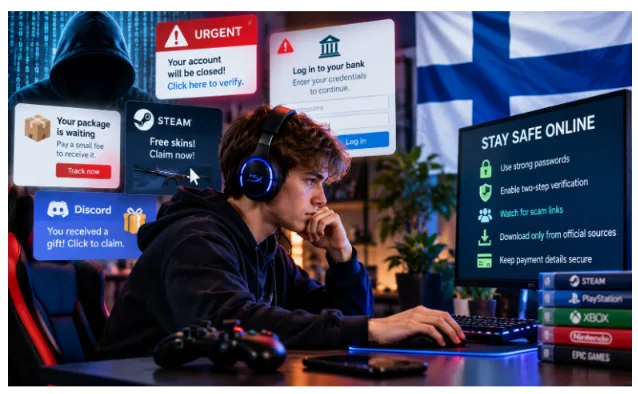
Finland is one of the most digital countries in the world. Most people bank online, identify themselves with their bank credentials, get their post as a text message and buy their games without ever touching a disc. That convenience has a flip side. A society that trusts its digital services is also an attractive target for people who want to exploit that trust.
Gamers are a particular target. They tend to have accounts worth money, they’re used to clicking links in chats, and many are young. This guide covers the scams you’re most likely to meet, how to lock down your gaming accounts, what rights you have as a consumer and where to go if something goes wrong.
The Most Common Scams Right Now
According to the National Cyber Security Centre Finland (NCSC-FI), which belongs to Traficom, the vast majority of the phishing messages it receives have one goal: to lead you to a fake website where you type in your online banking credentials. Those websites look like the login pages of real banks, and the messages that lead to them come in many costumes.
Typical examples include messages pretending to be from a parcel or delivery service, saying your package is waiting and you need to pay a small fee. Others claim to come from the Tax Administration, announcing a refund. Some pretend to be Suomi.fi or a health service, saying that you have an important document waiting. Impersonation of authorities is a recurring theme: there have been text messages in the name of the police about an unpaid fine, and even messages from supposed social workers referring to child protection. The police have made it clear that they don’t issue fines by text message or email.
One change deserves particular attention. For years, bad spelling was the giveaway. You could spot a scam by its clumsy Finnish. That’s no longer reliable. The NCSC-FI has pointed out that producing fluent Finnish text has become easier than ever, which means scam messages now often read perfectly well. Don’t judge a message by its grammar. Judge it by what it asks you to do.
Other patterns show up again and again:
- Too good to be true. Messages about winning a prize or receiving free gift cards are usually scams.
- Urgency. Anything that says “act now” or “your account will be closed” is designed to stop you thinking.
- Long-term trust building. Romance and investment scams start slowly, building a friendship or a sense of confidence for weeks before money comes up.
- Marketplace scams. When buying or selling on online classifieds, fake payment confirmations and advance payment requests are common.
- CEO and invoice fraud. These mostly hit companies, but they matter if you work somewhere that handles payments.
The good news is that authorities and operators are fighting back. Traficom and the telecom operators have protected dozens of text message sender names so that criminals find it harder to fake messages from well-known organisations. That helps, but it doesn’t stop everything, so your own judgement remains the best defence.
The golden rule: never click a link in a message that asks for your bank details, your password or a payment. Open the organisation’s website or app yourself, and log in there instead. If the message was genuine, you’ll see the same notification there.
Protecting Your Gaming Accounts
Game accounts are worth more than many people realise. A Steam library can hold hundreds of euros in games, and accounts linked to payment cards, rare items or in-game currency are attractive to thieves. Here’s how scammers usually go after them, and what you can do about it.
Fake giveaways and phishing links. A friend’s hacked account sends you a message: “Look, free skins, just log in here.” The link leads to a page that looks like Steam, Discord or a game launcher, but it’s fake. Once you type in your password, the thieves have it. Always check the address bar. If you’re not sure, go to the real site by typing it yourself.
Fake trade offers and “middlemen”. When you trade items with strangers, scammers pretend to be an official middleman, or ask you to confirm a trade on an outside website. Real platforms don’t need you to log in elsewhere to complete a trade.
Cheats, mods and cracked games. Downloads that promise free cheats or free copies of paid games are a classic way to spread malware. If a download is “too good”, it’s probably carrying something nasty that steals saved passwords.
Fake support. Someone contacts you claiming to be from a game’s support team and asks for your password or a verification code. Real support never asks for your password.
The defences are simple, and they work:
- Use a different password for every account. A password manager makes this easy. If one service is breached, the rest stay safe.
- Turn on two-step verification everywhere. Steam, Epic, PlayStation, Xbox, Nintendo and most other services support it. It’s the single biggest protection against account theft.
- Never share verification codes. A code sent to your phone is for you only. Nobody legitimate will ask you to read it out.
- Keep your payment details out of reach. Don’t leave cards saved on shared devices, and consider using gift cards or setting spending limits.
- Download only from official sources. Use the official stores and the developers’ own sites for games and mods.
- Use a separate email address for gaming. If that account is leaked, your main email and banking stay protected.
- Keep devices updated. Updates often fix security holes that criminals are actively using.
Parents should talk about this with children, who often don’t see the risk. A short chat about not clicking links from strangers, not sharing passwords even with friends and telling an adult when something feels strange does a lot of good. The Finnish authorities have even organised information at gaming events such as Assembly in Helsinki, precisely because gamers are a target group.
To stay on top of current developments in gaming and digital life, Voxly.fi follows these topics regularly, and it’s worth keeping an eye on warnings as new scams appear.
Your Rights as a Consumer
Even careful people get caught sometimes, and it helps to know where you stand.
Unauthorised payments. If someone uses your card or bank credentials without permission, contact your bank or card provider immediately. Speed matters. The sooner you report it, the better your chances of limiting the loss. Keep any messages and receipts as evidence.
Buying digital games. When you buy online, you generally have a 14-day right of withdrawal in the EU, but there’s an important exception for digital content. If you agree to start downloading or playing straight away, you normally lose that right. That’s why store-specific refund policies matter. Steam, for example, has a policy that generally allows refunds within 14 days of purchase if you’ve played for less than two hours. Other stores have their own rules, so read them before you buy.
Children’s purchases. Minors have limited legal capacity in Finland, and large purchases generally need a guardian’s consent. If a child has spent a lot of money on in-game items without permission, contact the platform’s support quickly and explain the situation. Many companies will consider refunds in such cases, though it’s not guaranteed. The best protection is prevention: set up parental controls and spending limits from the start.
Where to get advice. The Finnish Competition and Consumer Authority (KKV) provides consumer guidance and explains your rights when you buy goods and services online. If a seller won’t help, the authorities can advise you on the next steps, including the Consumer Disputes Board for certain disputes.
The wider picture. Online fraud is a Europe-wide problem, and police work across borders. Europol, the EU’s law enforcement agency, publishes awareness materials on online fraud and cybercrime, which can be a useful complement to national advice.
Where to Report Scams
Many people feel embarrassed after being tricked and never report it. That’s understandable, and it’s also exactly what scammers count on. Reporting helps you, and it helps others too, because authorities use reports to block fake sites and warn the public.
If you’ve fallen for a scam, act in this order:
- Contact your bank immediately if you’ve given out banking credentials or card details, so that accounts can be protected and payments stopped if possible.
- Change your passwords, starting with the email and any accounts where you used the same password.
- Report to the police. The Finnish police take online fraud reports, and you can file one through their website. The NCSC-FI advises you to report fraud to the police after contacting the organisation concerned.
- Report the scam message to Traficom. The National Cyber Security Centre accepts reports of phishing and fraudulent messages through Traficom’s website. Your report helps get fake sites taken down.
- Contact the platform. If your game account was hijacked, use the official support route of the service to recover it.
- Talk to someone. Being scammed can feel humiliating, but it can happen to anyone. Telling a friend or family member helps, especially if you’re young and worried about getting into trouble.
It’s also worth remembering that you don’t need to wait until something goes wrong. If you receive a suspicious message, you can report it even if you didn’t click. And if you’re unsure whether something is real, ask. Contact the organisation through its official website or phone number, never through the details in the message.
A Few Final Thoughts
You don’t need to be paranoid to stay safe online. A handful of habits cover most of the risk: don’t click links that ask for money or credentials, use unique passwords and two-step verification, download only from official sources and take a moment before acting on anything urgent. Scammers rely on speed and emotion. If you slow down, most scams fall apart.