Generative AI in Payroll: What Gen AI in Supply Chain Reveals About Intelligent Enterprise Operations
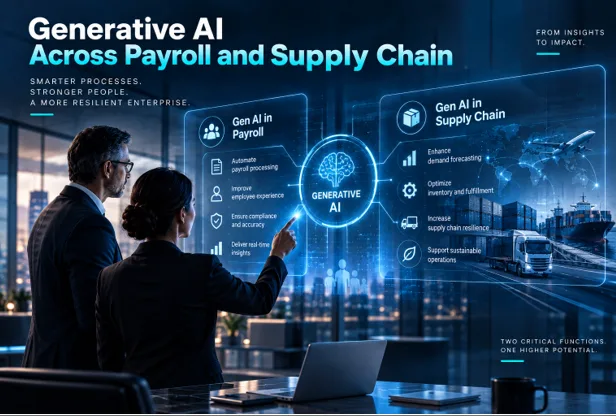
Organizations are expanding generative artificial intelligence beyond individual productivity tools and embedding it into core business processes. Two areas with significant potential are payroll and supply chain management. Generative AI in Payroll can improve employee support, knowledge retrieval and exception management, while Gen AI in Supply Chain can help teams interpret operational information and respond more quickly to planning and supply issues.
Although these functions address very different business requirements, they share important implementation priorities. Both depend on reliable enterprise data, integrated technology, clearly defined workflows and appropriate human oversight. Examining them together provides useful insight into how organizations can scale generative AI across business-critical operations.
This article explores applications of Generative AI in Payroll and Gen AI in Supply Chain, their business benefits, implementation considerations and the principles organizations can apply across the enterprise.
What is Generative AI in Payroll?
Generative AI in Payroll refers to the application of generative artificial intelligence across payroll processes, employee support and payroll knowledge management.
Generative AI can interpret natural-language questions, summarize information, draft employee communications and make policies or procedural knowledge easier to access.
For payroll teams, these capabilities can reduce time spent responding to routine questions or searching through documentation. AI can also summarize information related to payroll exceptions, helping specialists investigate issues more efficiently.
The objective is to augment payroll professionals rather than remove human accountability from sensitive payroll decisions.
What is Gen AI in Supply Chain?
Gen AI in Supply Chain refers to the use of generative artificial intelligence across planning, sourcing, manufacturing, inventory, logistics and other supply chain processes.
Supply chain professionals can use generative AI to summarize operational information, explain planning exceptions, retrieve knowledge and synthesize information from multiple sources.
For example, AI can help planners understand why demand or inventory conditions have changed or provide concise summaries of supplier and logistics information.
Gen AI in Supply Chain therefore complements analytics and automation by making complex operational information easier for employees to interpret.
Why these two AI applications matter
Payroll and supply chain operations have several characteristics that make them relevant for enterprise generative AI.
Both manage large volumes of data and rely on information distributed across multiple systems. Both also involve exceptions that can require employees to gather context before making a decision.
However, the risks differ.
Generative AI in Payroll operates with sensitive employee and financial information, making privacy and accuracy critical. Supply chain AI can influence inventory, production and supplier decisions, making operational reliability particularly important.
Organizations therefore need use-case-specific controls rather than applying the same AI governance approach everywhere.
Core technologies supporting intelligent operations
Generative AI works alongside several complementary technologies.
Large language models
Large language models enable employees to interact with business information through natural-language questions and responses.
Machine learning
Machine learning can identify patterns and anomalies across historical and operational data.
Predictive analytics
Predictive models can help organizations anticipate workforce costs, demand, inventory requirements and other future outcomes.
Intelligent automation
Automation can execute predefined activities while generative AI handles knowledge-intensive elements such as summarization and information retrieval.
AI agents
AI agents can potentially coordinate multistep workflows across enterprise systems while escalating decisions requiring specialist judgment.
These technologies provide the foundation for both Generative AI in Payroll and Gen AI in Supply Chain.
Key applications of Generative AI in Payroll
Organizations can apply generative AI across several payroll activities.
Employee payroll support
Conversational AI can help employees access information about payroll schedules, deductions, pay statements and approved policies.
Payroll case management
AI can summarize employee inquiries and retrieve relevant information, helping payroll specialists understand cases faster.
Payroll knowledge management
Generative AI can make payroll policies, procedures and documentation easier to search and interpret.
Exception support
AI can summarize relevant information when payroll systems identify transactions requiring additional investigation.
Employee communications
Payroll teams can use AI to prepare initial communications related to processing schedules, policy updates and common employee questions.
Payroll reporting
Generative AI can help summarize payroll trends, operational information and workforce costs for payroll and business leaders.
These applications can reduce knowledge-intensive work while maintaining appropriate professional oversight.
Key applications of Gen AI in Supply Chain
Generative AI can also support multiple supply chain processes.
Demand planning
AI can summarize forecast changes and help planners understand potential demand drivers.
Inventory management
Gen AI in Supply Chain can explain inventory exceptions and help employees investigate factors affecting stock positions.
Supplier management
AI can summarize supplier information, contracts and performance data for procurement and supply chain professionals.
Manufacturing
Generative AI can make production documentation and maintenance knowledge easier for operational teams to access.
Logistics
AI can summarize transportation information, delivery exceptions and potential disruption issues.
Supply chain risk management
Generative AI can synthesize supplier, market and operational information to help teams understand emerging risks.
These applications illustrate how generative capabilities can complement existing planning and analytical technologies.
Business benefits across both functions
Despite their differences, both areas can benefit from similar AI capabilities.
Greater employee productivity
AI can reduce time spent searching for information, preparing summaries and completing repetitive knowledge work.
Faster exception resolution
Generative AI can collect and summarize relevant context before a specialist reviews an issue.
Improved knowledge accessibility
Conversational interfaces can make complex policies and operational information easier to find.
Greater scalability
AI-enabled self-service and workflow support can help teams manage increasing business volumes without equivalent increases in manual work.
Better decision support
Employees can receive more relevant information faster, allowing them to focus on evaluating implications and choosing appropriate actions.
What payroll can learn from supply chain AI
Gen AI in Supply Chain demonstrates the importance of combining generative capabilities with broader analytical information.
A supply chain professional needs more than a textual summary. Decisions may require demand forecasts, inventory positions, supplier performance and operational constraints.
The same principle applies to Generative AI in Payroll.
An AI assistant should not simply generate explanations. It needs access to appropriate, governed payroll knowledge and relevant context while respecting employee data permissions.
In both functions, generative AI becomes more valuable when it is integrated with established data, analytics and workflow capabilities.
What supply chain can learn from payroll AI
Payroll provides an important lesson about governance.
Generative AI in Payroll may interact with highly sensitive employee information, requiring strict access controls, privacy protections and human accountability.
Supply chain organizations should apply similar discipline when AI accesses confidential supplier information, contracts, pricing or commercially sensitive operational data.
As Gen AI in Supply Chain moves toward agentic workflows capable of initiating actions, clear permissions and decision rights will become even more important.
Strong governance should therefore be designed into AI workflows rather than added after deployment.
Best practices for enterprise implementation
Organizations can apply several common principles across payroll and supply chain AI:
- Start with clearly defined business problems and expected outcomes.
- Establish current performance baselines before implementation.
- Improve enterprise data and knowledge quality.
- Prioritize use cases according to value, feasibility and risk.
- Integrate AI into existing workflows rather than creating disconnected tools.
- Establish role-based access to sensitive information.
- Maintain human accountability for consequential decisions.
- Test AI outputs using realistic business scenarios.
- Monitor performance after deployment.
- Measure business outcomes rather than AI usage alone.
These principles can help organizations scale generative AI while maintaining appropriate controls.
Common implementation challenges
Data fragmentation affects both payroll and supply chain operations. Payroll information may be distributed across HR, time, payroll and finance systems, while supply chain information can span ERP, planning, procurement, manufacturing and logistics platforms.
Outdated knowledge can also reduce AI reliability. Incorrect payroll documentation or obsolete operational procedures can result in poor responses.
Integration with legacy technology may create additional implementation complexity.
Organizations must also establish employee trust. Users need to understand when AI is being used, how its outputs should be evaluated and when a specialist should make the final decision.
Measuring the value of generative AI
Generative AI should be evaluated according to business performance rather than the number of users or prompts.
For Generative AI in Payroll, relevant measures can include case resolution time, employee self-service, payroll productivity and information retrieval time.
For Gen AI in Supply Chain, organizations might evaluate planning productivity, exception resolution, decision cycle time and operational performance.
The important principle is to establish a baseline before implementation and determine whether AI creates a measurable improvement.
This also enables leaders to compare use cases and direct investment toward applications generating stronger returns.
The future of intelligent enterprise workflows
The next phase of generative AI will increasingly involve AI agents capable of coordinating activities across business systems.
In payroll, an agent could receive an employee inquiry, retrieve relevant information, initiate an authorized workflow and escalate an exception to a payroll specialist.
In the supply chain, an agent could identify an operational exception, gather relevant planning and supplier information and initiate an approved analytical workflow.
As Generative AI in Payroll and Gen AI in Supply Chain evolve, organizations will need to define how much authority these systems receive and where human approval remains mandatory.
Conclusion
Generative AI in Payroll and Gen AI in Supply Chain demonstrate how intelligent technology can support very different but business-critical enterprise functions. In both areas, generative AI can improve knowledge access, reduce repetitive work and help employees investigate exceptions more efficiently.
The strongest results will come from integrating AI with reliable enterprise data, existing workflows and clearly defined governance. Organizations that apply these principles consistently can move beyond isolated AI applications toward intelligent operations that improve productivity while preserving the human accountability required for consequential business decisions.