ProxyStores Review 2026: IPv4, IPv6 or MTProto—Which Product Fits?
One storefront, several different jobs
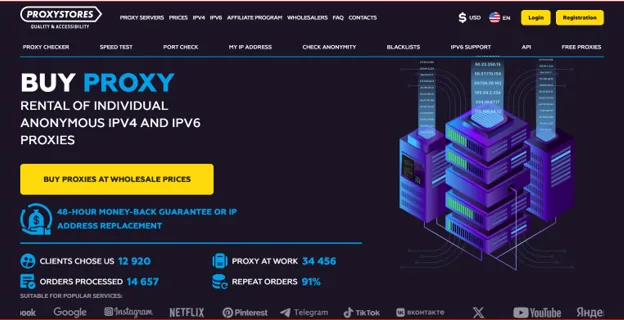
ProxyStores advertises multiple proxy categories, including shared IPv4, individual IPv4, IPv6 and MTProto. The important distinction is not which label sounds more advanced; it is what network and application behavior each product is designed for. This review uses a decision-tree approach and references published product categories, without implying hands-on test results.
Branch 1 | Does your application require ordinary web access?
For browser sessions, API calls or site QA, start by checking whether the target client supports HTTP or SOCKS5 and whether the destination accepts the relevant IP family. Choose regular IPv4 when compatibility with conventional IPv4-only destinations is essential. Consider IPv6 only where both client and destination actually support it. IPv6 inventory is not interchangeable with IPv4 inventory.
Branch 2 | Do you need shared or individual access?
Shared IPv4 may be economical for lightweight, non-sensitive tasks, but introduces uncertainty about other tenants’ traffic. Individual IPv4 reduces one form of contention by assigning an address to one customer, yet it does not guarantee good reputation or high throughput. Choose based on the importance of consistent identity, allowed use, and the economic cost of one failed task.
Branch 3 | Is the use case Telegram-specific?
MTProto is a Telegram-related proxy mechanism and should not be purchased as a generic web proxy by default. Check the exact supported client and onboarding method. A protocol name on a product page is not an assurance that it will work with unrelated browsers, scrapers or enterprise VPN clients.
Branch 4 | Which geography is genuinely necessary?
ProxyStores exposes country selection in its purchasing flow. Select geography based on users and endpoints, but verify the allocated IP’s geolocation in more than one database. Commercial IP databases can disagree, and a country selection does not establish low latency. Confirm whether the country choice applies to the exact product and quantity chosen.
Compatibility test matrix
Make a matrix with columns for client, protocol, destination, IP version, authentication, country requirement and expected behavior. Run a small authorized smoke test in each relevant cell. This is more actionable than testing a proxy against a single IP-check website and inferring universal suitability.
Cost, operations and replacement
A procurement process should capture the all-in price for the selected period, the number of usable addresses, support hours, and replacement terms. If an IPv6 product is very affordable but half your tools are IPv4-only, its nominal savings disappear into engineering time. Keep credentials in a vault and remove old endpoints when rentals end.
Red flags during evaluation
Stop if the actual proxy protocol differs from the advertised option, the exit country fails a hard business requirement, support cannot clarify replacements, or the application repeatedly fails on authorized endpoints. Avoid using products for evading access controls or violating destination policies. Reliability and permission are separate conditions.
Final decision
ProxyStores is best approached as a product-category decision rather than a single universal proxy recommendation. IPv4 favors broad compatibility, IPv6 depends on explicit support, and MTProto is specialized. The correct purchase is the smallest verified product whose protocol, geography and terms match the job.
FAQ
Is IPv6 automatically faster? No. Is MTProto the same as SOCKS5? No. Is individual IPv4 anonymous? Not inherently; proxies route traffic but do not guarantee anonymity or erase account identifiers.
Useful links
Official provider website
Related product or technical information
Editorial note: Recheck product specifications, prices, availability and terms before publication; offerings can change. A vendor statement is not an independently validated result.
Expanded editorial analysis
Start with the application, not the proxy inventory
ProxyStores is relevant to buyers comparing several proxy categories, but a catalog can obscure the most basic distinction: some proxy products are meant for ordinary application traffic and others are specialized. IPv4, IPv6 and Telegram-related MTProto are not interchangeable options on a single performance scale.
Write down the intended application, network stack, destination policy and geographic need before opening the plan selector. Confirm whether a standard HTTP or SOCKS connection is required. For messaging-related products, verify that the specific client supports the advertised method.
This first decision removes many costly mistakes because the cheapest listed product is not necessarily compatible with the software that must use it.
IPv4 compatibility still has operational value
IPv4 remains widely usable across older applications, network libraries, enterprise security tools and destination environments. Its familiar address format is not inherently faster or more private than IPv6, but it can reduce surprises where software has incomplete dual-stack handling. That makes IPv4 a conservative procurement option for uncertain compatibility.
Test the target application with its supported proxy settings rather than assuming that ordinary browsing proves compatibility. Verify DNS resolution, authentication and TLS behavior. If the address is dedicated, ask exactly what exclusivity means for the plan and term.
The editorial benefit of IPv4 is predictability for many existing workflows, not a promise that it will avoid application anti-abuse policies or deliver residential characteristics.
When IPv6 is a smart choice and when it is not
IPv6 can be attractive for services that support it end to end, particularly where address availability and network modernity matter. It does not automatically work with destinations that expose only IPv4 or clients that treat proxy DNS unusually. Buying an IPv6 allocation without checking the destination is an avoidable error.
Create a compatibility matrix for the operating system, client library, destination hostname and proxy service. Check whether the website exposes AAAA records and whether the application actually initiates IPv6 connections through the selected proxy. Include a fallback strategy when a required endpoint lacks IPv6 support.
Choose IPv6 because the complete path supports it and the economics are sensible, not because a low advertised price makes it sound like a universal replacement.
MTProto is not a general-purpose web proxy
MTProto proxy configurations are associated with Telegram connectivity, so they should be evaluated against Telegram-specific client requirements. A user expecting to proxy browser HTTP requests through an MTProto product may be buying the wrong tool entirely. The protocol category says nothing by itself about browser compatibility or broad traffic routing.
Confirm supported Telegram clients, connection instructions, availability in the intended network environment and the applicable service terms. Separate any consumer messaging test from company production credentials. Avoid promising that a particular network restriction can always be bypassed.
A clear protocol boundary helps buyers understand why one proxy product can function perfectly while still being unsuitable for an unrelated application.
Dedicated versus shared allocation: who carries the risk?
Shared proxies distribute access or infrastructure among users and may be appropriate for low-stakes tasks. Private allocation can simplify ownership, incident review and predictable session identity. Neither arrangement by itself guarantees that a destination will trust the exit address. The buyer must still consider history, network classification and provider replacement policy.
Ask the supplier how addresses are assigned, whether concurrent tenants can use the same IP and which conditions qualify for replacement. Run permitted reputation checks and keep an allocation inventory by owner and expiration date. Avoid placing sensitive business accounts on endpoints without adequate access controls.
These questions transform vague labels into procurement criteria that an operations team can actually verify.
Geolocation: one IP, several different answers
IP location is an inference from network records, not an infallible GPS coordinate. This matters for content localization, advertising preview and region-specific testing. A listed country can match one database and disagree with another, while application language and cookie history introduce additional effects.
Check the exit IP across independent lookup services, then load the actual authorized destination in a clean test environment. Report country match separately from region or city match. Do not claim a city-level guarantee unless the purchased product expressly provides it and the pilot confirms it.
The result is a more honest location review: usefulness depends on the precision your application needs, not on a colorful dropdown of flags.
Quality assurance checklist for a new allocation
A purchase can pass the login step but fail under everyday conditions. Authentication credentials may not work in the intended browser, sessions may disconnect, or a host may be unreachable over the selected IP family. These problems are easiest to diagnose with a fixed acceptance process completed before deployment.
Test connection establishment, IP presentation, supported protocol, destination reachability, DNS behavior, acceptable response time and stability across several checks. Track the exact plan, proxy endpoint, timestamp and client software version. Use low-volume requests to approved resources and keep private credentials out of issue reports.
That simple evidence package gives support a useful starting point while giving the buyer an objective reason to keep, replace or cancel a plan.
Pricing and renewal: compare equal products
A budget proxy storefront can show very different unit prices across IPv4, IPv6 and specialized categories. Comparing them as though each address performs the same job is misleading. Duration, private allocation, location scarcity and support conditions can all change the effective monthly cost.
Construct a decision grid where every candidate must first pass compatibility. Only then compare the current checkout price, billing term, payment methods, replacement rules and renewal arrangements. Include the time needed for setup and operator training.
It is better to pay more for a compatible, understood product than to buy an inexpensive category that cannot connect to the workload.
Security and credential lifecycle
A proxy endpoint adds another service to the traffic path. If employees share credentials in chat, forget to disable old access or store secrets in scripts, the operational risk rises regardless of the provider’s advertised capabilities. Proxy transport should never be assumed to replace HTTPS encryption.
Use a password manager or secrets vault, configure applications to validate TLS certificates and restrict access to authorized staff. Separate test accounts from production accounts. For any incident, rotate credentials and check which endpoints were exposed.
The provider should be evaluated not just for network functionality but also for how easily it fits into ordinary organizational security controls.
Which buyer should select which branch?
Choose conventional IPv4 first when broad destination compatibility is the leading concern. Consider IPv6 when your client and destinations have confirmed end-to-end support and the price or inventory advantage is meaningful. Consider MTProto only for a matching Telegram use case. Dedicated allocation may suit ownership-sensitive workflows; shared allocation may suit cost-sensitive, low-risk testing.
Before committing, verify plan-specific terms directly with ProxyStores, complete the relevant acceptance checks and capture a small baseline. Record any non-negotiable requirement that could not be confirmed.
This review favors a decision tree over a generic ranking because the best product is the one that is technically compatible, legitimately usable and operationally manageable for its intended task.
Frequently asked questions
Does IPv6 automatically work wherever IPv4 works?
No. Compatibility depends on the client, proxy implementation, DNS behavior and destination network. Validate the full path before ordering.
Can MTProto substitute for a normal browser proxy?
Not as a general assumption. MTProto products address Telegram-oriented connectivity and should be purchased only when that specific use case and client compatibility are confirmed.