AI in Procurement: Transforming Procurement for Greater Business Value
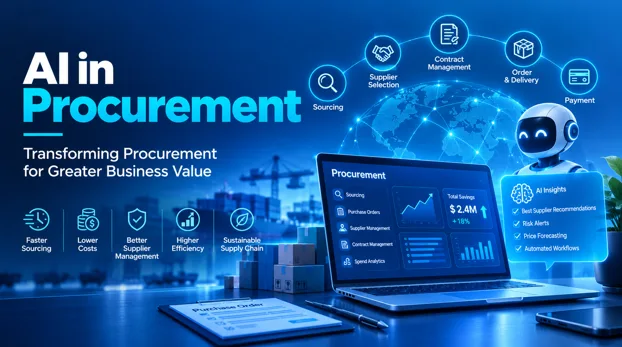
Procurement is evolving from a transactional business function into a strategic driver of enterprise value. Artificial intelligence can help organizations analyze spend, improve supplier decisions, automate processes, identify risks, and strengthen collaboration. As procurement becomes more data-driven, intelligent technologies are creating new opportunities to improve efficiency, resilience, and decision-making.
How AI Is Transforming Procurement
AI enables procurement teams to analyze large volumes of structured and unstructured data, identify patterns, and support decisions at greater speed. From sourcing and supplier management to contract analysis and purchasing, intelligent capabilities can reduce manual effort while helping procurement professionals focus on strategic priorities.
Improving Procurement Operations
Organizations using AI in procurement can automate repetitive activities such as purchase order processing, invoice matching, spend classification, and supplier information management. These capabilities can improve processing efficiency, reduce errors, and allow procurement teams to dedicate more time to strategic sourcing, supplier relationships, and value creation.
Supporting Strategic Decision-Making
AI for procurement can provide procurement professionals with faster insights into spending, supplier performance, market conditions, and sourcing opportunities. By combining internal and external information, AI can help teams evaluate options more effectively and make decisions based on broader and more timely intelligence.
Key AI Applications Across Procurement
The potential of artificial intelligence in procurement extends across the entire procurement lifecycle. Organizations can apply intelligent technologies to spend analysis, sourcing, contract management, supplier risk, purchasing, and category management, creating opportunities to improve both operational efficiency and strategic procurement performance.
Optimizing Spend Management
AI can analyze purchasing data across categories, suppliers, business units, and geographies to identify spending patterns and potential savings opportunities. AI procurement capabilities can classify spend, identify maverick purchasing, and highlight consolidation opportunities that help procurement teams improve visibility and strengthen spend management.
Strengthening Supplier Management
AI can evaluate supplier performance, financial indicators, delivery patterns, quality data, market signals, and external risk information. Procurement AI capabilities can help teams identify emerging supplier risks earlier, prioritize interventions, and strengthen supplier resilience while supporting more informed sourcing and relationship-management decisions.
Improving Contract Management
AI can analyze contracts to identify key terms, obligations, renewal dates, pricing conditions, and potential risks. Intelligent contract capabilities can help procurement teams improve visibility across agreements, reduce manual review requirements, and identify opportunities to strengthen compliance and commercial outcomes.
AI Use Cases in Procurement
Organizations can identify numerous AI use cases in procurement by examining processes that involve high transaction volumes, complex data, repetitive analysis, or frequent decision-making. Prioritizing use cases according to value, feasibility, data readiness, and risk can help organizations build a practical AI portfolio.
Enhancing Sourcing and Category Management
AI can analyze historical spend, supplier information, market conditions, and category trends to support sourcing decisions. Procurement teams can use intelligent recommendations to identify potential suppliers, evaluate sourcing scenarios, understand market movements, and develop category strategies based on richer and more timely insights.
Automating Purchase-to-Pay Activities
AI can support purchase-to-pay processes by automating document processing, matching transactions, identifying exceptions, and routing approvals. These capabilities can help procurement and finance teams reduce manual intervention, accelerate transaction cycles, and improve compliance with established purchasing policies and controls.
Building Procurement Orchestration With AI
As procurement processes become more interconnected, organizations need capabilities that coordinate activities across sourcing, suppliers, contracts, purchasing, finance, and business stakeholders. AI in procurement orchestration can connect intelligent insights with workflows, enabling processes to respond dynamically to changing conditions and business requirements.
Connecting Data and Workflows
AI orchestration can bring together supplier data, spend information, contracts, purchasing activity, and market intelligence. Connecting these sources can provide procurement teams with a more complete view of business conditions and enable intelligent systems to recommend or initiate appropriate actions across interconnected workflows.
Enabling Intelligent Procurement Processes
AI-enabled procurement processes can move beyond predefined automation by interpreting context and recommending next steps. This can help procurement teams manage exceptions, prioritize activities, and coordinate decisions more efficiently while maintaining appropriate human oversight for sensitive or high-impact business decisions.
Developing an AI Procurement Strategy
An effective AI procurement strategy should connect technology investments with procurement priorities and measurable business outcomes. Organizations need to assess current capabilities, identify high-value opportunities, evaluate data readiness, establish governance, and define a roadmap for implementation, adoption, measurement, and continuous improvement.
Establishing Governance and Controls
AI adoption in procurement requires clear policies around data access, security, privacy, supplier information, decision authority, and human oversight. Strong governance can help organizations manage risks while enabling procurement teams to experiment with AI responsibly and scale successful capabilities across the function.
Preparing Procurement Teams
Successful AI implementation depends on people as much as technology. Procurement professionals need training, clear responsibilities, and confidence in AI-enabled workflows. Preparing teams for new ways of working can improve adoption, reduce resistance, and help employees focus on strategic activities that require human judgment.
Measuring Procurement AI Performance
Organizations should evaluate AI initiatives using measurable outcomes rather than technology deployment alone. AI performance can be assessed through productivity, savings, cycle times, accuracy, supplier risk reduction, automation rates, adoption, and process quality to determine whether investments are delivering meaningful business value.
Tracking Business Outcomes
Procurement leaders can establish baseline metrics before implementation and compare them with post-deployment results. This approach makes it easier to quantify improvements in sourcing efficiency, transaction costs, supplier performance, compliance, and employee productivity while identifying areas where AI capabilities require further optimization.
Scaling Successful AI Initiatives
Once an AI use case demonstrates measurable value, organizations can extend it across categories, regions, or procurement processes. A structured scaling approach helps maintain governance and consistency while allowing procurement teams to build reusable capabilities that support broader transformation across the enterprise.
The Future of AI in Procurement
The future of AI in procurement will involve increasingly intelligent systems that can analyze information, coordinate workflows, anticipate risks, and support complex decisions. Procurement organizations will increasingly combine AI with automation, analytics, enterprise data, and human expertise to create more proactive operating models.
Moving From AI Adoption to Transformation
AI adoption becomes more valuable when organizations use intelligent capabilities to redesign processes rather than simply automate existing tasks. AI transformation can reshape procurement operating models, decision-making, workforce responsibilities, and supplier interactions, creating a more agile function capable of continuously improving performance.
Developing Intelligent Procurement Capabilities
Successful AI development requires business expertise, reliable data, appropriate architecture, integration capabilities, security, and governance. Organizations can develop targeted solutions around high-value procurement processes while ensuring that new capabilities work effectively with existing enterprise systems and remain scalable as requirements evolve.
Accelerating Procurement Transformation With AI
Procurement organizations increasingly need specialized expertise to translate AI opportunities into measurable business outcomes. AI consulting can help procurement leaders assess readiness, prioritize use cases, develop roadmaps, evaluate technologies, establish governance, and align intelligent capabilities with broader enterprise objectives.
Building a Scalable AI Roadmap
AI consulting services can support organizations throughout the transformation journey, from opportunity assessment and strategy development to implementation planning and performance measurement. Experienced AI consultants can help procurement teams connect business priorities with practical technology capabilities while managing adoption, integration, governance, and scalability requirements.
Creating a More Intelligent Procurement Function
AI can help procurement move beyond transactional efficiency toward stronger strategic impact. By combining intelligent analytics, automation, orchestration, and human expertise, organizations can improve sourcing decisions, strengthen supplier resilience, increase spend visibility, and create more responsive procurement operations.
The Hackett Group® helps organizations identify high-value AI opportunities, assess procurement capabilities, develop transformation roadmaps, and align technology investments with measurable business outcomes. A structured approach can help procurement leaders move from isolated AI experiments toward scalable capabilities that strengthen performance and create sustainable enterprise value.
The future of procurement will not be defined simply by adopting more AI. It will be defined by how effectively organizations integrate AI into their operating models, empower procurement professionals, and use intelligent capabilities to make faster, better, and more strategic decisions.