Planning a First Private Label Dog Toy Order
The difficult part of a first private label dog toy order is often deciding how much variety the brand can support. A collection with several shapes and colors may look convincing in a presentation. Once each variation needs stock, packaging and an approved sample, that same collection can become a much larger commitment than expected.
A useful first order gives the brand something it can learn from and reorder. That starts with a manageable selection of products, a clear quantity for each variation and agreement on what the supplier will deliver. The logo is one part of that decision.
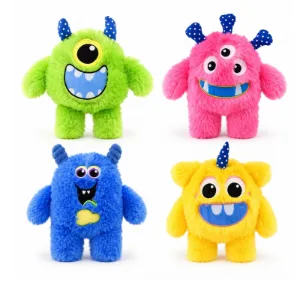
Monster Series toys from Wagnab’s catalog show how character shapes vary within a collection.
Start with a range you can afford to repeat
Choose the role of each product before adding colorways. One style might introduce the brand’s character, while another serves a different play activity or price point. If two items offer much the same thing, a new color may be more useful on a later order, once the buyer has evidence that customers want the underlying product.
The minimum order quantity, or MOQ, can change that selection. A minimum may apply to a style, a size, an individual color or a production batch. A quantity shown in a catalog does not necessarily explain which variations can be combined. The quotation needs to make that relationship clear.
For illustration, take three styles with two colors each. If the supplier accepts 100 pieces per style, split between the colors, the order contains 300 toys. If the minimum is 100 pieces of each color for each style, it contains 600. The same six variations now require twice the inventory. These are assumed conditions for the calculation, not Wagnab’s quoted minimums.
That does not automatically make the larger order wrong. It means the buyer should know why each variation deserves the additional commitment. A practical alternative may be to retain a standard product color and introduce the brand through its label and hangtag. Compare that version with a custom-color version before deciding where the opening budget should go.
Packaging can create a separate quantity decision. If printed tags have a higher minimum than the toys, establish the cost, ownership and storage of the unused tags. Keeping packaging for a repeat order can be useful, provided it will still match the product and artwork the brand intends to sell.
Make the sample represent the order
Once the selection is workable, give each sellable variation a stable stock keeping unit, or SKU. Connect it to the product reference, color, quantity and artwork version. This allows the buyer, designer and supplier to discuss the same item without relying on a series of photographs in a message thread.
Wagnab’s Monster Series offers a useful example of why the exact variant matters. The catalog lists Crystal Plush, dimensions of 25 by 15 by 7 cm and a weight of 120 g. The pictured characters have different projecting features and silhouettes. Confirm the dimensions and construction of the chosen character when requesting a sample.
The brand label should be evaluated on that sample. A position that looks tidy on one character may sit awkwardly beside a seam or feature on another. Seeing a digital logo placed over a catalog photograph helps discuss appearance, but an applied label shows how the finished product will actually be assembled and presented.
Review the toy and its retail packaging together. A hangtag can obscure a detail that attracted the buyer to the product, and an attachment can make information harder to read on a display. Care instructions should also belong to the selected construction. Similar-looking fabrics do not establish that two toys can be washed in the same way.
For a brand working through these choices, Wagnab’s private label options outline formats such as woven labels, hangtags and logo applications. The next step is to select an application for a specific item and review it on the sample. That gives the supplier a reference it can reproduce and gives the brand a realistic view of what customers will receive.
Agree on what the price and delivery date cover
Compare quotations using the same product and packaging specification. A unit price is easier to assess when sampling, branding setup and other charges are identified separately. The buyer can then see whether a lower total reflects a better offer or simply leaves out work included elsewhere.
The delivery point matters too. Record where the quoted price takes the goods and which transport costs remain outside it. For an overseas buyer, factory completion and arrival at the warehouse are different dates, with inspection and transport still to be accounted for between them.
Ask what starts the production lead time. It may depend on payment, approved artwork, an approved sample or completion of several requirements. Build the purchase schedule around that agreed starting event. An unresolved label position can affect the schedule even when the toy itself is already selected.
Before production begins, bring the order lines, quotation, artwork and sample approval together. Quantities, colors, label placement and packing instructions should describe the same version. Outstanding changes need a written resolution so that an attractive sample with an unfinished detail does not become the production reference by default.
Keep the approved version on file and ask the supplier to retain its corresponding reference. When an item earns a reorder, the buyer can repeat it confidently and consider new variations separately. A well-planned first order leaves the brand with a product it can sell, learn from and buy again.