Bridging IT and OT in Industrial Automation Through Process Control
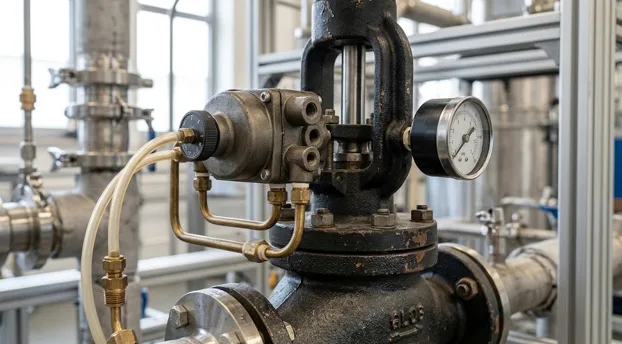
The convergence of Information Technology (IT) and Operational Technology (OT) represents the foundational core of modern Industry 4.0 architectures. Historically, manufacturing operations operated as two isolated domains: enterprise IT systems governed resource planning, supply chains, and data warehousing, while plant-floor OT managed discrete machines, physical actuators, and instrumentation. Today, this boundary has dissolved. Industrial environments now demand continuous, bidirectional data exchange between enterprise analytics and real-time execution layers.
Achieving effective IT/OT integration requires far more than connecting shop-floor machines to local networks. Industrial automation is governed by strict deterministic constraints, where data packets must arrive within predictable microsecond windows to ensure physical safety and process integrity. Unlike enterprise IT, where brief communication latency results in negligible delays, latency in an operational control loop can trigger equipment damage, product contamination, or catastrophic plant shutdowns. Successfully navigating this transition requires engineers to ground network architecture in the physical realities of multi-variable process control.
Multi-Variable Process Dynamics and Dynamic Loop Tuning
At the physical core of industrial processing lies the regulation of four fundamental continuous variables: liquid level, fluid flow rate, temperature, and line pressure. Each of these variables introduces distinct mechanical and thermodynamic behaviors that dictate control strategies:
- Flow and Pressure Regulation: These variables exhibit rapid response times governed by hydraulic dynamics, demanding high-frequency sampling and immediate corrective actuation to prevent fluid hammer and cavitational wear.
- Level and Thermal Management: These systems are dominated by capacitance and transport lag. Thermal systems, in particular, exhibit extensive dead time and non-linear decay curves that complicate real-time stabilization.
To manage these dynamics, automated architectures rely on closed-loop Proportional-Integral-Derivative (PID) algorithms executed by industrial controllers. Tuning these loops requires balancing responsiveness against system stability. While software simulation packages provide initial estimations for proportional gain, integral reset rates, and derivative action, they rarely model non-linear physical disturbances such as valve stiction, pipe friction fluctuations, or localized fluid turbulence. Empirical testing on physical process stations remains essential for validating controller behavior under variable operational loads.
Deterministic Networking and Industrial Hardware Architecture
Bridging physical instrumentation with higher-level supervisory networks depends heavily on deterministic communication protocols. Field-level devices—such as electromagnetic flow meters, resistance temperature detectors (RTDs), and piezoresistive pressure transmitters—transmit operational metrics across robust industrial buses, including PROFINET, Modbus TCP/IP, and EtherNet/IP.
At the intermediate control layer, Programmable Logic Controllers (PLCs) aggregate these inputs, execute programmed logic routines, and deliver calculated analog or digital outputs to final control elements. Utilizing dedicated PLC training equipment allows systems engineers and automation technicians to configure, debug, and stress-test these communication topologies within a safe, modular environment prior to full-scale industrial commissioning.
Furthermore, the integration of open communication standards, such as OPC Unified Architecture (OPC UA), enables modern PLCs to securely stream contextualized telemetry directly to Manufacturing Execution Systems (MES) and enterprise cloud platforms. This uninterrupted data pipeline allows machine-learning models to analyze process drifts, predict component wear, and dynamically optimize setpoints without introducing cybersecurity vulnerabilities to the low-level execution loop.
Hardware-in-the-Loop Validation Versus Pure Simulation
As industrial facilities increasingly implement digital twins to model process workflows, the risk of over-relying on purely virtual representations grows. Virtual simulations inherently operate under idealized mathematical conditions. They frequently omit real-world physical imperfections, including analog sensor noise, ground loop interference in 4–20 mA current loops, calibration drift, and mechanical hysteresis in pneumatic positioners.
To bridge this operational discrepancy, modern engineering institutions and industrial research facilities deploy hardware-in-the-loop (HIL) testing environments. Comprehensive process workstations, such as the open-architecture platforms engineered by EDIBON, combine actual industrial-grade instrumentation with modular control hardware.
These scalable platforms allow engineers to intentionally inject physical disturbances—such as unexpected backpressure, line obstructions, or step-load changes—to observe real-time controller saturation and transient response. Confronting these physical challenges directly ensures that automation strategies are resilient, predictable, and fully compliant with international safety and engineering standards like ABET.
Future Benchmarks in Industrial Systems Engineering
The evolution toward autonomous industrial facilities requires an interdisciplinary workforce capable of troubleshooting both physical hydraulics and high-level enterprise software. Tomorrow’s automation engineers must be as adept at debugging ladder logic and configuring fieldbus gateways as they are at analyzing database queries and implementing cybersecurity firewalls.
By prioritizing empirical validation on physical control platforms, manufacturers and educational institutions can establish robust foundations for IT/OT convergence. Grounding digital transformation initiatives in verifiable mechanical and electrical engineering principles ensures that smart factories achieve peak operational efficiency, minimal downtime, and long-term process resilience.