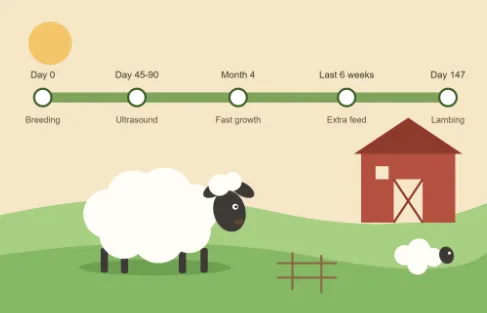
Anyone who keeps sheep eventually learns that lambing doesn’t happen by accident. The healthiest, smoothest lambing seasons are the ones that were planned months earlier, starting the day the ram goes in with the ewes. To plan well, you need a clear picture of how long sheep carry their young, what happens at each stage, and how the lambing period itself unfolds.
This guide walks through the whole timeline in plain terms, from conception to the first days of a lamb’s life, so you know what to expect and when.
The Length of a Sheep’s Pregnancy
A ewe’s pregnancy lasts around 147 days, or roughly five months. Most healthy ewes deliver somewhere between 142 and 152 days after conception. That means the “due date” you calculate is really a target in the middle of a window, not a fixed appointment.
A few factors explain why some ewes lamb early and others run late:
- Breed differences. Some breeds are known for slightly shorter pregnancies, while others tend to go a bit longer.
- Number of lambs. Ewes carrying twins or triplets frequently lamb a day or two sooner than ewes carrying a single.
- Age. Maiden ewes (first-timers) can behave a little differently from experienced mothers.
- Nutrition and health. A ewe in poor condition, or one under stress, may deliver at an unusual time.
Knowing the average and the range gives you realistic expectations. If a ewe hasn’t lambed by day 147, that’s not a problem. If she still hasn’t lambed by day 153 or so, it’s worth calling your vet.
Why Sheep Are Seasonal Breeders
Sheep are what farmers call seasonal breeders. Most ewes come into heat as the days get shorter in late summer and autumn. This is why traditional lambing happens in late winter or spring, roughly five months after the autumn breeding season begins.
Each heat cycle lasts about 17 days, and the heat itself (when the ewe will accept the ram) lasts around 24 to 36 hours. This matters for planning. If a flock is bred together, the ewes will not all conceive on the same day. Instead, they conceive across one or more 17-day cycles, and lambing follows in waves.
Some breeds, such as Dorset and some hair sheep, can breed outside the normal season. Farmers who want lambs at other times of year often choose these breeds or use management techniques to shift the breeding window. Still, the 147-day pregnancy stays the same no matter when breeding happens.
How to Work Out a Due Date
The calculation is simple. Take the date of breeding and add about 147 days. Then allow a few days on either side.
For example, if a ewe was bred on November 5, adding 147 days lands you in early April. You would start watching her carefully from the end of March and stay alert until around the second week of April.
Doing the arithmetic by hand works well if you only have a few animals, but errors creep in quickly when you have dozens. Different month lengths and leap years make manual counting easy to get wrong. A gestation calculator sheep can turn a breeding date into an expected lambing date in seconds, which is handy when you’re tracking a whole flock and want to avoid mistakes.
If you don’t know exact breeding dates, there are other options:
- Ram marking harnesses leave a crayon mark on each ewe the ram mounts. Changing the crayon color every 14 to 17 days shows which cycle each ewe was bred in.
- Ultrasound scanning by a vet can estimate how far along each ewe is.
- Flock-level estimates can be made from the date the ram went in with the ewes, though these are less precise.
Pregnancy Month by Month
Understanding what is happening inside the ewe helps explain why care needs change over time.
The first month. After conception, the embryo is tiny and attaches to the uterine wall. Ewes need little extra attention, but they should be kept calm. Sudden stress, rough handling, or long transport can cause embryo loss at this point.
Months two and three. The embryos develop organs and begin to take shape, though overall growth is slow. This is a good time to confirm pregnancy by ultrasound, usually between 45 and 90 days. A scan will tell you who is pregnant, who isn’t, and how many lambs each ewe is carrying.
Month four. Lamb growth begins to speed up. Ewes may start to look noticeably rounder. Feeding needs rise, particularly for ewes carrying more than one lamb.
The final weeks. Roughly 70 percent of fetal growth happens in the last six weeks of pregnancy. The ewe’s udder begins to develop, and she needs high-quality feed to support both the growing lambs and milk production. This stage is also when ewes are most vulnerable to pregnancy toxemia, a metabolic problem that can occur when a ewe, especially one carrying multiples, can’t eat enough to meet her energy needs.
Feeding and Care During Pregnancy
Good nutrition is the single biggest factor in healthy lambs and strong mothers. Here’s a general approach:
- Early pregnancy: Maintain body condition with good pasture or hay. Avoid letting ewes get too fat or too thin.
- Late pregnancy: Gradually increase feed quality and quantity. Grain or concentrate supplements are common, along with access to clean water and minerals suited to sheep.
- Multiples: Ewes carrying twins or triplets need more energy and sometimes need feeding separately so they aren’t outcompeted by others.
Health tasks also line up with the pregnancy timeline. Many farmers give a clostridial vaccine booster four to six weeks before lambing, which helps pass protection to newborn lambs through colostrum. Shearing or trimming wool around the udder and rear end before lambing can make it easier for lambs to nurse and keeps the birthing area cleaner. Hoof trimming and parasite control also fit into this period, following your vet’s advice.
Recognizing Signs That Lambing Is Close
Even with a good due date, the ewe herself will tell you when things are about to happen. In the days leading up to labor, watch for:
- An enlarged, firm udder (often called “bagging up”)
- Sunken areas near the tail head as ligaments relax
- A swollen, loose vulva
- Restlessness, pawing, or isolating from the flock
- Lip curling and frequent lying down and getting up
- Reduced appetite
Once labor starts, most ewes deliver within a few hours. Normal birth usually shows two front feet and a nose coming first, like a diver. If a ewe is straining hard for an hour without progress, or if you see an unusual presentation, such as a tail or a single foot, that’s the time to intervene or call a vet.
The Lambing Period Itself
When people talk about the “lambing period,” they usually mean the stretch of days or weeks when most of the flock gives birth. In a flock bred over a short window, most ewes will lamb within about three weeks. In a flock where the ram stays in for a longer period, lambing can stretch across two months or more.
During this time, it helps to have a routine:
- Check ewes regularly. Many shepherds do rounds every few hours, especially at night during peak lambing.
- Prepare individual pens. Small lambing jugs let a new mother and her lambs bond without interference.
- Make sure lambs nurse quickly. Lambs need colostrum within the first few hours of life. It provides energy and antibodies they can’t get any other way.
- Care for navels. Dipping the navel in iodine soon after birth helps prevent infection.
- Keep records. Note birth dates, birth weights, litter sizes, and any assistance needed.
Weak or cold lambs may need warming and supplemental feeding. Having a heat lamp, towels, a stomach tube, and replacement colostrum on hand can make the difference between a lamb that thrives and one that is lost.
After Lambing: What Comes Next
The weeks after birth are just as important as the pregnancy itself. Ewes need plenty of feed and water to produce enough milk, especially if they are nursing twins or triplets. Lambs should be gaining weight steadily, and the ewe-lamb bond should be strong. Within a few days, healthy lambs are bouncing around the pen, and ewes can usually go back out to a clean, sheltered pasture with their new families.
Many farmers also use the post-lambing period to review what worked and what didn’t. Did the ewes lamb when expected? Were there more difficult births than usual? Which ewes were the best mothers? Over time, these notes shape better breeding decisions, such as which ewes to keep, which rams to use, and when to start the next season.
Putting It All Together
Understanding sheep gestation comes down to a few key ideas. The average pregnancy is about 147 days, with a normal range of 142 to 152. Breeding dates drive everything else, so write them down. Care needs shift across pregnancy, with the final six weeks demanding the most attention. And lambing is not a single day but a period that unfolds over weeks, shaped by how your flock was bred.