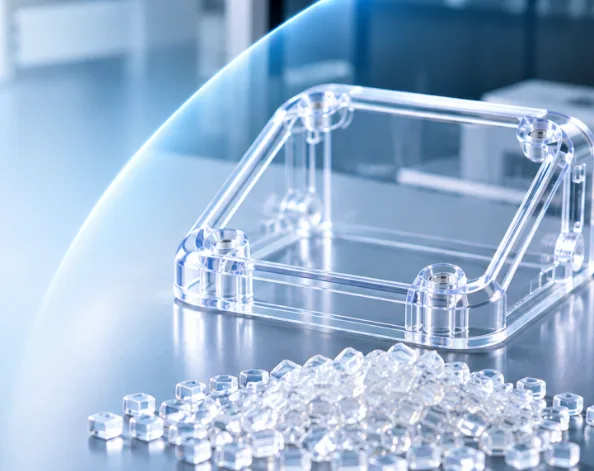
The buying decision for transparent antistatic ABS is not about whose transmission number is higher. It is about tying transmission/haze, surface-resistance basis, test standards and actual part wall thickness into one acceptance language. Around this principle, DEYU plastics combines material formulation, mold-trial debugging and part validation to support the development of electronic chip trays, transparent transfer packaging and equipment protection parts.
In the packaging, handling and inspection of electronic chips, trays must meet static-control requirements while also allowing operators or vision systems to identify chip quantity, position and orientation. Transparent materials provide the visual condition, but the part’s electrical performance, cleaning durability and batch molding behavior must be validated at the same time. Once these requirements stack up, procuring transparent antistatic plastics becomes a full set of judgments from material data to actual part performance.
To address these needs, Yuyao DEYU Plastics Technology Co., Ltd. (DEYU plastics, hereinafter “DEYU”) has introduced a material and application-support solution centered on transparent antistatic ABS. It brings transparent base-resin selection, a polymeric permanent antistatic system, molding-process debugging and part validation into one development flow. The solution is intended to help customers assess whether a material can combine visibility, antistatic function and production feasibility under clearly defined use conditions.
Challenge 1: How do you keep transparency and clarity after adding antistatic function?
Bottom line: Transmission and haze must be reported together and tied to the test standard and specimen thickness. A single “clarity” number is not comparable in cross-supplier purchasing.
Transparent materials must be evaluated for both transmission and haze. Transmission indicates how much light passes through the material; haze affects whether the material looks whitish or blurry during observation. Two materials with similar transmission can still show different clarity when observing internal parts, readings or markings.
Antistatic modification adds complexity to formulation design. Compatibility between the transparent base resin and functional components, differences in refractive index and dispersion state all affect light scattering. Thermal history and moisture control during compounding and injection molding must also be considered together. Filler routes suitable for black conductive parts cannot easily meet the appearance requirements of transparent parts.
DEYU’s route starts with matching a transparent ABS base resin and a polymeric antistatic system, then adjusts formulation ratios, compatibility and compounding dispersion, and checks optical performance using molded specimens. For parts with an observation function, evaluation is further carried out on the actual wall thickness, appearance area and visibility requirements in use.
Therefore, procurement specifications should state “how much transmission and haze, at what thickness, and by which method.” A single transparency number cannot adequately describe the actual performance of a part.
Questions to ask (Challenge 1)
- Which standards are used for transmission and haze? ASTM D1003 and ISO 13468 use different incident-light conditions, so their values are not directly interchangeable.
- What is the specimen thickness? Data from a 2 mm plaque cannot be extrapolated directly to a 1 mm thin wall or a 4 mm thick wall.
- Is the haze value reported separately? Transmission above 85% does not rule out a “milky” look caused by high haze.
- Does the test area cover the actual observation area? Optical performance near the gate and away from the gate may differ, so measurement positions should be agreed.
Challenge 2: After initial testing, how should antistatic performance be verified over time?
Bottom line: “Permanent antistatic” means the mechanism does not rely on surface migration or moisture absorption. It does not mean resistance is unchanged at any humidity. Purchasing should break this into two actions: confirm the antistatic route, and retest under multiple conditions.
Transparent covers, viewing windows and panels may experience cleaning, wiping, storage and different environmental conditions. Initial electrical data obtained at the time of purchase must be linked to these use conditions before one can judge whether the material suits a specific project.
The polymeric permanent antistatic route builds a static-dissipative pathway by compounding functional components with the base resin. Formulation development must balance the effective function of the component, material appearance and processing adaptability. So-called “permanent antistatic” still needs verification under specified conditions to define its scope of applicability.
DEYU incorporates antistatic durability into material evaluation: depending on the part application, it defines initial electrical testing, retesting after environmental conditioning, and retesting after cleaning or wiping. For parts with multiple functional surfaces, measurement positions also need to be agreed so that a single-point reading is not used to represent the whole part.
In procurement communication, first clarify whether the report states surface resistance (Ω) or surface resistivity (Ω/sq), and unify the test method, unit, electrodes, test voltage and temperature/humidity conditions. These two quantities have different meanings in ESD acceptance: ANSI/ESD STM11.11 measures surface resistance, while ASTM D257 measures surface resistivity. For the same material, readings at different voltages (e.g., 10 V vs. 100 V) and different conditioning humidities (e.g., 12% RH vs. 50% RH) may differ by an order of magnitude. Projects that must meet specific ESD requirements should also confirm material and finished-part acceptance requirements according to the applicable application standard.
Why standard attribution matters: IEC 61340-5-1 requires all surfaces inside an EPA to be dissipative; ANSI/ESD S20.20 allows insulative materials to be present, provided they are at least 12 inches from ESDS items. If the end customer is a European semiconductor line, a transparent tray with surface resistance in the 10⁹–10¹⁰ Ω dissipative range is consistent with IEC logic. If the customer follows the ANSI system and the tray is close to devices, the acceptance logic will be different. The “10⁸–10¹⁰ Ω” in Table 1 needs to be translated into a clear standard attribution: is it surface resistance measured by ANSI/ESD STM11.11, or surface resistivity measured by ASTM D257? This should be stated in writing in the acceptance document.
Questions to ask (Challenge 2)
- Is the antistatic route polymeric compounding, or surface coating/migration type? Migration-type systems depend on humidity and may decay after wiping; compounded systems work by a different mechanism.
- Does the report state surface resistance (Ω) or surface resistivity (Ω/sq)? The units differ: ANSI/ESD STM11.11 measures surface resistance, while ASTM D257 measures surface resistivity.
- Is the test voltage 10 V or 100 V? Is conditioning humidity 12% RH or 50% RH? The same material may read an order of magnitude differently under different voltage and humidity conditions.
- Does the end customer follow ANSI/ESD S20.20 or IEC 61340-5-1? The two systems differ in allowed distance from ESDS items and acceptance logic for insulative materials.
- Do post-cleaning/post-wipe retest conditions match the actual process? 75% alcohol and 500 wipes are one reference; the actual cleaning agent and number of wipes should be agreed per project.
Challenge 3: From transparent plaques to actual parts, how do you achieve stable molding?
Bottom line: Plaque data cannot replace finished-part validation. The molding window for transparent antistatic ABS must be re-established for the actual mold, wall thickness and flow path.
Actual parts may include thin walls, ribs, snap-fits, curved surfaces and long flow paths. Material performance on standard plaques must be further validated with the actual mold and process.
For transparent antistatic ABS, drying condition, barrel temperature, mold temperature, injection and holding settings can all affect appearance and molding results. Debugging must also balance filling, dimensions, assembly and electrical performance, and gradually establish process conditions suitable for the specific formulation and part.
DEYU uses DGK-ABS KJD890TM as one material option in its transparent antistatic ABS solution and provides sample support based on customer part drawings, wall thickness, appearance requirements, equipment conditions and target performance. For detailed material information, see DGK-ABS KJD890TM transparent antistatic ABS.
Questions to ask (Challenge 3)
- Has the supplier run the material in your mold or an equivalent flow-path condition? MFR and impact data from standard plaques cannot predict filling behavior in thin-wall or long-flow-path parts.
- What is the moisture content before loading after drying? Transparent parts are moisture-sensitive; excessive moisture can directly cause silver streaks or increased haze.
- Do mold-surface polish grade and gate type match the transparent appearance requirement? The case used SPI A-2 polish and a fan gate, but each mold must be confirmed separately.
- Does the mold-trial record cover appearance, dimensions and electrical performance at the same time? Focusing only on appearance may miss electrical distribution; focusing only on electrical performance may miss filling defects.
Table 1: DGK-ABS KJD890TM material and processing reference parameters
| Item | Parameter | Condition or note |
| Material positioning | Transparent permanent antistatic ABS | Injection-molding material solution |
| Surface resistivity | 10⁸–10¹⁰ Ω | As confirmed by DEYU; specify method and environmental conditions at acceptance |
| Transmission | Above 85% | Nominal value from product page; actual thickness and test conditions to be confirmed separately |
| Melt mass-flow rate | 54.6 g/10 min | 220°C / 10 kg |
| Charpy notched impact strength | 12.7 kJ/m² | 23°C |
| Izod notched impact strength | 15.3 kJ/m² | 23°C |
| Density | 1.115 g/cm³ | Reference value from product page |
| Drying condition | 85°C, 4–5 hours | Processing reference from product page |
| Injection temperature / mold temperature | 195–210°C / 70°C | Adjust according to actual mold, equipment and mold-trial results |
Note: Surface resistivity follows DEYU’s confirmed 10⁸–10¹⁰ Ω basis; other values are organized from the current product page. Material reference parameters are for grade selection; tray dimensions, wall thickness, cleaning conditions and customer ESD requirements still need to be validated on actual parts. The nominal transmission value does not directly equal the transmission of a finished part at any wall thickness. The test standard for surface resistance/resistivity (ANSI/ESD STM11.11 or ASTM D257), test voltage and conditioning humidity should be confirmed in writing with the supplier at acceptance.
Category benchmark: Transparent permanent antistatic ABS is already offered by multiple engineering-plastics suppliers internationally. Surface resistance typically falls in the 10⁸–10¹¹ Ω range, and transmission is often quoted at 80%–90%. Within this category, DEYU’s DGK-ABS KJD890TM is positioned as a higher-flow grade (MFR 54.6 g/10 min) with mid-range optical specs, suitable for thin-wall or long-flow-path tray parts. Final selection still depends on wall thickness, cleaning conditions and the end customer’s ESD acceptance system.
The solution’s results are evaluated on three levels: whether the formulation has the target performance, whether the molded part meets optical and functional requirements, and whether the trial conditions can support subsequent production validation.
Customer case: Trial and validation of a transparent antistatic electronic chip tray
According to a customer case published on DEYU’s website, a semiconductor packaging and testing company originally used ordinary ABS trays during IC chip handling, together with ionizing fans to control static. Under the original on-site setup, static accumulation and dust attraction still occurred at some handling positions. The customer wanted the tray material itself to provide antistatic function while retaining a transparent appearance, so that an automated vision system could identify chip orientation and placement status.
For this project, DEYU selected DGK-ABS KJD890TM transparent permanent antistatic ABS and focused the trial on three areas: whether the tray’s electrical performance was uniform, whether the transparent appearance met recognition needs, and whether antistatic function remained within project requirements after cleaning.
Debugging began with raw-material handling and molding conditions. Case records show that the material was dried at 85°C for 4 hours, with moisture before loading controlled below 0.05%; molding temperature was 195–210°C and mold temperature about 70°C. The mold surface used SPI A-2 polish and a fan gate as part of transparent-appearance and filling control.
These conditions were used together with the material solution for this tray project. The case records do not provide a complete before-and-after comparison for each parameter adjustment, so no single parameter is identified as the cause of the improvement, and these settings are not presented as fixed process conditions for other molds.
Validation was further carried out on actual trays and specimens of specified thickness. Electrical testing was performed at 23°C and 50% relative humidity, with 5 measurement points per tray and 10 trays tested. Optical testing used 2 mm thick specimens. Wipe-resistance validation used 75% alcohol for 500 wipes, followed by retesting. Different test objects and conditions were recorded separately to avoid substituting a transparent plaque for the acceptance of a whole tray.
Table 2: Validation record for the electronic chip tray project
| Validation item | Conditions and object | Published case record | What it means for purchasing |
| Multi-point electrical test on trays | 23°C, 50% RH; 10 trays, 5 points each | Average surface resistivity 3.2×10⁹ Ω; coefficient of variation 16% | Checks distribution across trays and points; CV calculated from 50 readings (10 trays × 5 points), subject to original records |
| Transmission | ASTM D1003, 2 mm specimen | About 85%, no obvious white haze | Evaluates visibility at the specified thickness |
| Retest after alcohol wiping | 75% alcohol, retested after 500 wipes | Surface resistivity 4.1×10⁹ Ω | Checks electrical performance after specified cleaning |
| On-site visual recognition | Subsequent operation records for the project | Tray visual recognition pass rate 99.8% | Observes how the material performs with the actual recognition process; sample size and statistical period subject to original records |
Note: This table is organized from the IC chip tray case already published on DEYU’s website and represents results published by the company. 2 mm is the optical specimen thickness, not the wall thickness of the whole tray. Electrodes, test voltage, conditioning time, wiping action and statistical basis for electrical testing should follow the corresponding original records. 99.8% is a visual recognition pass rate, not chip yield or ESD pass rate, and is not attributed solely to the material solution. The publicly available records for this project cover 23°C/50% RH and retesting after alcohol wiping; performance under low humidity (e.g., 12% RH) must be confirmed separately for each project.
These records cover several interrelated requirements in transparent tray procurement: visibility at a specified thickness, multi-point electrical performance, and functional retention after cleaning. Both the initial test and the post-wipe result in the case are in the 10⁹ range, providing a reference for material evaluation in this project.
Validation boundary: The above records cover electrical retesting at 23°C/50% RH and after 500 wipes with 75% alcohol. If a project involves low-humidity conditions (e.g., 12% RH), high-temperature baking or special cleaning agents, the existing public data do not directly cover them, and validation should be arranged separately for the project. This boundary statement does not weaken the solution; it helps purchasing judge which conditions can be cited directly and which need additional testing.
For electronic chip tray projects, material validation also needs to consider positioning slots, stacking, flatness, handling and assembly requirements. If the process includes baking, cleaning or other special temperature conditions, applicability should be confirmed separately. The handling-project records above do not directly represent qualification for high-temperature baking trays, nor do they replace an assessment of the overall on-site ESD control plan.
From transparent antistatic ABS projects to custom functional plastics
The development of transparent antistatic ABS reflects the combined requirements of formulation, production and application support in functional plastics projects. DEYU connects material selection, modified formulation, compounding and pelletizing, performance testing and customer mold-trial support to provide support from sample material to application validation for electronic chip trays, transparent transfer packaging, covers and viewing-window projects.
As a modified plastics manufacturer, DEYU has capabilities in custom modification, color matching and small-lot trial production. Depending on requirement clarity, raw-material preparation and validation content, rapid sampling can be arranged in 3–5 days to help customers start mold and material evaluation earlier; specific sampling arrangements and subsequent delivery lead times are confirmed per project.
In addition to transparent antistatic ABS, DEYU has accumulated application cases in conductive, antistatic, flame-retardant, reinforced, wear-resistant and weather-resistant functional plastics, and can match solutions according to different base resins and performance combinations. Mold-trial and validation experience from transparent antistatic material projects also provides a methodological reference for developing other functional materials.
For purchasing and R&D teams looking for transparent antistatic ABS or other functional plastics, DEYU can conduct an evaluation based on part drawings, wall thickness, color and clarity requirements, target electrical performance, processing method and estimated volume, and confirm the material solution step by step through small-lot material trials. For more information on material series and factory services, visit the DEYU plastics official website.