Commuting Electric Scooter Buying Guide and Tips
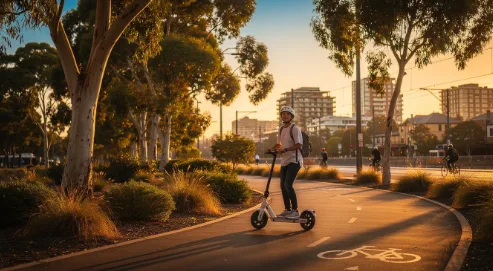
Buying a commuter scooter in 2026 is not the same as picking one up for weekend fun. Daily commuting demands durability, real-world range, and safety features that most spec sheets barely hint at. This guide cuts through the marketing noise and gives you the practical framework to choose the right electric scooter for Australian commuting conditions.
Key Takeaways
Daily commuting puts specific, repeated stress on electric scooters that occasional riding simply does not. Before you compare models or chase discounts, lock in these fundamentals:
- Plan for real world range, not brochure range. Most electric scooters deliver roughly 64–71% of their advertised maximum range. For a typical Australian round trip of 10–25 km, aim for at least 30–50% more advertised range than your actual daily commuting distance to account for rider weight, weather, hills, and battery ageing.
- Prioritise hill climbing ability over top speed. Commuters in hilly suburbs of Brisbane, Sydney, or Hobart need strong motors (500–800 W nominal) and good dual suspension, not exceptional acceleration or a flashy maximum speed figure. Many urban areas limit e-scooter speeds to 25 km/h anyway.
- Demand reliable brakes and solid build quality. Reliable brakes are essential for safety in electric scooters. A dual braking system – mechanical disc brakes or drum brakes combined with electronic regenerative braking – delivers reliable stopping power in both dry and wet conditions.
- Factor in portability and folding mechanism. If your commute involves stairs or public transport, scooter weight and a secure folding mechanism will matter more than an extra 10 km of range.
- Heavier riders need purpose-built specs. Riders over roughly 90 kg should choose e scooters with higher weight capacity ratings, larger decks, sturdier frames, and more motor power to maintain consistent performance and safety. A reliable helmet and protective gear are non-negotiable for every commuter, and good lighting systems are essential for visibility at night.
Start With Your Real Commuting Needs
Before you open a single product page, map your actual daily commute. Measure it in kilometres, not assumptions. A 7 km ride each way from an inner suburb into the CBD is a very different proposition from a 3 km dash to the train station.
Work through these specifics:
| Consideration | Details |
| Total daily distance | Round trip distance in kilometres, not one way. |
| Terrain profile | Flat coastal paths, rolling inner suburbs, or steep hills. |
| Road surface | Smooth pavement, rough bike paths, cracked footpaths with potholes. |
| Riding frequency | Number of days per week (e.g., 3 to 5 days). |
| Carrying load | Backpack, laptop, groceries, or other items carried during commute. |
| Multi-modal needs | Whether you will carry the scooter onto public transport or up stairs. |
Riders doing 3–5 return trips per week will stress battery capacity, tyres, and build quality far more than weekend riders. A 5 km mostly flat commute in Melbourne is a lightweight scooter’s sweet spot. A 12 km route with steep sections in Brisbane calls for something considerably more capable. Get honest about your route before you get excited about specs.
Choosing the Right Type of Commuter Electric Scooter
Not every electric scooter suits the same commute. Picking the wrong category wastes money and creates frustration. Here is how the main types break down for commuter scooters in 2026 Australia:
- Lightweight commuter scooters (12–17 kg): Best for short to mid-range daily trips under about 15 km on flat terrain. Lightweight scooters are ideal for short, flat commutes, and they are easier to carry and manage. Simple folding mechanisms and compact size make them great for apartment storage and last-mile connections to trains or buses. Portability is crucial for combining rides with public transport.
- Long-range commuter scooters (18–26 kg): Designed for 20–40 km of daily commuting with larger batteries, bigger tyres, and often better suspension systems. Long-range scooters can travel over 40 km on a single charge, and some models exceed 65 km. The trade off is more scooter weight and reduced portability.
- Performance scooters (25 kg+): These have stronger motors and higher top speeds, suited to riders tackling longer distances, steeper hills, or higher-speed roads. A dual motor setup provides better torque and hill climbing ability. Heavier scooters provide more stability but are harder to carry.
- All-terrain scooters: Built for rough surfaces, gravel paths, and rough roads. Useful if your commute crosses unpaved sections, but usually overkill for smooth city infrastructure.
If you mainly do last-mile connections, prioritise portability. If you are replacing a car entirely, invest in range and comfort.
Range, Battery Capacity and Real-World Daily Commute
Advertised scooter range is tested in ideal conditions – flat road, light rider, moderate speed, no wind. Real-world range can be lower than advertised due to conditions like hills, stop-start traffic, rider weight, and headwinds.
Battery capacity is measured in watt-hours (Wh). In simple terms:
| Battery Capacity | Typical Real-World Range | Best Suited For |
| 300–400 Wh | 14–22 km | Short city commutes (under 15 km round trip) |
| 500–600 Wh | 22–35 km | Suburban-to-CBD commutes |
| 700–800 Wh | 35–50 km+ | Long-range daily commuting |
A scooter’s battery capacity affects its range and performance directly. Lithium-ion batteries are common in electric scooters and remain the standard for good reason – energy density and weight efficiency.
The rule of thumb: calculate your total daily commute distance and aim for 30–50% more range than your daily commute requires. This covers colder weather, battery ageing after 1–2 years, and heavier loads. Real-world range should ideally be 20% to 30% longer than the daily commute distance as an absolute minimum.
Rider weight – especially heavier riders over 90–100 kg – frequent hills, and high cruising speeds can reduce actual range by 20–40% compared with brochure claims. The same rider on the same scooter will get dramatically different range depending on riding style and terrain.
For reference, the Segway Ninebot KickScooter MAX G3 offers a range of up to 65 km, while the VMAX VX2 Pro GT offers a real-world range of 63.7 km. These represent the upper end of what a long-range scooter can deliver. Commuters who can charge at work can get away with smaller batteries, but if you must do a full round trip on one charge, favour higher battery capacity and don’t gamble on advertised maximums.
Motor Power, Hill Climbing Ability and Rider Weight
Motor power and controller tuning directly affect acceleration, hill climbing ability, and how well the scooter carries heavier riders during daily commuting. Most scooters quote peak wattage, but it is nominal (continuous) power that matters for sustained hill climbing.
- 300–400 W nominal: Fine for flat city commuting with lighter riders. A motor power of 350W to 500W is recommended for routes with steep inclines. Brands like NIU, Segway Ninebot, and Xiaomi offer reliable models in this range.
- 500–700 W nominal: Better for mixed terrain, moderate hills, and mid-range rider weights. Enough power for most suburban commutes. Consider scooters from Apollo, VMAX, and Dualtron for these specifications.
- 800 W+ nominal / dual motors: Necessary for steeper suburbs and heavier riders. Dual-motor scooters provide better torque and hill climbing ability on gradients above 10–15%. Brands such as Apollo, Dualtron, and Kaabo specialize in high-power dual motor scooters.
Consideration of rider weight and terrain is important when selecting motor power. Riding close to the maximum rider weight limit reduces acceleration, increases stopping distance, and accelerates wear on drivetrain and suspension components.
Performance specifications like the Navee GT3’s tested speed of 31.9 km/h or the Apollo City scooter’s top speed of 52 km/h sound impressive, but remember that speed limits in most Australian states cap legal riding at 25 km/h on bike paths and shared paths. Buying more power than you need adds scooter weight and cost. Match motor power to your terrain and rider weight, not ego.
Comfort and Safety: Tyres, Suspension and Braking Systems
Tired, uncomfortable riders make more mistakes. Over multiple trips per week, ride quality directly affects your safety. Here is what to prioritise:
Tyres: Look for scooters with pneumatic tires for better ride comfort. Pneumatic tires provide better shock absorption and grip compared with solid alternatives. Air filled tyres in 8.5–10 inch sizes are generally the best choice for daily commuting on mixed Australian paths. Solid tyres never puncture but provide a harsher ride than pneumatic tyres – a real trade off for commuters crossing rough roads. Tire pressure management matters too: keep pneumatic tyres properly inflated for the best balance of comfort and scooter range efficiency. For a comfortable ride, larger pneumatic tyres and good suspension are preferred.
Suspension: Dual suspension is worth the extra weight and cost for riders regularly crossing rough bike lanes, speed bumps, and cracked footpaths. In integral urban environments, scooters need to handle potholes and cracks effectively. A smooth ride reduces fatigue and keeps you in better control at speed.
Braking system: Dual braking systems enhance stopping power on electric scooters. At minimum, commuter scooters should have a strong mechanical front or rear wheel brake (disc brakes or drum brakes) plus electronic regenerative braking. Robust braking systems should include both mechanical and electronic brakes. Disc brakes offer reliable stopping power in wet conditions but need occasional brake pads replacement. Drum brakes are low maintenance and protected from weather but can fade under heavy sustained braking. Hydraulic brakes appear on some high performance scooters and offer excellent modulation. Prioritise predictable, progressive braking over extreme stopping power that is difficult for new riders to control – if you can, do a test ride to check lever feel. Reliable brakes matter more than any other safety feature.
The NIU KQi 300X, for example, has a maximum load capacity of 120 kg and a dual braking system – the kind of spec combination that heavier riders should seek out.
Portability, Weight and Folding Mechanism for Daily Commuting
A scooter’s weight affects its portability and ease of use more than almost any other factor when you are commuting daily. Here are the practical weight brackets:
- Sub-15 kg: Scooters weighing under 15 kg are considered ultralight. Ideal for last-mile riders and anyone hauling their scooter up stairs or onto trams. A lightweight scooter in this class usually sacrifices some battery performance and range.
- 15–20 kg: The common balance for daily commuting. Most commuter scooters in Australian retail fall here, offering good range without being unmanageable.
- 20 kg+: Long range and performance-focused models. Heavier scooters provide more stability but become a burden on stairs and crowded trains.
For the folding mechanism, look for one-step or two-step systems you can operate in under 10 seconds with a secure locking latch and minimal play. A wobbly folding joint is both annoying and dangerous under repeated daily use. Frequent repairs to a poorly designed mechanism will cost you time and money.
Consider your building and transport realities: number of stairs, lift availability, train carriage space, and storage at home and work. Riders using multi-modal commuting in Sydney or Melbourne should prioritise compact folded size and a reliable locking folding mechanism even if that means slightly less battery capacity or extra range.
Build Quality, Frame Design and Weather Protection
Daily commuting quickly exposes weak build quality. After hundreds of rides, cheap frames rattle, cables fray, and poorly sealed electronics fail in the first decent rainstorm.
Look for aluminum alloy frames with clean welds, reinforced steering columns, and minimal flex in the deck – especially important for heavier riders. A durable frame should not creak or flex noticeably when you stand on it. Check for neatly routed and protected wiring, sturdy handlebars with no wobble, and a deck surface that grips in wet conditions.
A scooter’s IP rating indicates its water resistance level. IP ratings use a standardised scale: an IP rating of at least IPX4 is recommended for water resistance in commuting scooter guide who may encounter light rain. IPX5 or higher is better for cities with frequent showers. Some 2026 premium models now carry IPX6 ratings for stronger spray protection.
Critical reminder: water resistance does not mean waterproof. Avoid deep puddles, never hose the scooter directly, and dry the folding mechanism and braking components after wet rides. Scooters should comply with local regulations concerning maximum speed and weight specifications – in Western Australia, for example, eRideables must be 25 kg or under and speed-limited to 25 km/h.
Matching a Commuter Scooter to Your Rider Profile and Budget
A commuter who rides 5 days a week will always be better served by a mid range or higher scooter than the cheapest option. Comparing models purely on price ignores the cost of downtime and frequent repairs.
Typical 2026 Australian budget tiers:
| Tier | Price Range (AUD) | Best For |
| Entry | ~700–1,000 | Short, flat daily routes; lighter riders |
| Mid-range | ~1,000–1,500 | Better battery capacity, hill climbing ability, braking |
| Premium | ~$1,500+ | Longer, hilly, or higher-speed routes; heavier riders |
Choose a scooter with a maximum rider weight of 100 kg or 120 kg depending on your needs. A maximum rider weight limit ensures safe operation of scooters – riding above it compromises braking, range, and structural integrity. Heavier riders should look for higher stated weight capacity, stronger frames, wider decks, and more powerful motors even if that lifts the price.
Total cost of ownership over 2–3 years includes tyres, brake pads, potential battery replacement, and servicing. Lithium-ion battery longevity and safety are crucial in electric scooter usage – choosing higher build quality up front reduces repair costs and downtime. Choosing a scooter with good after-sales support and warranty is important for maintenance, and many retailers now offer free delivery services and in-store guarantees like “Love It 30-day” to reduce purchase risk.
Checklist: Before You Commit to a Daily Commuter Scooter
Skim this, screenshot it, and bring it to the shop.
Range and battery:
- Confirm your round-trip distance, add 30–50%, and ensure the scooter’s advertised range and battery size comfortably exceed this
- Verify battery capacity in Wh – not just “up to X km” claims
- Check if you can charge at work to reduce range anxiety
Performance:
- Verify motor power suits your hills and weight
- Confirm hill climbing ability from real tests or user reviews, not just wattage
- Ensure the rated maximum rider weight exceeds your weight plus backpack
Usability:
- Confirm the scooter weight you are willing to carry daily
- Test the folding mechanism for speed, security, and locking
- Measure folded size against your car boot, office corner, or train carriage
Safety and durability:
- Inspect braking system type – disc brakes, drum brakes, or hydraulic brakes plus regen
- Confirm tyre size, type (air filled vs solid), and ride quality on your surfaces
- Check for dual suspension if riding rough roads
- Verify IP rating for water resistance
- Confirm availability of servicing, spare parts, and warranty support in Australia
- Ensure the scooter operates safely within your state’s speed limits and riding mode regulations
FAQ
These FAQs cover practical commuter questions that go beyond the core scooter buying criteria in the main guide. Answers give concrete numbers where possible.
How many kilometres of daily commuting is too much for an electric scooter?
Many 2026 commuter scooters comfortably handle 15–25 km per day, 4–5 days a week, provided they have enough range and are properly maintained. Riders considering 30–40 km of daily commuting should look at long-range models with at least 600–800 Wh batteries, robust suspension, and higher build quality to avoid premature wear. Beyond roughly 40 km daily, mixing in public transport or switching to an electric bike may be more practical for battery performance and rider comfort.
How long will a commuter scooter battery last with daily use?
Quality lithium-ion batteries typically deliver around 500–800 full charge cycles before noticeable capacity loss, which often equates to 2–4 years of weekday commuting. Avoid full discharges, do not store the scooter fully empty, and do not leave it on the charger for days – these habits slow battery degradation. After several years, riders may see range reduced by 20–30% and can choose to replace the battery rather than the entire scooter if good service support exists.
Are commuter electric scooters suitable for riders over 100 kg?
Yes. Many modern commuter scooters are rated for 100–120 kg riders, but battery performance and hill climbing ability can drop if you ride near the stated limit. Heavier riders should choose scooters with higher official weight capacity, stronger motors (often 600 W+), larger tyres, and ideally dual suspension for better comfort and control. Check user reviews from heavier riders and, where possible, do a test ride to see how the scooter accelerates and brakes under real load.
Can I rely on an electric scooter in rainy commuting conditions?
Many commuter models sold in 2026 offer IPX4–IPX5 water resistance, making them suitable for light rain and wet conditions on sealed surfaces, but not for heavy downpours or deep standing water. Slow down on wet paths, avoid metal surfaces like tram tracks and painted road markings, and dry the scooter afterwards. Commuters in consistently wet climates should favour models with higher IP ratings, good mudguards, and tyres known for wet-weather grip on smooth pavement – and still treat water resistance as a safety margin, not a licence to ride through floods.
Is it better to buy a commuter scooter online or in-store?
Buying online can give access to a wider range of models and prices, but it limits your ability to test ride, assess ride quality, inspect build quality, and check the folding mechanism before committing. In-store purchases let you physically lift the scooter, stand on the deck, and sometimes try short rides – particularly valuable for daily commuters who need to know exactly what they are living with. Whichever way you buy, prioritise retailers who clearly list battery specs, rider weight limits, service options, and warranty terms. The best scooter for your commute is the one that fits your actual life – not the one with the most impressive performance specifications on paper.