ArtmeetAI.com – Stop at Version 87: The Moment AI Art Needs a Human Decision
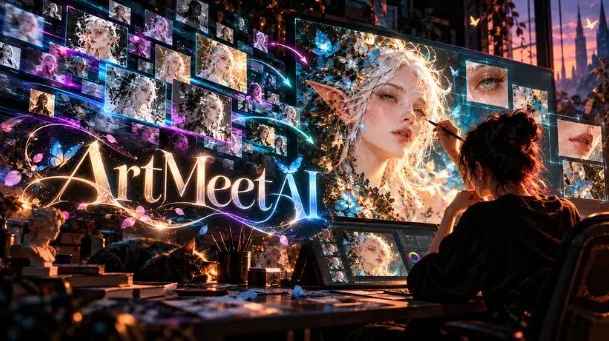
Infinite variations feel productive until every fix creates a different problem.
There is a specific kind of creative exhaustion that only generative tools can produce: version 87 is technically better than version 14, but somehow you still prefer version 14. The face improved. The lighting got worse. The coat finally makes sense, but the pose lost all its energy. ARTmeetAI targets that frustrating loop by changing the question from “what should I prompt next?” to “what should a human artist keep, fix or rebuild?”
The prompt loop has no natural finish line
Traditional editing gives you a file and asks what should change. Generative editing often gives you a new file and asks whether you like the new interpretation better. Those are not the same task. One preserves decisions. The other keeps reopening them.
That is why a creator can spend hours solving the same image. The model repairs a hand but invents a different sleeve. It improves the background but changes the character. It makes the face prettier but removes the expression that made the original interesting. Every attempt is a trade.
The best version can still be the broken one
This is the counterintuitive part. The image worth finishing may not be the cleanest generation. It may be the one with the strongest posture, the strangest but most memorable silhouette, or the lighting accident that suddenly makes the scene feel alive. A human artist can look at that imperfect version and ask a different question: what is the core that should survive?
Once that core is identified, the work becomes more controlled. Anatomy can be corrected without sacrificing the pose. A face can be redrawn without changing the composition. Clothing can be simplified instead of regenerated. Background perspective can be rebuilt while the subject remains untouched.
ARTmeetAI is designed around that handoff. Creators can bring a generated image, rough sketch or unfinished concept and describe intent in ordinary production terms. “Keep this. Change that. Make this colder. Remove this. Rebuild this area.” The output becomes a brief for a person rather than another lottery ticket for a model.
Fast ideation, slow commitment
That division of labor makes sense because speed and judgement solve different problems. AI is excellent when the creator needs ten possibilities before committing to one. It is less useful when the creator already knows which possibility they want and only needs several specific flaws repaired.
At that point, continuing to generate can become destructive. The creator is no longer exploring. They are gambling with things they already like.
The human advantage is not “drawing better”
The strongest argument for human refinement is not nostalgia for traditional art. It is selective attention. An artist can understand that the odd asymmetry in a costume is intentional while the malformed buckle beside it is not. They can see that the face should remain imperfect because perfect symmetry would kill the expression. They can disagree with the draft.
That disagreement is valuable. Generated images tend to arrive with many decisions bundled together. Human editing can unbundle them. One choice can be kept while another is rejected. That is how the image stops being merely plausible and starts becoming specific.
A service, not a future feature
ARTmeetAI is not waiting for a hypothetical future where human artists might join the process. Skilled graphic artists are available for refinement work. That matters because the site’s value is not a promise that AI will soon become flawless. It is an alternative workflow for the moment when the model has already done enough.
The moment the creator starts bargaining with the model
The loop usually becomes obvious when the prompt starts sounding like a negotiation: keep the face exactly the same, change only the hand, do not touch the coat, preserve the lighting, fix the perspective, please stop changing the eyes. At that point the creator is no longer asking for a new concept. They are trying to protect a nearly finished image from the tool that created it.
That is a strong signal to switch workflows. A human editor can lock onto the existing composition instead of reinterpreting the entire scene every time one defect is addressed.
REALITY CHECK
The useful claim is intentionally limited: ARTmeetAI can connect creators and visual material with human refinement. A submitted image may need cleanup, structural correction, a style-led rebuild or a larger artistic intervention. The service does not make every draft worth saving; it gives a promising draft a path other than endless regeneration.
FAST FACTS
- Best starting point: a visual with a strong core idea and specific remaining problems.
- Human refinement can be local, such as anatomy and detail correction, or broad, such as composition and style rebuilding.
- AI output, sketches and other rough material can all function as starting points.
- The creative objective is continuity: preserve what works while changing what does not.
When version 87 is cleaner but version 14 still feels better, the problem is no longer a lack of options. ARTmeetAI gives that older, stronger version somewhere to go. At some point the smartest prompt is to stop prompting. https://www.artmeetai.com