From a 1985 Workshop to Global Exporter: A Qingdao Family’s Three Generations in Rubber Belting
Qingdao, China — In 1985, Wang Wensen gathered a few workers in a small workshop in Qingdao and started making rubber belts. Four decades later, his grandson leads the export business of the company that grew from it, shipping heavy-duty conveyor belts to customers across Southeast Asia, South Korea and Central Asia.
The story of Qingdao High-tech Industrial Hongkun Rubber Co., Ltd. is a familiar one in China’s manufacturing heartland: a family workshop that grew step by step, reinvested in its factory, and eventually learned to sell to the world. What makes it worth telling is how much of that growth rests on three generations staying with one product.
A workshop with one product
The early years were about rubber belts and little else. That focus on heavy rubber belting, rather than chasing every product line, still shapes the company today.
Becoming a company
In 2000, the family formally established the company in Qingdao’s Laoshan District, with registered capital of RMB 50 million. The second generation took over day-to-day management and expanded production. In 2018, the company set up a wholly owned subsidiary, Qingdao Hongkun Precision, managed by the second generation.
Over the same period, the company built a record that buyers can check for themselves. According to the Credit China public credit system, it held an A-grade tax credit rating every year from 2017 to 2025, nine years in a row.
For overseas buyers, that kind of public record matters. Ordering industrial belts from a supplier thousands of kilometres away takes trust, and facts that can be checked, such as a registered address, a credit rating and a factory that can be visited, make that decision easier.
A new factory in Lingshan
In 2019, the company moved production to a new site on Xingling Road in the Lingshan Industrial Park, Jimo District, Qingdao. The new factory reached full production in 2020. It gave the company more space and capacity, and the base it needed to take on export orders.
The third generation looks abroad
2020 was also the year Wang Xinxiang, the founder’s grandson, started the company’s export business. Today he leads its overseas sales under the name Hongkun Belting.
Selling abroad meant learning new habits. Overseas buyers ask for test data, detailed drawings and clear lead times before they commit, and they compare suppliers online long before they send an inquiry. The company answered by putting specifications, application guides and buying advice on its website.
Instead of competing head-on in distant markets, the company focused on its neighbours. Mines, quarries, cement plants, ports and grain terminals in Southeast Asia, South Korea and Central Asia are now its main customers. The product range covers steel cord and fabric conveyor belts, heat-, fire-, oil- and abrasion-resistant belts, corrugated sidewall belts and bucket elevator belts.
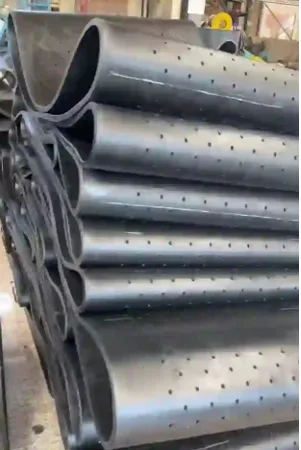
One product has become a calling card abroad: belts for tumble-type shot blasting machines, used by foundries and auto parts makers to clean castings. The company holds two utility model patents for these belts, covering a high wear-resistant design and a jointless design. Foundries in Thailand have placed repeat orders over several batches.
Perforated shot blasting machine belts made at the company’s Qingdao factory.
Built to drawing, not from a catalogue
Heavy industrial belts are rarely bought off the shelf. Almost every quote starts with the customer’s drawing or machine specifications: belt width, carcass, cover thickness, the material being carried and the operating temperature. That way of working suits a family factory, where the people who quote an order also know the production floor.
Customers increasingly ask for more than the belt itself. The company now helps buyers source matching accessories from Chinese suppliers, such as idlers, belt cleaners and shot blasting machine spare parts, so they can order and ship in one consignment.
What comes next
The company is building its website in its customers’ own languages, so buyers in Thailand, Korea and other markets can read specifications and send drawings without going through a translator. Readers can find more of its company history on its website.
“My grandfather started with a few workers and one product,” says Wang Xinxiang. “We still make heavy rubber belts, and we still treat every order as if the customer will come back. The difference now is that the customer may be in Bangkok or Busan.”