How Bay Area Cafes Can Add Matcha to the Menu Without Overbuying
Adding matcha to your menu looks easy: buy a bag and put a latte on the board. The problem shows up a month later, when half the bag has gone dull or the drink tastes flat. For Bay Area cafés with thin margins, a small, well-planned start costs less and teaches more.
This guide explains how to introduce matcha to a cafe menu, drink by drink, how much to order, the right grade for each drink, and how to test before you put it on the menu.
Start With Two or Three Drinks, Not a Full Menu
A short launch menu keeps prep simple. Many cafes begin by offering a hot matcha latte, iced matcha latte, and a seasonal flavor, like vanilla or strawberry.
Buying local helps at this stage. A local supplier lets you place smaller orders more often, instead of tying money up in one large imported order. Matchia is a Bay Area matcha supplier based in Hayward, California, and supplies cafés from its own stock.
| Starter drink | Grade to test first | Starting dose |
| Hot matcha latte | Latte or premium | 2 to 3 g |
| Iced matcha latte | Latte or premium | 3 g |
| Seasonal flavored latte | Latte | 2 to 3 g |
| Straight matcha (optional) | Ceremonial | 2 g |
How Much Matcha Should Your First Order Be?
A good first order should be a few weeks’ worth of sales, not a few months. Once opened, matcha oxidizes and loses color and aroma, so a small bag used up quickly tastes better than a large bag used slowly.
Step-1: Estimate how many matcha drinks you will sell a day. Be conservative the first month.
Step-2: Multiply that number by the number of grams in each drink.
Step-3: Multiply by the number of days between orders.
Step-4: Round up to the supplier’s pack size and minimum order.
Example: a café sells 25 matcha drinks a day at 3 g each. On a 2 week reorder cycle, that is about 1,050 g, so one 1 kg bag per grade is a sensible first order. Use your own sales forecast for these numbers.
Which Kinds of Matcha Belong on a Café Menu?
Matcha comes in grades and each grade is suited for a particular job.
Match the grade to the drink; milk does not hide the difference.
| Grade | Best for | What to expect |
| Ceremonial | Straight matcha and matcha-forward drinks | Smooth, sweet, bright green, highest cost |
| Premium | Lattes where matcha should stand out | Balanced flavor, mid-range cost |
| Latte | Everyday hot and iced lattes | Bold flavor that holds up in milk |
| Culinary | Baked goods and desserts | Stronger, more astringent, lowest cost |
Grade names vary from one supplier to another, and one supplier’s “premium” may not match another’s. The best way to make a selection is to compare different kinds of matcha directly from one supplier, in your own recipe.
Test in Your Own Recipe Before You Commit
Samples tell you more than a product description. Test each candidate with the same milk (whole, oat, almond), sweetener, cup size and ice you will actually use.
Score each one on:
- Color in the finished drink.
- Flavor through milk and syrup.
- Bitterness or astringency.
- How well it mixes with your whisk or frother.
- Cost per drink at the dose you choose.
Ask what paperwork comes with each lot, such as a certificate of analysis.
Store It Right So Nothing Goes to Waste
Keep unopened bags in the fridge. Let a bag come to room temperature before opening it, so condensation does not form inside. Keep a few days’ supply at the bar in a small, opaque, airtight container, away from the heat of the espresso machine.
Conclusion
The lowest-risk way to add matcha is to start with two or three drinks, order a few weeks’ supply, and test two grades in your actual recipe. A Bay Area supplier like Matchia offers 15 g samples so you can run that test before your first order.
Frequently Asked Questions (FAQs)
Which of the matcha drinks is easiest to serve in a cafe?
A matcha latte. It uses your existing steamer and cups, and works hot or iced.
Which matcha grade is the best for matcha lattes?
Latte or premium grade. A milk drink does not need ceremonial grade.
How long will an opened bag of matcha last?
Flavor and color are best within a few weeks of opening, so order what you can use in that time.
What is needed to serve matcha?
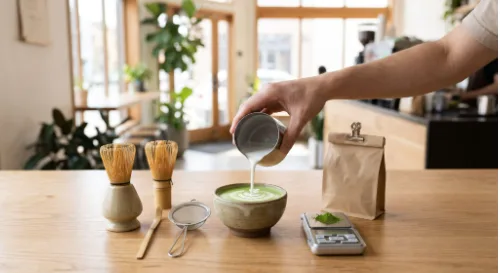
A bamboo whisk or electric frother, a fine mesh sifter, and a scale that reads to 0.1 g cover most café drinks.