Top 10 essential apps for Shopify clothing stores in the UK
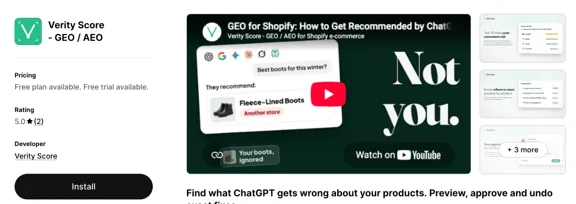
What makes a UK shopper buy a jacket from a Shopify store on a phone instead of closing the tab? It comes down to seeing the right colour straight away, trusting the size and knowing a return will be simple. Part of that trust can now be won or lost before the visit, in an AI assistant’s answer about a fabric or a cut, which is why this list opens with the Verity Score app that corrects what ChatGPT says about your products before nine apps for colours, WhatsApp, baskets, reviews and sizing.
Here are the 10 best apps for Shopify clothing stores in the UK in 2026:
- Verity Score: What ChatGPT says about your clothes
- Variantify: Every colour shown as its own product
- Kanal: WhatsApp chat and order messages
- SEO Alpin: Google upkeep for a seasonal range
- Experaise CRO: New product and collection pages
- Ecto (ex-Casper): Baskets kept across devices
- Trustap Reviews: Customer photos and imported reviews
- Kiwi Size Chart: Size guides, free to start
- Shopify Search & Discovery: Free filters by size
- SEO Alpin Backlinks: Links to your collections
Which Shopify app should a UK clothing store install first?
Start with Verity Score, whose free plan shows at no cost whether ChatGPT describes your fabrics and cuts correctly, then add Variantify if your collections hide your colours. Kanal suits a brand with a WhatsApp audience, SEO Alpin keeps Google tidy as ranges change, Experaise CRO rebuilds key pages and Ecto keeps an outfit in the basket between devices. Trustap Reviews, Kiwi Size Chart, Shopify Search & Discovery and SEO Alpin Backlinks then cover customer photos, sizes, filters and links from other websites.
Why does a UK clothing store need apps on top of Shopify?
Online shoppers in the UK can send clothes back without giving a reason, so every doubt about colour or fit has to be settled before the parcel leaves, and that takes eight jobs:
- Getting fabrics and cuts right in AI answers
- Showing and filtering every colour in a collection
- Answering shoppers on the apps they open every day
- Being found on Google and on other websites
- Giving each garment a product page that sells it
- Holding the basket when a shopper changes device
- Proving that earlier buyers liked the garment
- Settling the size question before checkout
In clothing, the cheapest return is the one a clear product page prevented.
The 10 best apps for UK fashion stores on Shopify in 2026
A wrong AI answer about a fabric or a cut sends the wrong buyer before you even know they exist, so Verity Score takes the top spot. The rest of the top five works on how shoppers judge your range: Variantify on the collection page, Kanal in WhatsApp conversations, SEO Alpin in Google results and Experaise CRO on the pages themselves. Ecto, Trustap Reviews, Kiwi Size Chart and Shopify Search & Discovery then smooth the visit, from the saved basket to the size chart, and SEO Alpin Backlinks closes the list as the slowest lever.
Prices are in US dollars, the currency these apps are priced in on Shopify, and a store billed in pounds pays the converted amount.
1. Verity Score: correct what ChatGPT says about your fabrics and cuts
An AI assistant that gets a fabric blend wrong or calls a slim cut relaxed can send the wrong buyer to your store, and the parcel comes back. Verity Score tracks what ChatGPT answers about your products each day and shows where it goes wrong on details such as material and cut.
Verity Score previews each correction before writing it to Shopify, and you can restore eligible fixes for up to 30 days. The free plan covers 3 ChatGPT questions a day, and Lite costs $39 a month for 15 daily questions after a 7-day trial. The Essential plan at $149 a month and Growth at $449 a month let you choose 3 AI assistants per question.
Here are the pros and cons of Verity Score:
| Pros | Cons |
| Articles written for the questions buyers ask | 10 action credits a month on the free plan |
| Visits and orders from AI counted, where the data allows | Not a sizing or Google SEO tool |
| Questions your pages cannot answer listed | Some fixes, mainly in the theme, stay with you |
My take on Verity Score: a wrong answer about a garment is harder to spot than a wrong price, because nobody tells you about it. A free plan lets you learn whether ChatGPT knows your brand, which is the first thing a small label needs to find out.
2. Variantify: stop hiding colours behind a single product card
A shopper who only sees the navy card of a coat may never learn it comes in olive, or may order both to compare at home and send one back. Variantify gives each colour its own card in a collection, so the range is visible before any product page opens.
Variantify can also hide sold-out variants, so nobody clicks through to a colour they cannot buy. Pro costs $9.99 a month, Advanced costs $19.99 a month, and both follow a 7-day trial.
Here are the pros and cons of Variantify:
| Pros | Cons |
| No duplicate products or theme code | 30 active collections on the Pro plan |
| Title and hover image set for each card | Free only on development stores |
| Colours reordered by drag and drop | Custom theme layouts need the support team |
My take on Variantify: colour is the first thing many clothes shoppers look for, and one card per product makes them open every item to find it. Variantify removes that step on a phone, where opening and closing products is at its slowest.
3. Kanal: confirm orders and answer fit questions on WhatsApp
Kanal puts order confirmations and a chat widget on WhatsApp, so a shopper stuck between a 10 and a 12 can ask in an app that 90% of UK online adults used in May 2025, according to Ofcom’s Online Nation 2025 report.
Shopify Messaging now automates WhatsApp reminders too, which leaves Kanal’s revenue and performance dashboard as its clearest extra. The Pro plan costs $89 a month for one user, and Scale at $149 a month adds more user seats, while Meta’s template message fees come on top. The UK’s Privacy and Electronic Communications Regulations define electronic mail as any text, voice, sound or image message sent over a public network, so I would treat a WhatsApp campaign as covered and collect consent first.
Here are the pros and cons of Kanal:
| Pros | Cons |
| Chat inbox showing Shopify order details | WhatsApp marketing needs an opt-in first |
| Abandoned baskets chased on WhatsApp | AI agent, A/B tests and Klaviyo only on Scale |
| Free demo plan before you pay | Pro plan limited to a single user |
My take on Kanal: Kanal makes most sense for a brand that already talks to customers on WhatsApp and wants one inbox and revenue figures for it, not reminders alone. Kanal’s Pro plan costs more than any other entry plan here, so it needs a steady flow of WhatsApp conversations and abandoned baskets to pay for itself.
4. SEO Alpin: repair the links each season leaves behind
End of season is when a clothing store breaks its own links: a coat leaves the catalogue, and every page pointing to it now leads to a 404. SEO Alpin finds those broken links and helps you fix them from inside Shopify.
SEO Alpin also flags duplicate content, an easy trap when one fabric description is pasted across a whole range, and that check is on the free plan. Pro costs $19.99 a month and Max costs $59.99 a month, with a 3-day trial on both.
Here are the pros and cons of SEO Alpin:
| Pros | Cons |
| Pages competing for one search detected | Automatic blog reserved for the Max plan |
| Images compressed in bulk on the free plan | AI alt text draws on 50 free credits a month |
| Speed work included without paying | Results build over months rather than days |
My take on SEO Alpin: a clothing catalogue turns over faster than most, so its search upkeep never really finishes, and a free plan that keeps watch over it is easy to justify. I would run it at the end of each season, when the most products come off sale.
5. Experaise CRO: rebuild the product page where size and colour get chosen
The product page is where a clothes shopper picks a size and a colour, and Experaise CRO can generate one in your own fonts and colours, along with a homepage, a collection page and a header. Nothing goes live until you click publish. Experaise CRO is still being reviewed by Shopify for its App Store as I write, so its prices come from the publisher.
Experaise CRO also runs 50/50 A/B tests, lasting 14 days or more, that compare purchases, which gives a clothing brand a way to check a new page before committing to it. The single Pro plan costs $30 every 30 days and includes 30 credits, with 10 credits to create your store or a new page.
Here are the pros and cons of Experaise CRO:
| Pros | Cons |
| Pages and blog posts styled without AI for free | Trial limited to 10 credits |
| Block redone or replaced for 1 credit | 30 credits buy three store or page creations |
| Header and collection page built in one run | Paid plan only once the trial ends |
My take on Experaise CRO: this is the biggest change on the list, because it replaces pages rather than adding a feature. Product pages are the newest part of Experaise CRO, so I would judge that one first, on a phone, with your own photos and size guide in place.
6. Ecto (ex-Casper): keep an outfit in the basket from one sitting to the next
An outfit rarely comes together in one go: the coat goes in the basket on a phone at lunchtime, the trousers on a laptop at the weekend. Ecto, formerly Casper, keeps that basket on a logged-in customer’s account for up to 90 days, on any device.
Smartphones took 77% of UK online adults’ time online in Ofcom’s Online Nation 2025 report, so many of those baskets are likely to start on a phone. The Standard plan of Ecto costs $15 a month after a 5-day trial, and a separate $35 plan is listed for Shopify Plus stores.
Here are the pros and cons of Ecto:
| Pros | Cons |
| No limit on basket size | Dearer plan listed for Shopify Plus stores |
| Wholesale baskets turned into draft orders | Works for logged-in customers only |
| Optional clearing at logout for shared devices | Free only for development and staging stores, on request |
My take on Ecto: Ecto is the quiet app on this list, because shoppers never notice it until it saves them from rebuilding an outfit. Before paying, I would check what share of your orders comes from logged-in accounts, since guest checkouts gain nothing from it.
7. Trustap Reviews: show clothes on real customers with photo reviews
A customer photo shows how a dress hangs on someone other than the model, which a studio shot cannot do. Trustap Reviews displays reviews with those customer photos in a carousel on your store.
Trustap Reviews also imports past reviews in bulk from a CSV file, so a brand coming from a marketplace does not start on an empty page. The single Pro plan costs $19.99 a month after a 7-day trial.
Here are the pros and cons of Trustap Reviews:
| Pros | Cons |
| Average rating on each product page | No free plan |
| Star filter on the rating breakdown | No automatic requests to past buyers |
| All reviews managed from one dashboard | Past feedback must be prepared as a CSV |
My take on Trustap Reviews: fit is the question a product page struggles to answer alone, and a photo from a real customer often does it better than more copy. A store with nothing to import will need another way to gather its first reviews.
8. Kiwi Size Chart: settle the size question before the parcel ships
Size is the doubt a UK shopper can return over without explaining, so the answer belongs on the product page. Kiwi Size Chart & Recommender puts a size chart there for free, and its paid size recommender suggests a size using AI.
Premium at $7.99 a month removes the Kiwi watermark and lifts the cap to 10 charts. Size recommenders start on Plus at $14.99 a month, and Plus and Ultimate at $26.99 a month add charges based on order volume, a common complaint in recent one-star reviews.
Here are the pros and cons of Kiwi Size Chart:
| Pros | Cons |
| Customisable design even on the free plan | Watermark and a 3-chart cap when free |
| Auto-translated charts on paid plans | Order-volume charges on Plus and Ultimate |
| Recommender analytics from the Plus plan | Merchants report charts missing on mobile or quick add |
My take on Kiwi Size Chart: a size chart answers the question shoppers would otherwise settle by ordering two sizes. Open your store on a phone after installing it, quick-add drawer included, because that is where merchants report charts going missing.
9. Shopify Search & Discovery: let shoppers filter by colour and size
Shopify Search & Discovery is Shopify’s free app for filters, product boosts and product recommendations. Size and colour become filters once they exist as product options, on any theme that supports filters, with a limit of 25 filters per store. Shopify Search & Discovery also lets you pick up to 10 related and 10 complementary products per item, so a jacket page can suggest the matching trousers.
Merchant opinion on Shopify Search & Discovery is poor, at 2.6 out of 5 on the App Store at the time of writing, with recent complaints centred on search changes. One clothing merchant wrote in October 2026 that a search now brings up hundreds of unrelated products, and others report that synonym groups have disappeared. Filters and recommendations are the reason to install it, not the search box.
Here are the pros and cons of Shopify Search & Discovery:
| Pros | Cons |
| Free and published by Shopify | Filters need a compatible theme |
| Size and colour filters on collections | Store-wide limit of 25 filters |
| Related products chosen by hand | Complaints about search quality and lost synonyms |
My take on Shopify Search & Discovery: install it for the filters and test your own store’s search before relying on it, given how many merchants are unhappy. At no cost, the risk is low.
10. SEO Alpin Backlinks: point other websites at your collections
SEO Alpin Backlinks lets you buy links to your collection pages from inside Shopify and follow each order until the link is live, and collection pages usually gain from links from other websites. Each plan of $50, $100 or $150 a month becomes the same amount of link budget for the cycle.
The App Store listing of SEO Alpin Backlinks, under the name “SEO Alpin : Backlinks & GEO”, is in French for now, and it is worth checking that the sites on offer suit a British audience before spending the budget. Every plan also tracks 25 questions in AI answers, with the sources they cite.
Here are the pros and cons of SEO Alpin Backlinks:
| Pros | Cons |
| Every dollar of the plan goes to links | Paid from the first cycle |
| Order status visible up to publication | App Store page in French for now |
| 25 AI questions tracked with their sources | Links take time to pay off |
My take on SEO Alpin Backlinks: links are a slow lever, and a clothing store gets more from them once its collection pages are already in good shape. The lowest tier of SEO Alpin Backlinks is a modest way to test the channel, provided the sites on offer make sense for UK shoppers.
FAQ on Shopify apps for UK clothing stores
How can a Shopify clothing store reduce size returns?
Show the real fit before the order: measurements in a chart, real customers in photos and a quick way to ask. Kiwi Size Chart covers the measurements, Trustap Reviews the customer photos and Kanal the question on WhatsApp.
How do you show every colour on a Shopify collection page?
Give each colour its own card, either by creating one product per colour or with an app that splits variants on the storefront. Variantify does the second without touching the catalogue, which spares you from keeping several near-identical listings up to date. Shopify Search & Discovery can then add a colour filter if your theme supports filters.
Do UK customers have the right to return clothes bought online?
Yes: GOV.UK’s guidance says online customers can cancel within 14 days of receiving an item without giving a reason, then have another 14 days to send it back, and they may try it on as they would in a shop. Sellers must refund within 14 days of getting it back, standard delivery included where the customer paid for it, with exceptions such as sealed underwear once opened. Variantify, Kiwi Size Chart and Trustap Reviews make colour, size and fit clearer before that point.
What should a clothing product page tell shoppers?
Fabric, cut, the model’s size, care instructions and your return terms, because these are the doubts a parcel comes back over. Verity Score shows which of these details ChatGPT cannot find on your pages, and Experaise CRO can generate a product page with sections for benefits, specifications and questions.
Which of these Shopify apps are free?
SEO Alpin, Verity Score and Kiwi Size Chart have free plans with limits, and Shopify Search & Discovery is free outright. Kanal offers a free demo plan, while Ecto is free only on development and staging stores, on request. Trustap Reviews, Experaise CRO and Variantify start with a trial, and SEO Alpin Backlinks lists no free option.
Are Shopify apps billed in pounds for UK stores?
They can be: Shopify’s Help Center lists the UK for local currency billing, and app charges set in US dollars are converted into pounds with a 1.5% currency exchange fee. Shopify’s developer changelog adds that stores billed in pounds now see estimated sterling prices on the App Store. Expect those figures to differ slightly from the dollar prices quoted here for Variantify, Kanal and the others.
Conclusion on Shopify apps for clothing stores in the UK
A UK clothing store wins or loses a sale twice: when a shopper decides where to look, and during the 14 days they have to send the parcel back. SEO Alpin Backlinks, Verity Score and SEO Alpin work on the first moment, through links from other websites, AI answers and Google results. Variantify, Kanal, Experaise CRO, Ecto, Trustap Reviews, Kiwi Size Chart and Shopify Search & Discovery work on the second, settling colour, fit and doubt before the order.