7 Best C&I Battery Energy Storage System Manufacturers in 2026
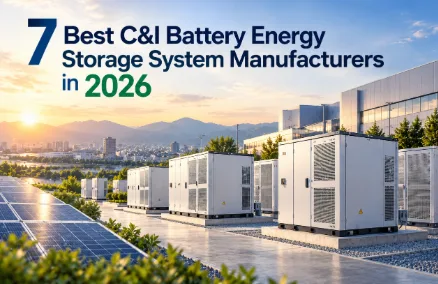
Commercial and industrial (C&I) battery energy storage systems help businesses control peak electricity demand, integrate renewable energy, and improve power reliability. However, choosing among BESS manufacturers requires more than comparing battery capacity or price. This guide introduces seven notable manufacturers in 2026, highlighting their technologies, strengths, and suitability for different commercial and industrial projects.
Key Takeaways
- Leading C&I BESS manufacturers in 2026 include Wenergy, Sungrow, Huawei Digital Power, TESVOLT, Fluence Energy, AlphaESS, and HiTHIUM, each offering distinct technologies and solutions for commercial and industrial applications.
- Wenergy stands out for its integrated C&I energy storage solutions, combining all-in-one battery cabinets, multilayer safety protection, intelligent energy management, and international project experience.
- Choosing the right C&I battery energy storage system requires evaluating power and capacity, safety features, system compatibility, application requirements, and long-term technical support rather than focusing on price alone.
What Are C&I Battery Energy Storage Systems Used For?
C&I battery energy storage systems store electricity and discharge it according to a facility’s operating needs. Common applications include:
- Peak Shaving and Demand Charge Management: Batteries discharge during peak demand periods to reduce grid electricity demand and potentially lower demand charges.
- Solar-Plus-Storage Integration: Excess solar electricity can be stored for later use, improving on-site renewable energy consumption.
- Backup Power: Properly configured systems can support critical equipment during grid outages, depending on their backup architecture and available capacity.
- EV Charging Infrastructure: Batteries help manage high-power charging loads and reduce pressure on grid connections.
- Industrial Microgrids: Energy storage coordinates with solar panels, generators, and grid electricity to improve energy flexibility.
These applications make industrial energy storage relevant to factories, logistics centers, commercial buildings, and industrial parks. The ideal configuration depends on electricity tariffs, load characteristics, and operational priorities.
7 Best C&I Battery Energy Storage System Manufacturers in 2026
The following seven companies represent different approaches to C&I energy storage, from integrated battery cabinets to large-scale energy management platforms.
Quick Comparison of C&I BESS Manufacturers
| Manufacturer | Country | Key Strengths | Best For |
| Wenergy | Singapore (R&D and Manufacturing in China) | Integrated cabinets, multilayer safety, international project delivery | Factories, solar-plus-storage, EV charging |
| Sungrow | China | Power conversion, liquid cooling, grid-forming technology | C&I solar storage, microgrids |
| Huawei Digital Power | China | Hybrid cooling, system safety, digital monitoring | Smart industrial parks, intelligent energy management |
| TESVOLT | Germany | Energy management, electricity trading, flexible configurations | European C&I projects, energy trading |
| Fluence Energy | United States | Large-scale integration, asset management software | Large industrial facilities, complex energy projects |
| AlphaESS | China | AC/DC coupling, modular expansion, backup integration | PV retrofits, distributed C&I storage |
| HiTHIUM | China | LFP cell development, high-capacity cabinets, liquid cooling | High-capacity industrial storage |
-
Wenergy — Integrated C&I Energy Storage and International Project Delivery
Wenergy is an energy storage solution provider headquartered in Singapore, with R&D and manufacturing operations in China. Specializing in commercial and industrial energy storage, the company offers integrated battery systems, intelligent energy management, and project-specific solutions. With over 1,000 C&I energy storage projects installed worldwide, Wenergy combines system integration capabilities with international project experience and localized technical support.
Key Strengths:
- All-in-one system integration: The Stars CL289Pro is a 125 kW/289 kWh C&I energy storage cabinet integrating 314 Ah lithium iron phosphate (LFP) cells, a power conversion system (PCS), built-in energy management system (EMS), liquid cooling, fire protection, and power distribution components.
- Multilayer safety architecture: The Stars CL289Pro features four layers of protection, early-warning mechanisms, and an aerosol fire suppression system. The cabinet also offers IP55 ingress protection and C4H corrosion resistance.
- Modular design and energy management: Modular battery packs support flexible capacity configurations, while the built-in EMS enables system monitoring and energy management. Wenergy also offers broader energy management solutions with communication and integration capabilities for compatible external systems.
- International project experience: Wenergy reports over 1,000 installed C&I energy storage projects worldwide, including a 625 kW/1.445 MWh solar-plus-storage project in Germany and a 60 kW/192 kWh hospitality installation in the Netherlands.
Best For: Industrial facilities, commercial buildings, solar-plus-storage developers, EV charging operators, and system integrators seeking complete energy storage cabinets with technical project support.
-
Sungrow — Power Conversion and Grid-Forming Energy Storage
Sungrow is a Chinese renewable energy technology company with extensive experience in photovoltaic inverters and energy storage systems. Its C&I energy storage solutions combine power conversion technology, battery systems, and intelligent energy management. The company focuses on efficient system integration, grid compatibility, and flexible energy applications, serving commercial facilities, industrial users, and distributed renewable energy projects.
Key Strengths:
- Power conversion efficiency: According to Sungrow’s official specifications, the PowerStack 255CS achieves PCS efficiency exceeding 98.5% and system round-trip efficiency of over 90%.
- Intelligent liquid cooling: Advanced thermal management helps control battery temperatures and auxiliary energy consumption.
- Grid-forming capabilities: The PowerStack 255CS series features grid-forming technology for selected grid-connected and off-grid applications. Microgrid operation and MW-level black-start capabilities depend on the PCS, controls, and overall system configuration.
- Simplified deployment: Pre-integrated components, flexible cabinet arrangements, and automated commissioning features help streamline installation.
Best For: Commercial solar-storage developments, industrial microgrids, and projects requiring coordinated power conversion and multiple operating modes.
-
Huawei Digital Power — Intelligent Safety and Energy Management
Huawei Digital Power is a Chinese technology company specializing in the integration of digital technologies and power electronics. Its commercial and industrial energy solutions combine smart photovoltaic systems, battery energy storage, and intelligent management technologies. With an emphasis on system-level safety, energy efficiency, and digital monitoring, Huawei supports businesses developing smarter and more flexible energy infrastructure.
Key Strengths:
- System-level safety: The LUNA2000-241-2S1 incorporates battery-pack oxygen barriers, directional gas exhaust, top pressure relief, and aerosol fire suppression.
- Hybrid cooling: The LUNA2000-241 series features an intelligent hybrid cooling architecture with multiple thermal management modes to regulate system temperatures under different operating conditions.
- Energy efficiency: The LUNA2000-241-2S1 has a maximum cycle efficiency of 91.3% under the manufacturer’s specified conditions.
- Digital monitoring: Communication interfaces and Huawei’s energy management ecosystem support system monitoring and coordinated operation.
Best For: Manufacturing facilities, industrial parks, commercial buildings, and projects prioritizing system safety and digital energy management.
-
TESVOLT — European C&I Storage and Energy Trading
Founded in Germany in 2014, TESVOLT specializes in battery energy storage solutions for commercial, industrial, and larger energy projects. The company combines storage hardware, proprietary control software, and energy management services to help businesses optimize electricity consumption.
Key Strengths:
- Electricity trading integration: TESVOLT integrates compatible battery storage systems with energy management and market participation solutions, subject to local market regulations, asset eligibility, and the required trading arrangements.
- Energy management software: Its control architecture helps coordinate battery systems and other connected energy assets.
- Flexible applications: PowerCore G2 is designed for peak shaving, photovoltaic self-consumption optimization, and electricity trading applications where the required market and control arrangements are available.
- European project support: System configuration, grid connection assistance, partner resources, and after-sales services support regional project delivery.
Best For: European industrial businesses, energy service companies, and project developers seeking electricity cost optimization alongside potential market-based revenue.
-
Fluence Energy — Large-Scale Storage Integration and Asset Optimization
Fluence Energy is a US-headquartered energy storage technology company established by Siemens and AES. Its offerings include Smartstack, Gridstack Pro, and Gridstack, alongside digital applications for energy asset management and market optimization.
Key Strengths:
- Standardized system integration: Modular storage platforms support large-scale deployment and project-specific configurations.
- Advanced asset management: Nispera software provides performance monitoring, reporting, and analytics across storage and renewable energy assets.
- Electricity market optimization: Fluence Mosaic provides intelligent bidding and market optimization software for eligible energy assets, with functionality and availability depending on the electricity market and integration requirements.
- Lifecycle services: Engineering, delivery, and operational services support complex energy infrastructure projects.
Best For: Large industrial campuses, data centers, independent storage developers, and organizations managing multiple energy assets.
-
AlphaESS — Flexible Coupling and Scalable C&I Storage
AlphaESS is a Chinese energy storage solution provider serving residential, commercial, industrial, and utility-scale markets. Its C&I business focuses on flexible battery storage configurations, renewable energy integration, and intelligent energy management. With modular system designs and remote monitoring capabilities, AlphaESS supports businesses seeking to optimize electricity costs, expand storage capacity, or integrate batteries with existing solar installations.
Key Strengths:
- Flexible solar integration: The TB125 supports AC-coupled, DC-coupled, and retrofit configurations.
- Modular expansion: Official specifications indicate support for up to 25 parallel units in grid-connected applications and five in on/off-grid configurations.
- Backup functionality: When equipped with a compatible static transfer switch (STS) and properly configured backup architecture, the STORION-LC-TB125 supports a specified transfer time of 20 milliseconds or less.
- Remote management: Web and mobile monitoring platforms enable remote operational oversight and parameter adjustments.
Best For: Commercial buildings, smaller industrial facilities, distributed solar-storage developments, and businesses upgrading existing photovoltaic installations.
-
HiTHIUM — High-Capacity C&I Storage and Battery Cell Technology
HiTHIUM is a Chinese energy storage technology company specializing in lithium-ion battery cells and integrated energy storage systems. Its commercial and industrial solutions emphasize cell-level innovation, high-capacity battery configurations, and liquid-cooled system design.
Key Strengths:
- Cell-to-system development: HiTHIUM develops LFP energy storage cells and integrated battery systems, supporting coordinated cell and system engineering.
- High-capacity configurations: HiTHIUM’s ∞Block 418kWh system uses 314 Ah LFP cells, while its ∞Power 1022kWh system incorporates 1,175 Ah cells.
- Compact design: The ∞Power 1,022 kWh cabinet occupies approximately 3.4 square meters of ground area, according to the manufacturer.
- Liquid cooling: Thermal management and protective system architecture support higher-capacity energy storage applications.
Best For: Larger commercial facilities, industrial campuses, and system integrators prioritizing battery technology, energy density, and high-capacity storage solutions.
How to Choose C&I Battery Energy Storage System Manufacturers for Your Project
Selecting among commercial-scale battery energy storage providers requires evaluating both equipment performance and project delivery capabilities.
-
Define Your Project Requirements
Identify whether the primary objective is peak shaving, solar self-consumption, backup power, EV charging support, or multiple applications. A factory managing demand charges may prioritize discharge power and scheduling, while a facility requiring emergency power must evaluate backup architecture and critical-load requirements.
-
Evaluate System Capacity and Scalability
Compare rated power in kilowatts (kW), stored energy in kilowatt-hours (kWh), and expected discharge duration. For example, a 125 kW/250 kWh system has a nominal discharge duration of approximately two hours at rated power, before accounting for usable capacity limits and energy losses.
-
Assess Safety and Certifications
Evaluate battery management, thermal protection, fire detection, suppression systems, and enclosure suitability. Depending on the destination market, relevant references may include IEC 62619, IEC 63056, UL 9540, UL 9540A testing, and NFPA 855 installation requirements. Verify the documentation applicable to the exact product configuration and jurisdiction.
-
Check System Integration and Compatibility
Review how the battery management system (BMS), PCS, and EMS work together. Confirm compatibility with existing solar inverters, grid infrastructure, communication protocols, and monitoring platforms. Backup operation may require additional transfer equipment or system modifications.
-
Review Manufacturer Experience and Technical Support
Request comparable project references, engineering documentation, commissioning assistance, and regional service information. Manufacturers with relevant installation experience may be better positioned to address site-specific integration challenges.
-
Compare Lifecycle Costs and Warranty Terms
Evaluate total ownership costs rather than purchase price alone. Important considerations include round-trip efficiency, battery degradation, cooling energy consumption, maintenance requirements, warranty conditions, and expected replacement costs.
FAQs
-
What Is the Difference Between a BESS Manufacturer and a System Integrator?
A BESS manufacturer produces battery cells, cabinets, or complete energy storage equipment. A system integrator combines batteries, PCS, EMS, electrical infrastructure, and controls into a functioning installation.
-
How Much Battery Storage Capacity Does a Commercial Facility Need?
Required capacity depends on the facility’s load profile, peak demand, operating schedule, and intended storage duration. Engineers typically analyze electricity consumption data and project objectives before determining suitable kW and kWh ratings.
-
What Certifications Should a C&I Battery Energy Storage System Have?
Requirements depend on local regulations and project design. Commonly referenced standards include IEC 62619, IEC 63056, and UL 9540. UL 9540A addresses thermal runaway fire propagation testing, while NFPA 855 covers stationary energy storage installation requirements.
-
How Long Do Commercial and Industrial Battery Storage Systems Last?
Service life depends on battery chemistry, operating temperature, charging cycles, depth of discharge, and maintenance. Buyers should review manufacturer cycle-life specifications, warranty conditions, and capacity retention guarantees rather than assuming a fixed lifespan for every installation.
Conclusion
Choosing among leading BESS manufacturers requires matching system capabilities, safety features, and technical support with your project’s operational needs. The right choice depends on your required storage capacity, application, and long-term energy goals.
For factories, commercial developments, and solar-plus-storage projects, explore Wenergy’s commercial and industrial energy storage solutions and contact its technical team to discuss suitable C&I battery storage options for your project.