What Is a USA Proxy Server and When Does Your Business Actually Need One?
If you run an online business outside the United States, there is a good chance you have never seen your American competitors’ websites the way their customers do. Prices change, products disappear, search results reshuffle and ads look completely different once a site detects a US visitor. Even teams based in the US run into limits when they try to check hundreds of pages from a single office connection.
A USA proxy server solves both problems. It gives you access to US IP addresses, so you can view, test and collect publicly available information from an American point of view – and spread your activity across many addresses instead of one. Below, we explain how it works in plain terms, the situations where it genuinely helps, and how to avoid the most common buying mistakes.
How a USA Proxy Server Works
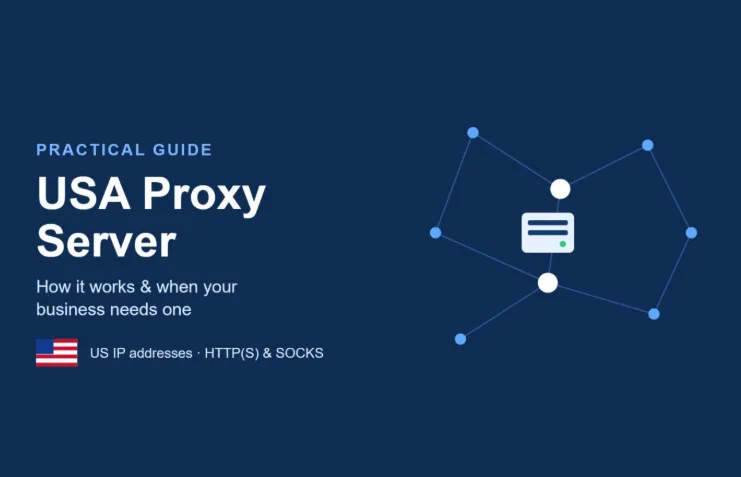
Every device connected to the internet has an IP address, and websites use it to estimate where a visitor is located. A proxy server acts as a middleman between you and the website:
- You send a request (for example, to load a product page) to the proxy instead of directly to the site.
- The proxy forwards that request using its own US-based IP address.
- The website responds to the proxy, believing the visitor is in the United States.
- The proxy passes the response back to you.
The whole process takes a fraction of a second with a good provider. To the website, your traffic simply looks like it comes from a US location.
7 Signs Your Business Needs a US Proxy
1. You sell to American customers from abroad
If the US is a key market, you need to see what American buyers see – your own store, your marketplace listings and your competitors’ offers. Local IP addresses make that possible without travelling or relying on contacts.
2. You track competitor prices
E-commerce prices on major US platforms can change many times a day. Automated price monitoring needs a pool of US IPs so requests are spread out rather than coming from one address that gets slowed down.
3. Your SEO reports do not match reality
Google results vary by country and even by city. Checking rankings from outside the US gives misleading data. Agencies use US proxies to see genuine local results and report accurately to clients.
4. You collect public data at scale
Market research, lead research and product analysis often involve collecting thousands of public pages. Without proxies, a scraper quickly hits rate limits. With a large US IP pool, the same job runs smoothly.
5. You run or verify ad campaigns
Advertisers and agencies need to confirm that their US campaigns display correctly, link to the right landing pages and appear in brand-safe placements.
6. You test geo-targeted features
Developers and QA teams use US IPs to test location-based content, pricing, payment options and compliance banners before a launch.
7. You manage several projects at once
Agencies handling many clients often need separate, stable IP addresses for different tools and workflows. Dedicated proxies keep those tasks organised and reliable.
Datacenter or Residential: Which Should You Choose?
| Feature | Datacenter proxies | Residential proxies |
|---|---|---|
| Source of IPs | Servers in data centers | Home internet connections |
| Speed | Very fast and stable | Usually slower |
| Typical pricing | Per IP, often with unlimited bandwidth | Per GB of traffic |
| Best for | Scraping, SEO tools, price monitoring, automation | Sites with very strict anti-bot systems |
| Cost at volume | Low | High |
For most business tasks – SEO research, price tracking and large-scale collection of public data – datacenter proxies offer the best balance of speed and cost. Residential proxies are worth considering only for targets that heavily restrict datacenter traffic.
What to Check Before You Buy
- US IP pool size: enough addresses to spread your requests, with room to scale.
- Protocols: support for both HTTP(S) and SOCKS5 so the proxies work with all your tools.
- Bandwidth: unlimited traffic keeps costs predictable.
- Anonymity: elite proxies that do not reveal your real IP or the fact that a proxy is in use.
- Infrastructure: proxies running on the provider’s own servers, not on compromised devices.
- Control: a clear dashboard and API for managing IP lists.
- Risk-free testing: a free trial or refund window, plus responsive 24/7 support.
Cyber Gateway: A Datacenter Option for US Proxies
Cyber Gateway is a proxy provider that has been operating since 2015 and specialises in datacenter IPv4 proxies. Alongside dedicated USA proxy plans, it offers mixed-location, country-specific, rotating, UDP and dedicated proxies.
The company says its US proxies are elite proxies hosted on its own bare-metal servers, with IPs spread across multiple American cities. Packages range from 250 to more than 20,000 IPs, with starting prices of roughly $0.07 to $0.16 per IP depending on the plan size. Every plan includes unlimited bandwidth and supports HTTP(S) and SOCKS – you switch protocols simply by changing the port.
Proxy lists are delivered automatically within minutes of payment and can be managed through a client panel or API. New users can test the service with a free 30-minute trial of 50 IPs in mixed locations, and US plans come with a 24-hour money-back guarantee. Support is available around the clock via email, live chat and Telegram.
Common Mistakes to Avoid
- Buying too few IPs. Sending heavy traffic through a handful of addresses leads to blocks and failed requests.
- Ignoring request speed. Even with a large pool, add sensible delays between requests.
- Choosing on price alone. Free or extremely cheap proxies are often slow, unstable or unsafe.
- Skipping the test. Always check compatibility with your own software before committing to a large plan.
- Forgetting the rules. Collect only public data, respect website terms and follow privacy laws.
Frequently Asked Questions
Is it legal to use a USA proxy server?
Yes. Proxies are legal in the US and most countries. What matters is using them for lawful purposes and in line with the terms of the websites you visit.
Will a US proxy slow down my connection?
A quality datacenter proxy adds very little delay. Slow performance usually points to overloaded or low-quality proxies.
Can I use one proxy list for different tools?
Yes. As long as your tools support HTTP(S) or SOCKS, the same list can be used across scrapers, SEO software, browsers and automation platforms.
Final Thoughts
A USA proxy server is not just a technical extra – for any business that sells to, studies or competes in the American market, it is a practical way to see accurate local data and to work at scale. Start by identifying your main use case, choose the right proxy type, test before you commit and use your proxies responsibly. Done right, it is one of the simplest ways to make better decisions based on what US customers really see.