LabFirstPeptides.com Guide: What to Check Before You Buy Retatrutide Peptide for Research
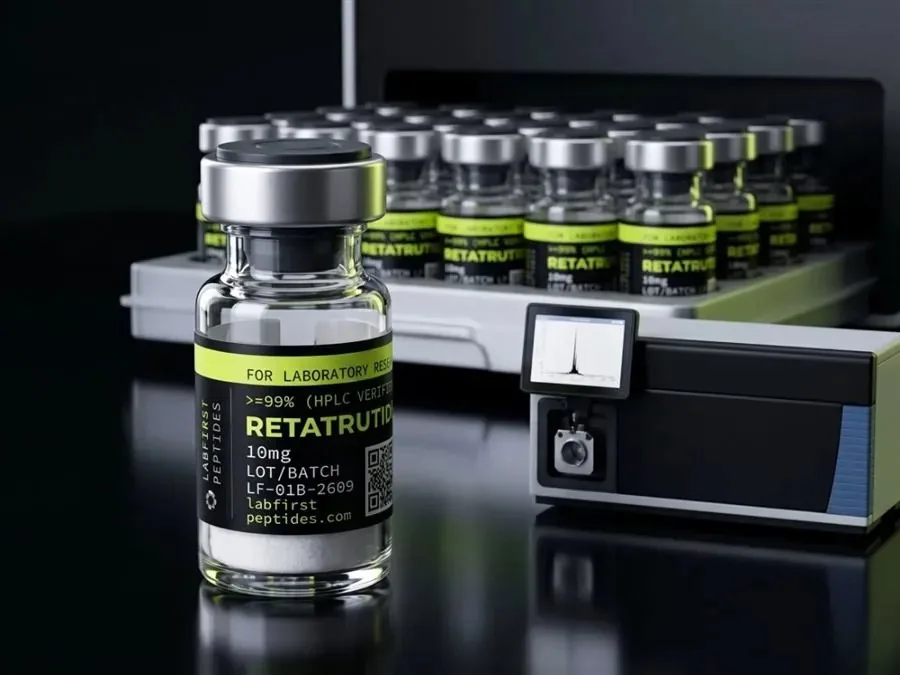
If you are comparing retatrutide peptide buy listings, the short answer is this: order from a supplier that publishes a laboratory certificate for the exact lot you receive, and check that certificate yourself before the box is opened. Everything else in this guide is detail on how to do that in a few minutes.
Retatrutide is a synthetic peptide with the molecular formula C221H342N46O68 and an average molecular weight of about 4,731 g/mol. It is sold to laboratories as a research material, for in-vitro work only, and it is not for use in people or animals. That is also why the buyer carries the burden of checking. Nobody inspects the vial on the way to the bench except the person who ordered it.
What does the certificate have to show?
A certificate of analysis is only useful if it names four things: the laboratory that ran the test, the method used, the lot tested, and the date. Leave any one of those out and the paper is a brochure.
The lot number is the hinge. It has to appear on the vial label and on the certificate, and the two have to match character for character. A certificate for a different lot, however good the numbers look, tells you nothing about the vial in your hand. A single year-old certificate attached to every product on a page is a borrowed document, and the first thing to rule out.
A supplier that is serious about this publishes a certificate of analysis for every lot it sells, on a page you can reach without logging in or asking. LabFirst Peptides, a research-peptide supplier in Santa Ana, California, runs its catalog that way, with a certificate published per lot and the lot number printed on each label. The pattern is easy to recognize once you have seen it.
Why is mass spectrometry the identity test?
Purity and identity are two different questions, and a buyer who confuses them can be fooled by a clean-looking number.
Identity asks: is the compound in the vial retatrutide at all? The test that answers it is mass spectrometry. The instrument measures the mass of the molecule and the laboratory compares that measured mass to the expected value for the sequence. For retatrutide the expected average mass is roughly 4,731 Da. A measured mass that lands on that figure, within the instrument’s stated tolerance, confirms identity. A measured mass that lands somewhere else means the vial holds something other than what the label says, no matter how pure that something is.
Purity asks a narrower question: of the material in the vial, what fraction is the main peak? That is HPLC, and it is reported as a percentage. A vial can read 99 percent pure on HPLC and still be the wrong peptide, because HPLC measures how much of one thing is present, not what the thing is. So a certificate that shows HPLC alone has skipped the harder half of the test.
There is a plain guide to how to verify a retatrutide certificate that walks through a real report field by field, which is faster than reading the method chapters.
Who ran the test, and can you check with them?
The certificate should come from a third-party laboratory, not from the seller’s own bench, and ideally from one accredited to ISO/IEC 17025, the international standard for testing laboratories.
The practical check is whether you can confirm the report with the laboratory rather than with the seller. Accredited labs issue reports with a reference number or a QR code that resolves on the lab’s own site. If the only place a certificate exists is the seller’s product page, you are taking the seller’s word for the seller’s work.
What about endotoxin and net content?
Two more fields separate a careful supplier from a casual one.
Endotoxin testing, run under USP General Chapter <85> using LAL methods, reports bacterial endotoxin in endotoxin units. For research material the figure matters because endotoxin interferes with cell-based assays. A certificate that reports it, with the method named, is a certificate from a lab that was asked the right questions.
Net peptide content is the other one. A lyophilized vial labeled 10 mg can contain well under that mass of actual peptide, because the powder includes counter-ions and water. Net content is measured separately from purity, by a different method, and should be reported as its own line. Purity and net content are not the same number and should never be presented as if they were.
How should it arrive, and how should it be stored?
Lyophilized retatrutide ships as a dry powder in a sealed vial. It should arrive cold, in insulated packaging, and the supplier should state its storage range on the label and on the product page. A label that says nothing about temperature is a label written by someone who did not expect the buyer to ask.
A supplier shipping from inside the United States, with tracking at dispatch, keeps a cold-chain parcel out of customs.
What are the red flags?
- One certificate reused across many products or lots.
- A certificate with no lot number, no laboratory name, or no date.
- HPLC purity shown with no mass spectrometry identity result.
- A certificate you cannot confirm with the laboratory that issued it.
- Purity and net content reported as one figure, or net content missing.
- No storage range on the label or the page.
- Claims about results in people. Research material is for in-vitro work, and a supplier making those claims has stopped selling research material.
The check, in order
- Find the lot number on the listing and confirm a certificate exists for that lot.
- Read the certificate for lab name, method, lot and date.
- Confirm mass spectrometry identity against the expected mass, about 4,731 Da.
- Read HPLC purity and net content as separate lines.
- Look for endotoxin reported under USP <85>.
- Confirm the report with the laboratory, not the seller.
- Match the lot on the vial to the certificate when the box arrives.
LabFirst Peptides publishes a certificate for each lot it sells, which makes steps 1 and 7 a quick job.
Common questions
What is the difference between purity and identity on a retatrutide certificate? Identity, by mass spectrometry, confirms the compound is retatrutide. Purity, by HPLC, reports what fraction of the material is the main peak. A vial can score high on purity and still fail identity.
How do I know a certificate belongs to my vial? The lot number on the certificate must match the lot number printed on the vial label. If they differ, the certificate does not describe your vial.
Should the certificate come from the seller or a third party? A third party, ideally an ISO/IEC 17025 accredited laboratory, with a report you can confirm on the lab’s own site.
LabFirst Peptides supplies research materials for laboratory use only, not for human or animal use.