Beating the Mojave: How 346 Unsupported Miles, a $30 Gas Station Sweater, and a System Meltdown Forged an Ultra-Cycling FKT
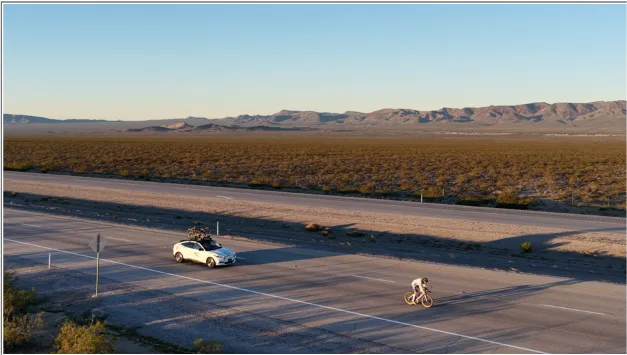
Two weeks after crossing the finish line at the Ironman World Championship for the third time, Andy Funk found himself standing at the edge of the desert outside Chase Field in Phoenix, Arizona. He wasn’t there to watch a ballgame. He was clipping into his pedals to launch The Bullet—a newly minted 346-mile ultra-distance route across Arizona, California, and Nevada, finishing at the iconic ‘Welcome to Fabulous Las Vegas’ sign. The attempt was part of Vegas In 24™, a brutal circuit of four single-day, unassisted desert crossings originally conceived by Funk in 2016, and now operated by Ho’omau Endurance Co, which he founded in 2024.
Under the circuit’s strict “Desert Code,” riders must navigate the full distance in 24 hours or less. While a support vehicle follows for safety, medical emergencies, and continuous video logging, crew members are strictly forbidden from handing off hydration, providing draft protection, or assisting with mechanical repairs during the attempt.
When Funk touched down at the Vegas sign 19 hours, 12 minutes, and 18 seconds later, he set the inaugural Fastest Known Time (FKT) for The Bullet. But the official clock masks a harrowing 346-mile exercise in extreme problem-solving, environmental survival, and sheer refusal to quit.
The 100-Mile Garmin Ghost
Trouble began early. Leaving Phoenix at 4:40 PM, Funk settled into a target power output of 210 watts—a calculated pace designed to preserve his legs for the brutal climbs stacked at the tail end of the course. However, a malfunction on his primary GPS unit began feeding him erratic distance data. Four hours into the ride, the display indicated he was only 72 miles into the course, leaving him drastically behind pace to reach his first critical rest stop in Salome, Arizona (Mile 103) before the store’s 10:00 PM closure.
Faced with the prospect of being locked out of his only nutrition supply for 80 miles—a disaster that would force a DNF less than 5 hours into the race—Funk surged his power output to 230 watts, averaging 24 mph over the next hour to beat the clock.
Upon rolling into the Dollar General in Salome, Funk discovered the truth: the store was far from closing, and he had arrived well ahead of schedule. The GPS unit had simply frozen its distance tracking intermittently, resulting in the display of a shorter overall distance ridden. In his bid to avoid a fatal logistical error, he had burned vital physiological matches way too early on a course that saves its steepest gradients for the final third.
The Hypothermia Trap & “The Gas Station Sweater”
By the time Funk reached the California agricultural inspection station on the high desert plateau near the I-95 Vidal Junction, he had been riding in total darkness for over seven hours. An unexpected post-storm cold front lingered across the region, dropping temperatures into the upper low 50s. Biting northern headwinds pushed the effective wind chill down even further.
Dressed in a thin skin suit optimized for aerodynamics rather than thermal insulation, shivering set in. Funk lost all sensation in his hands and feet, and his heart rate plummeted from 130 bpm down to under 110 bpm despite continuous pedaling effort—a classic indicator of an acute hypothermic event.
To compound the crisis, his primary headlight failed unexpectedly on the pitch-black plateau just five hours into its rated 13-hour battery life. Navigating rough desert asphalt with minimal forward illumination, Funk was forced to coast down key descents at reduced speeds to prevent the possibility of a high-speed crash.
“For the first time in my 30 years as a cyclist, I had to ask myself if continuing at all was worth the potential risks,” Funk admitted during his post-race debrief interview.
Arriving at a Needles gas station just before 4:00 AM – still noticeably shivering – he adapted: he purchased a $30 oversized gas station sweater and a hot tea. The bulky fleece created substantial aerodynamic drag and sitting upright to maintain control sacrificed every aero advantage he had engineered for his “Bullet Masterplan.” Yet, that $30 sweater saved the day and the attempt, allowing his core body temperature to stabilize enough to push back out into the night toward Las Vegas.
The Final Third: A 35-Mile Vertical Battle
If the first 240 miles of The Bullet test a cyclist’s aerodynamic efficiency and mental resolve, the final 100 miles test their raw physical durability.
Packing over 35 miles of net elevation gain into its final third—including a 17-mile mountain ascent followed by the relentless crawl to Searchlight—the route forces athletes to climb on depleted glycogen stores and exhausted legs. Battling a dead-on headwind and riding through the drag of his makeshift sweater, Funk reached Searchlight shortly after sunrise.
As temperatures rose into the low 60s, a sense of physical normalcy returned. However, the cumulative cognitive overload—the early 100-mile surge to Salome, the hypothermia on the plateau, and hours in the dark without a headlight—triggered severe central nervous system fatigue. At a red light just miles from the finish on Las Vegas Boulevard, Funk’s motor coordination failed. Unable to unclip his shoe in time, he suffered a slow-motion tip-over onto the pavement.
The fall snapped his Garmin mount. As he stashed the computer inside his tight suit, the touchscreen accidentally triggered a “Discard Activity” command, wiping his onboard telemetry data. While the effort was officially verified via the continuous multi-camera video feed mandated inside the support vehicle, Funk noted that not being able to analyze your metrics after such a massive effort is “simply cruel.”
The Anatomy of an Ultra Finish
Funk rolled up to the iconic Las Vegas sign at 11:52 AM, completing the 346-mile traverse in 19 hours, 12 minutes, and 18 seconds.
While the attempt yielded an inaugural record, Funk views the ride less as a personal achievement and more as a proof-of-concept for the overall Vegas In 24™ framework and the global Ho’omau Endurance platform he built. The lesson of The Bullet isn’t merely about enduring suffering; it is about pre-race planning and the tactical execution required when every system fails around you. Funk is already looking ahead to a return to The Bullet, confident he can break the 18-hour barrier under optimal conditions.
“Ultra-cycling isn’t a sport where everything goes according to plan,” says Funk. “It’s a roulette wheel, which is one of the many reasons our circuit ends in Las Vegas. The desert will throw cold fronts, extreme winds, equipment failures, and mental fatigue at you all at once. Beating the Mojave isn’t about avoiding those problems—it’s about having the fitness, guts, and clarity to solve them at 3:00 AM in the middle of nowhere.”
What’s next for the Vegas In 24 ultra-cycling circuit? Funk plans to tackle the 400-mile “Skyway” route in 2027—the most mountainous challenge on the circuit with nearly 20,000 feet of elevation gain—as he inches closer to earning induction into the Vegas In 24™ Hall of Fame.