More than half of the office workers currently have pain or discomfort from computer work, but only just over one in four of them has asked their employer for ergonomic equipment, shows new survey made by Contour.
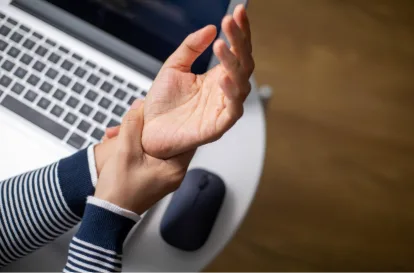
Fifty-two percent of the office workers surveyed currently have pain or discomfort they associate with their computer work. That is according to a survey conducted by Kvadrant Consulting on behalf of Copenhagen-based Contour, the company behind the ergonomic RollerMouse.
The survey covered 1,602 office workers, decision-makers, health professionals and workplace assessors in Denmark, Sweden, Norway, Germany, France, the U.K. and the U.S.
When discomfort sets in, most people try to fix it themselves, and 59% of those who currently have pain or discomfort have adjusted their posture or workstation setup on their own. Only 27% have asked their employer for ergonomic equipment, which is equivalent to about 14% of all the office workers surveyed.
“Sore shoulders, a stiff neck and a wrist that starts to complain late in the afternoon are, unfortunately, part of everyday life for many people, but nobody should have to go around in pain at work. It is a frustrating paradox that so many people are in pain and that help is available, yet so few ask for it,” says Lars Christian Lund, CEO of workplace health company Contour.
Help should be there from day one
In the survey, 84% of the decision-makers say their organization provides an ergonomic keyboard or mouse when an employee asks for one. This is the decision-makers’ own assessment of their organization’s practice, and they are not the employers of the office workers in the survey.
Among the office workers surveyed, only 5% say that every employee at their workplace receives an ergonomic keyboard or mouse when they start the job, while 37% say employees can ask for one and get it, and 17% say it requires approval from a manager or HR.
“It is good that help is available in many places, but it shouldn’t be reactive and depend on individuals taking the initiative themselves. So my advice to employers is not to wait to be asked, but to offer the right workstation from the very first day on the job, because that is what workplace health means to us,” says Lars Christian Lund.
Ergonomics pays off
According to the European Agency for Safety and Health at Work (EU-OSHA), musculoskeletal disorders (MSDs) remain the most common work-related health problem in the European Union, and absence due to MSDs accounts for a large share of the working days lost in EU member states. A 2015 analysis also estimates that lost productivity from MSDs among working-age people in the EU could amount to as much as 2% of GDP.
For office workers, more than four hours a day at the computer or mouse is linked to a 25% higher risk of new arm, neck and shoulder complaints, according to a meta-analysis of prospective studies.
“For employers, having help in place before discomfort becomes a problem is not only a matter of well-being, but also of common sense, and at the same time a way to reduce the cost of sick leave,” says Lars Christian Lund.
About Contour: Contour is a workplace health company that helps organizations build healthier, safer and more sustainable workplaces. Contour develops ergonomic keyboards, mice and pointing devices that take strain off shoulders and wrists, as well as medical keyboards and mice that are easy to disinfect, from shared workstations to the point of care. Its designs are tested in independent labs and in Contour’s own ErgoLab, and many are built with replaceable parts so they last longer. More than 2 million Contour devices have been sold since 1995. Contour is headquartered in Copenhagen, Denmark.