Rainbow Six Siege Cheating Explained: Aimbots, ESP, DMA Hardware, and the Risks Players Should Know
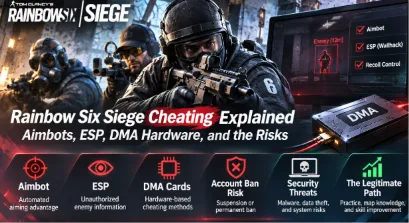
Rainbow Six Siege is a competitive, tactical shooter that is all about information, positioning, timing, communication and precision. The community has always been concerned about the possibility of cheating, as any slight edge given can make a difference in a round. However, players might come across terms such as software cheats, wall info, automated aiming, or hardware-assisted, but what is meant by these terms and why are they so controversial?
Cheating has more than just an impact on individual games. It erodes the integrity of competition, it becomes frustrating to those who play according to the rules and it can lead to penalties on accounts, malware, and the potential theft of credentials and more security issues. Knowing the terrain around them, players can be better able to identify suspicious activity and make safer decisions on third-party tools.
What Players Mean When They Talk About Rainbow Six Siege Cheats
Changing the meaning of a tool that would not otherwise give the player information or control. They are typically: aim assistance, enemy-location overlays, recoil manipulation, and other types of unauthorized game modifications.
The phrase r6s hacks is used in many ways; for instance, the phrase could represent a number of types described under each category. Some tools work directly within game software, others try to work outside of the game. Whatever way it is done, cheating on a game does not respect the game’s terms and conditions and can lead to suspension or permanent ban.
The key takeaway is that not all third party tools are per se bad or banned. Performance monitoring software, accessibility tools, and legitimate overlays (depending on how they work) may be permitted. Players are always encouraged to read the rules of the game before using any object that interacts with the game.
Aimbots and ESP Change the Core Competitive Experience
Aimbot is a tool that helps or fully automates the targeting process. They can try to lure the player’s aim closer to another player or make it easier to aim. In a game like Rainbow Six Siege where the ability to react and make accurate shots is vital to success, this presents a clear imbalance.
In general, ESP – or extra-sensory perception overlay – are tools that show information which should not be seen by the player. This could be enemy positions, distances, health information, or other secrets. Siege is largely a game of limited information, sound effects, drones, cameras and team communication, so any information not given to the team can have a big impact on the game.
These tools can also help other players to detect suspicious activity more easily. Reports from players, impossible pre-aiming and perfect reactions over a period of time may result in an investigation of the play.
Why DMA Hardware Is Discussed in Modern Anti-Cheat Conversations
There has been greater attention on hardware assisted cheating as it may be performed in a different way from software-based cheating. The term Dma cards Rainbow six siege usually describes the conversation on Direct Memory Access hardware reading certain information from a system with a view of trying to avoid the normal methods of detection.
In itself, DMA technology is not malicious. Direct Memory Access is not a fake computing principle; it is in fact employed in numerous hardware and system applications. The issue comes when hardware is utilized in a particular way to acquire an unfair benefit in an on the web game.
Modern anti-cheat systems look at behaviour, interactions with the system, unusual input patterns and more, instead of just one method to detect cheating. This does not always mean that external hardware to hide from detection is safe and undetected.
The security risks are often underestimated.
Not only is there the danger of getting banned from a game, one of the biggest dangers with cheat software is the risk of installing untrusted code. Unregulated tools can ask for administrator permission, block security settings or require users to execute files they do not know.
This provides a way for malware, credential theft, ransomware, browser-session theft, or cryptocurrency-mining software to exploit the user. A player who seeks a competitive edge might open themselves up to hacking into email, payment, gaming or personal files.
This risk also extends to “modified” drivers, loaders, injectors or other software that is said to have the ability to circumvent security systems. User requests to loosen antivirus security or turn off operating system security should be taken seriously.
Account Bans Can Have Long-Term Consequences
Competitive games usually employ a mix of automated detection, player reports, server side analysis and manual review. Consequences of a ban include the loss of progression, purchased content, ranked history, cosmetics or access to an account altogether.
It should also be noted that anti-cheat technology is a dynamic process that changes over time. A tool that does not currently seem to be detected could be detected in the future. Sometimes detection occurs in waves; users can be penalized days or weeks after using software prohibited.
Whereas the long-term benefits of cheating might be short-term, but if you are someone with an account with tons of value or have a lot of progression, the loss of that can be quite immense.
A legitimate improvement is better sustainable.
Rainbow Six Siege values knowledge as much as skills. Through map layout, common angles, help from the operator, sound cues, recoil patterns, and team coordination, players can develop much more.
There are various ways to enhance performance without risking an account, which are all facilitated by the aim trainer, custom matches, replay reviews, sensitivity adjustments, and structured practice. Learning about professional gameplay can also be beneficial for understanding positioning, timing and utilising.
Developing by legitimate practice may take longer but will yield skills that will continue to be valuable throughout updates, seasons and competitive settings.
Final Thoughts
The cheating in Rainbow Six Siege isn’t as straightforward as just downloading some software. The use of Aimbots, ESP tools, and hardware-assisted methods brings up concerns regarding competitive justice, account security, and individual cyber safety.The use of Aimbots, ESP tools and hardware-assisted methods raises questions about competitive justice, account security, and individual cyber security.
Knowing these risks allows players to know what to look out for and not use unsafe third-party tools. As a tactical game where information and decision-making are integral to winning, legitimate improvement is the best method to develop skill, secure an account and enjoy the competitive experience over time.