How Digital Transformation Is Reshaping the Future of Manufacturing Businesses
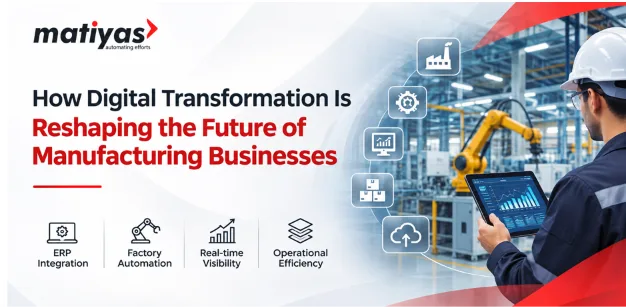
Manufacturing is entering a period in which speed, visibility and the ability to make informed decisions are becoming as important as production capacity. Customer expectations are changing, supply chains remain exposed to disruption, and businesses are under pressure to control costs while maintaining quality. In this environment, digital transformation in manufacturing is no longer simply about replacing paper records with software. It is about connecting people, machines, materials and business systems so that decisions can be made using reliable, timely information.
For manufacturers, the change is both operational and strategic. A connected factory can identify production delays earlier, respond to material shortages and show managers how shop-floor activity affects delivery performance and profitability. The goal is a more responsive, measurable and resilient operating model.
From Digitization to Enterprise Digital Transformation
Digitization converts information into a digital format. Digitalization uses technology to improve an existing task, such as recording quality checks on a tablet instead of paper. Enterprise digital transformation goes further: it changes how the organization works by redesigning processes, connecting departments and using data to guide decisions.
A change in customer demand affects sales forecasts, purchasing, material availability, production schedules, warehouse activity and finance. When each function works with separate spreadsheets or disconnected applications, teams may act on different versions of the same information.
A manufacturing digital transformation program therefore needs to connect the entire business, not just automate individual machines. It should link operational technology on the factory floor with enterprise systems used by planning, procurement, inventory, sales and finance.
Why Digital Transformation Matters for Manufacturers
Better Visibility Across Production
Manual updates and disconnected systems make it difficult to know what is happening across multiple production lines or facilities. Digital production records and live dashboards can show supervisors machine status, work in progress, downtime and output, helping teams investigate delays and coordinate corrective action.
More Dependable Planning and Inventory Control
Production plans rely on accurate demand, raw-material, work-in-progress, capacity and supplier data. When these details are scattered across systems, shortages and excess stock can go unnoticed. Integrated manufacturing inventory management and planning tools help businesses compare requirements with available stock, track material movement and make purchasing decisions with better context.
Consistent Quality and Traceability
Digital quality records can connect inspection results, production batches, materials and corrective actions. This makes it easier to investigate a defect, identify affected orders and understand where a process needs attention. In sectors where batch history and product traceability are important, reliable records can support audits and customer confidence.
Faster, More Informed Decisions
When operational and financial data are connected, leaders can move beyond periodic reports assembled manually. They can review indicators such as production output, scrap, order status, material costs and delivery performance together.
The Technologies Driving Industrial Digital Transformation
Industrial IoT and Connected Equipment
Sensors and industrial Internet of Things (IIoT) devices can capture information such as temperature, vibration, energy use, cycle time and machine status. When this information is collected consistently, manufacturers can identify patterns, monitor assets and investigate performance changes.
Artificial Intelligence and Advanced Analytics
Artificial intelligence can support demand forecasting, anomaly detection, visual quality inspection, maintenance planning and production optimization. A 2026 KPMG report on industrial manufacturing found that 49% of surveyed executives said active AI use cases were already delivering business value, while 76% cited unreliable data as a leading AI risk. The message is clear: AI adoption needs strong data foundations, not just new tools. The findings appear in KPMG’s Global Tech Report 2026: Industrial Manufacturing.
ERP as the Business Integration Layer
ERP systems connect processes that are often managed separately, including purchasing, inventory, production, sales, accounting and order management. In a manufacturing environment, an ERP platform can bring bills of materials, work orders, stock availability, procurement requirements and financial records into a shared workflow.
This is where ERP and digital transformation become closely linked. Manufacturing ERP software does not replace every specialist production or machine-control system. Instead, it can provide a common business record and coordinate information between departments and connected applications.
Automation, Digital Twins and Smart Factories
Robotics, automated material handling and machine-control systems can reduce repetitive manual tasks and improve process consistency when implemented appropriately. Together with connected data, these tools contribute to smart factory digital transformation and the wider Industry 4.0 shift.
Automation should follow process improvement. Automating an inefficient workflow can amplify problems, so manufacturers should define the desired outcome before selecting technology.
The Challenges That Can Slow Transformation
Legacy equipment and applications are common obstacles. Many factories also have separate systems for production, inventory, maintenance and finance. Integration can be difficult when data formats, identifiers and processes are inconsistent.
Cybersecurity also deserves attention. As operational technology becomes more connected to enterprise IT and external networks, the number of potential access points can increase. PwC’s 2026 manufacturing cybersecurity outlook highlights how the growing connection between IT and operational technology is expanding cyber exposure across industrial businesses. Security therefore needs to be considered during system selection, integration and ongoing maintenance, rather than added at the end. PwC discusses these risks in its 2026 Cybersecurity Outlook for Manufacturing and Industrial Products.
People and change management are equally important. Employees need to understand why processes are changing and how new systems affect their roles. Without training and clear ownership, even well-designed tools can remain underused. Involving operators and supervisors early helps ensure workflows reflect real conditions.
Building a Practical Manufacturing Digital Transformation Roadmap
A successful manufacturing digital transformation roadmap should begin with business priorities rather than a technology shopping list.
- Assess Current Processes and Systems. Map how orders move from customer enquiry to production, dispatch and invoicing. Identify duplicate data entry, manual approvals, recurring delays and gaps in reporting. Review existing machines, applications and integration requirements.
- Set Measurable Goals. Choose a small number of outcomes, such as reducing schedule changes, improving inventory accuracy, shortening order processing time or increasing visibility into production delays. Establish a baseline before implementation so progress can be evaluated.
- Design the Enterprise Architecture. Decide which system should own key information, how shop-floor equipment will connect to business applications and which data needs to be shared. A clear architecture helps prevent new technology from creating another isolated data source.
- Start with a Focused Pilot. Select one plant, production line or workflow where the business case is clear. Test the process, gather feedback, resolve integration issues and measure results. Use what is learned to improve the design before expanding across the organization.
- Prepare People and Protect Operations. Provide role-based training, document new procedures and assign responsibility for data quality. Include access controls, backups, monitoring and cybersecurity reviews in the implementation plan.
What Comes Next for Manufacturing?
The next phase of industrial digital transformation is likely to involve more connected operations, broader use of AI and closer collaboration between people and intelligent systems. The National Institute of Standards and Technology’s 2026 roadmap for AI in smart manufacturing identifies industrial data management, integration across different sensing and control systems, trustworthy AI and applications such as digital twins and supply chain optimization as important areas for progress. See the NIST 2026 Roadmap on AI and Machine Learning for Smart Manufacturing.
Each factory will move at a different pace. The strongest enterprise digital transformation strategy matches investment to operational readiness and delivers value in stages.
Take the Next Step with Matiyas Solutions
Digital transformation becomes practical when technology is connected to the way a manufacturing business actually works. Matiyas Solutions LLP is a certified Frappe and ERPNext partner, offering ERPNext implementation, customized modules and workflow development. For manufacturers looking to bring production, inventory, purchasing, sales and finance processes into a more connected environment, the team can help assess requirements and shape an ERP approach around business needs.
Explore ERPNext implementation and manufacturing ERP solutions from Matiyas Solutions to discuss how an integrated system could support your organization’s next stage of growth.