
What Is a Tirzepatide Calculator and How Does It Help Explain Medication Measurements?
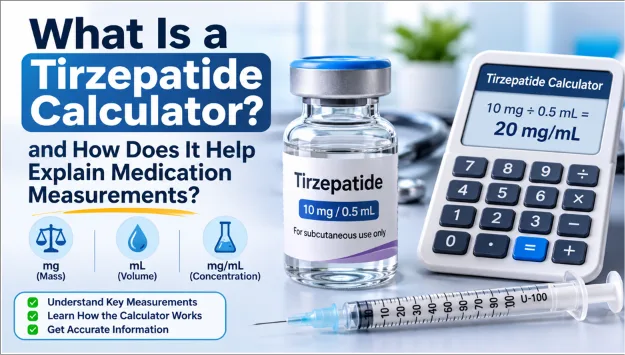
Introduction
Understanding injectable medication measurements can be confusing, particularly when product labels use several different units. Milligrams describe the amount of medication, milliliters describe liquid volume, and concentration explains how much medication is contained in a given volume. These terms are related, but they are not interchangeable. A misunderstanding can make it difficult to interpret product information or understand a calculation.
A digital medication calculator can help explain the mathematical relationships between these measurements. However, its usefulness depends on accurate information and a clear understanding of what the result represents. With tirzepatide, product presentation and labeling are especially important because different formulations may have different strengths and concentrations.
What Is Tirzepatide and Why Do Medication Measurements Matter?
Tirzepatide is a prescription medication that acts on two hormone receptors: glucose-dependent insulinotropic polypeptide (GIP) and glucagon-like peptide-1 (GLP-1). In the United States, it is marketed in products approved for specific medical uses, including managing type 2 diabetes and, in eligible patients, chronic weight management. Its use and prescribing requirements depend on the particular product and the patient’s clinical circumstances.
Medication measurements matter because the amount of active ingredient and the volume of liquid are two separate pieces of information. A label may state a strength in milligrams while also specifying the volume in milliliters. Understanding the relationship between these figures helps readers interpret the product information without assuming that a particular volume always represents the same amount of medication.
Three basic terms provide a useful starting point:
- Strength: The stated amount of active medication in a product or dose.
- Volume: The quantity of liquid, usually expressed in milliliters (mL).
- Concentration: The amount of medication contained in a specific volume, commonly expressed as mg/mL.
What Is a Tirzepatide Calculator?
A tirzepatide calculator is a digital tool designed to explain or calculate mathematical relationships between medication amount, liquid volume and concentration. Depending on the tool, users may enter information such as a stated vial strength, solution volume and a measurement value supplied by a healthcare professional. The calculator then processes those figures using mathematical conversions.
A tool like a tirzepatide calculator is meant to make measurement relationships easier to understand, not to decide how much medication someone should take. A calculator can process the information entered, but it cannot confirm that the information matches the actual product or determine whether a dose is appropriate for an individual.
Its role is therefore limited to mathematical support:
- Explaining relationships between medication amount and liquid volume.
- Converting compatible measurement units.
- Helping users understand calculation results.
- Reducing the need for repeated manual arithmetic.
A result is only as reliable as the information entered.
Understanding mg, mL, mg/mL and Syringe Units
Milligrams and milliliters measure different things. A milligram (mg) is a unit of mass, while a milliliter (mL) measures liquid volume. You cannot substitute one for the other. To understand how much medication is in a liquid, you need to consider concentration, which describes the amount of medication per unit of volume.
For example, mg/mL expresses how many milligrams of a substance are contained in one milliliter of liquid. Syringe markings introduce another measurement system. With a U-100 insulin syringe, the scale is based on 100 units per milliliter. These markings describe liquid volume, not the mass of medication inside it.
| Measurement | What it represents | Meaning |
| mg | Mass | Amount of medication |
| mL | Volume | Amount of liquid |
| mg/mL | Concentration | Medication mass per unit of liquid volume |
| U-100 units | Syringe scale | 100 units per 1 mL |
These distinctions are important because the units are not interchangeable. A syringe unit does not automatically represent a particular number of milligrams. You must know the medication concentration before you can relate a volume measurement mathematically to the amount of active ingredient.
Why Medication Concentration Matters
Concentration determines how much medication a particular volume of liquid contains. Two solutions can contain the same total amount of medication but have different concentrations if their liquid volumes differ. Equally, two products with the same stated volume may contain different amounts of active ingredient. This is why a volume figure alone cannot explain the amount of medication present.
The product label is the best place to start when understanding concentration. Readers should not assume that two tirzepatide products have identical formulations simply because they contain the same active ingredient. Product strength, total volume, and concentration may vary between presentations. Do not transfer information from one product to another without confirming it in the official labeling or with a qualified healthcare professional.
Before interpreting a measurement, it is important to distinguish:
- The stated product strength.
- The labeled liquid volume.
- The concentration, where provided.
- The specific product presentation and instructions.
These details help prevent confusion when comparing product information or interpreting a mathematical conversion.
How a Tirzepatide Calculator Explains Measurement Relationships
A medication calculator applies mathematical relationships to the values supplied by a user. In general terms, concentration connects the mass of a substance with the volume of liquid it is in. When the relevant values are known and expressed in compatible units, a calculation can show how these measurements relate. This is a mathematical explanation, not a recommendation about how much medication to use.
Digital tools can make these relationships easier to follow by processing numerical inputs and displaying corresponding conversions. They may also reduce simple arithmetic errors. However, a calculator cannot independently determine whether an entered strength, volume or concentration is correct. Incorrect or incomplete information can produce a result that appears precise but does not accurately describe the product.
Responsible interpretation depends on three considerations:
- Input accuracy: Values must match reliable product information.
- Calculation consistency: Units must be compatible with the mathematical relationship being used.
- Result interpretation: A numerical conversion must not be mistaken for a prescribing instruction.
Approved Tirzepatide Products and Compounded Preparations
Tirzepatide products are not necessarily supplied in one identical format. In the United States, FDA-approved products include different presentations, such as single-dose pens, single-dose vials, and multi-dose formats. Available strengths, volumes, and instructions depend on the specific product and its current labeling. Readers should consult the official information for the exact presentation they have been prescribed rather than relying on a general online example.
MOUNJARO- tirzepatide injection, solution+1
Compounded preparations are a separate category and should not be treated as interchangeable with FDA-approved products. Their formulations, concentrations and presentations may differ. The FDA has also raised concerns about dosing errors involving unapproved GLP-1 products, including errors associated with measuring and administering compounded medications. These differences make it particularly important not to transfer measurements or assumptions from one preparation to another.
FDA
Three factors should always be distinguished:
- Product labeling: The official strength, volume and instructions.
- Presentation: Whether the medication is supplied in a pen, vial or another format.
- Regulatory status: Whether the product is FDA-approved or compounded.
What a Tirzepatide Calculator Cannot Tell You
A calculator can process numerical information, but it cannot independently verify what is inside a medication container. It cannot establish a product’s identity, authenticity, sterility, quality or suitability for a particular person. It also cannot determine whether a product has been stored correctly or whether its packaging and labeling are reliable. Those questions require appropriate product verification and professional guidance.
Most importantly, a mathematical result is not a prescription. A calculator cannot assess a person’s medical history, treatment response, other medications or individual clinical needs. It cannot decide whether a dose should be started, changed or repeated. If a calculated result does not match the instructions provided by a prescriber or pharmacist, users should not choose between the conflicting figures themselves. They should pause and ask the relevant healthcare professional to clarify the information.
Using Digital Medication Tools Responsibly
Digital medication tools are most useful when they support understanding rather than replace professional advice. Before entering information, users should consult the official product label and make sure the figures correspond to the exact medication presentation. It is also important to check that the units are clearly identified. A number without its measurement unit can be misleading, even when the arithmetic is correct.
When a calculation seems unexpected, the safest response is to verify the source information rather than repeatedly changing values until the result looks familiar. A pharmacist or prescriber can help explain unclear labeling, confirm which product information applies and resolve differences between a calculator result and professional instructions. Educational platforms such as Peptide Dose Calculator can provide a starting point for understanding measurement relationships, but their outputs should remain educational.
A sensible approach involves three steps:
- Verify the product information against its official labeling.
- Understand which measurement each value represents.
- Confirm unclear or conflicting information with a qualified healthcare professional.
Conclusion
A tirzepatide calculator can make medication measurements easier to understand by showing how mass, liquid volume, and concentration relate mathematically. It can also help explain conversions that may otherwise seem confusing. However, accurate results depend on correct inputs and information that matches the exact product presentation. Approved products and compounded preparations should never be assumed to share the same measurements or instructions.
Most importantly, a calculator cannot prescribe medication, verify product quality or replace a pharmacist’s or prescriber’s guidance. Used as an educational resource rather than a dosing authority, Peptide Dose Calculator can help readers approach medication measurements with greater clarity and care.
Frequently Asked Questions
1. What is a tirzepatide calculator?
A tirzepatide calculator is a digital tool that helps explain mathematical relationships between medication amount, liquid volume, and concentration. Depending on its features, it can process supplied values and display measurement conversions. It does not determine an individual’s prescribed dose or replace professional medical guidance.
2. What is the difference between mg and mL in tirzepatide measurements?
Milligrams (mg) measure the mass of the medication, while milliliters (mL) measure the volume of liquid. They describe different properties and cannot be directly substituted for one another. Concentration, usually expressed as mg/mL, connects the amount of medication with the volume of liquid.
3. What does mg/mL mean on a medication label?
The measurement mg/mL describes medication concentration. It indicates how many milligrams of active ingredient are contained in one millilitre of liquid. Understanding this value helps explain the relationship between medication strength and liquid volume when interpreting product information.
4. Are U-100 syringe units the same as milligrams of tirzepatide?
No. U-100 syringe units represent liquid volume, not medication mass. A U-100 syringe is calibrated so that 100 units correspond to 1 mL. The amount of medication a particular volume represents depends on the solution’s concentration.
5. Can a tirzepatide calculator determine the correct dose?
No. A calculator can perform mathematical conversions using the information entered, but it cannot determine an appropriate dose for an individual. Dosing decisions must follow the prescription and guidance of a qualified healthcare professional. If a calculation conflicts with the product label or professional instructions, consult a pharmacist or prescriber.