
What the Gold Price Per Gram Means for the Jewelry in Your Drawer
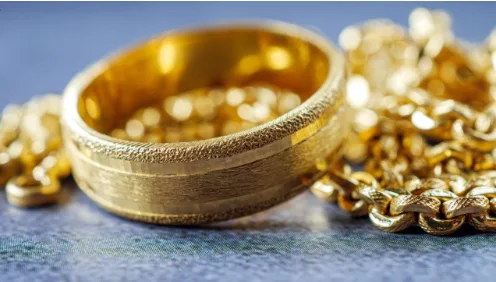
Americans search Google for “14k gold price per gram” about 135,000 times a month, according to Google Ads keyword data for the past 12 months. That is more than the 90,500 monthly searches for “gold price per gram” with no karat attached. Searches for the 14K figure peaked at 201,000 in January 2026.
The numbers suggest that many of these searchers are holding jewelry. Gold bars and bullion coins are pure or close to it. Fourteen karat is a standard for American wedding bands, chains and class rings.
From the ounce price to the gram price
Gold trades on world markets by the troy ounce, which is 31.1 grams. News reports quote that ounce price. Jewelry is weighed in grams, so the first step is to divide the ounce price by 31.1. Sites that track the live gold price per gram do that division as the market moves.
That figure is for pure, 24 karat gold. Almost no jewelry is pure, because pure gold is soft. Jewelers alloy it with metals such as copper and silver, and the karat stamp records how much gold is left.
What each karat is worth
Each karat is one twenty-fourth, so 14K gold is 14 parts gold out of 24. The table shows what a gram of each karat is worth if pure gold is priced at $100 a gram. The $100 figure is a round number chosen as an example.
| Karat | Gold content | Value per gram at $100 pure |
| 10K | 41.7% | $41.70 |
| 14K | 58.3% | $58.30 |
| 18K | 75.0% | $75.00 |
| 22K | 91.7% | $91.70 |
| 24K | 100% | $100.00 |
A 14K chain that weighs 10 grams holds 5.83 grams of gold. At the example price, the gold in it is worth $583.
How to find the karat and the weight
The karat is stamped on the piece, usually inside a ring band or on the clasp of a chain. American jewelry is marked 10K, 14K or 18K. Imported pieces often carry a three-digit number that states the gold content in parts per thousand, so 417, 585 and 750 match 10K, 14K and 18K.
Letters after the karat change the picture. GP means gold plated, GF means gold filled and HGE means heavy gold electroplate. All three describe a thin layer of gold over another metal, and the per-gram math does not apply to them.
For weight, a digital kitchen scale that reads in grams gives a workable estimate. Pieces of different karats should be weighed separately, since a gram of 18K is worth almost twice a gram of 10K. Some buyers quote by the pennyweight, an older jeweler’s unit of about 1.56 grams, so a seller comparing offers needs to confirm the unit.
What a seller is paid
The per-gram figure is the value of the metal, known as melt value. Jewelers, pawn shops and refiners who buy gold pay less than that, because they carry refining costs and need a margin. Offers vary between buyers, so sellers who know the melt value of their pieces can compare each offer against it.
The math has limits. It ignores gemstones, and it misses the premium that collectors pay for rare coins and for jewelry from sought-after makers. Those pieces can be worth more than their gold and are better shown to a specialist before they are sold by weight.
Before selling
The whole check takes five steps:
- Read the stamp on each piece and sort by karat.
- Weigh each group in grams.
- Multiply the weight by the karat’s gold content and by the day’s price per gram.
- Set aside anything with stones, a maker’s name or collector interest for a second opinion.
- Take the total to at least two buyers and compare their offers with it.
Gold prices change every trading day, so a figure worked out last week may be off by the time of a sale. Checking the price again on the day takes a minute, and it gives the seller the same starting number the buyer is working from.