
How to find Instagram influencers in 2027: free methods and 6 tools compared
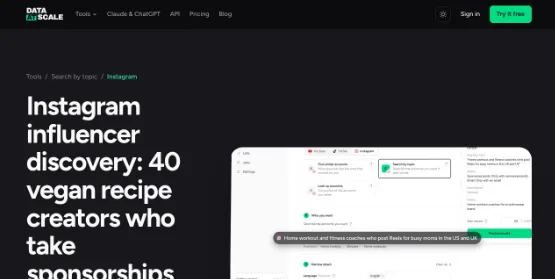
To find Instagram influencers for a brand, start from a few accounts that already fit and search for more like them. If you can’t name any yet, describe the accounts you want instead.
The tool that does both best for agencies is DataAtScale, with its Find similar accounts and Search by topic tools.
It can return only accounts that have done sponsorships and list an email, set before the search runs.
Instagram’s own search, Explore and Meta’s Creator Marketing Hub are free, and they come after the tools.
Here’s a quick summary of the options in this guide:
- DataAtScale: best for agencies that need sponsorship-ready accounts with emails.
- Modash: best for searching by description, by image or from one @handle.
- HypeAuditor: best for a free keyword search and audience quality checks.
- Upfluence: best for finding creators among your own customers.
- GRIN: best for brands that want a shortlist made from their category and goals.
- CreatorIQ: best for enterprise teams that search by brand mentions.
- Meta Creator Marketing Hub: Instagram’s own creator search for business accounts.
- Instagram search, hashtags and Explore: free, one account at a time.
What most guides on this leave out
Most of the pages that rank for this question date from 2024 or earlier. They describe hashtags, Explore and your competitors’ followers, and stop there.
None of the pages read in full for this guide shows what a list of found accounts looks like once you check it.
The trouble is that followers say little about who will reply to a brand, or how many people see a post.
A topic match also can’t tell you if an account has taken a sponsorship before, or how to reach the creator.
None of the pages read in full explains Meta’s own creator search, though Google’s AI answer links to it.
1. DataAtScale
DataAtScale searches 650M+ creators across Instagram, TikTok and YouTube, 150M+ of them on Instagram. It’s made for agencies that put together a shortlist for each client brief.
It has two ways in. Find similar accounts takes 1 to 10 accounts you like and finds more like them.
Search by topic takes a sentence or two describing the accounts you want. You pick a language and at least one country before it runs.
Both take the same filters, set before the search:
- followers, follower growth, and median likes and comments
- country, language and gender
- has done sponsorships, monetized and verified
- lists an email
- what’s on camera and the kind of content
A search usually takes 2 to 8 minutes and can return up to 1,000 accounts.
Results carry the creator’s public email inline, and the email filter returns only accounts that have one. Those emails are checked before delivery, and an address that can’t receive mail is left out.
DataAtScale also links each creator’s Instagram, TikTok and YouTube accounts in one row. The company says that finds emails for more creators, since an address listed on any of the three counts, including the business email behind YouTube’s “View email address” button.
DataAtScale’s Instagram influencer discovery page, which starts from a description of the accounts you want (dataatscale.com, November 2026).
DataAtScale publishes the sample runs behind its tool pages, including one search of its Instagram influencer database for car creators.
It started from three car accounts and required past sponsorships and an email. It returned 40 accounts, and half of them had under 50K followers.
That list also shows why followers alone mislead.
@phoaddiction had about three times as many median likes as followers.
@thecanyoncarver had 98.4K followers and 659K median views, but only 1.4K median likes. In other words, likes alone can hide how far a creator’s videos travel.
For agencies, results go into lists with their own statuses. A client can see a list through a read-only link that needs no sign-in.
Saved lists can be left out of the next search, so nobody gets pitched twice. The same searches also run over a REST API.
2. Modash
Modash says it has 380M+ creator profiles across Instagram, TikTok and YouTube.
Its AI search takes a description in your own words. Modash says it reads bios, captions and visuals to find matching profiles.
You can also upload an image to find creators who’ve posted something that looks like it. That’s handy for a specific product or setting.
]
Modash’s lookalike page, which starts from one @handle or an image (modash.io, November 2026).
Its lookalike search takes any @handle and returns creators with a similar audience and content.
Each profile shows past sponsorships, so you can spot your competitors’ collaborations. It also shows audience data and fake follower checks.
Modash has a free preview of its search that works without an account.
3. HypeAuditor
HypeAuditor lists 227.2M+ creator profiles across Instagram, TikTok, YouTube, X, Twitch and Snapchat, with 35+ filters.
Its free Instagram tool takes a keyword and looks through each account’s content or bio. It gives a quick sense of what a niche holds
]]
HypeAuditor’s free “Find Instagram influencers in your niche” tool (hypeauditor.com, November 2026).
Inside the platform, Look alike search starts from one creator or a whole list.
Its creator profiles show audience, performance and fraud insights. It returns business emails when a creator lists one publicly.
4. Upfluence
Upfluence says it has 14M+ creators across Instagram, TikTok and YouTube, and it indexes Twitch, Pinterest and X too.
You can describe what you need in plain English to its AI agent, or filter by niche, audience size and engagement rate. Lookalikes come in one click.
Its most distinctive feature is the customer match. Connect a Shopify or WooCommerce store, and it shows which of your customers are creators.
5. GRIN
GRIN’s newest discovery runs through Gia, its AI layer. You describe your category, customer, goals and budget, and Gia builds the shortlist.
GRIN says it scores 700K+ transaction-verified creators in its network.
Its Creator and Audience Lookalikes filters on Instagram start from one creator you already like. GRIN also has a free lookalike tool, capped at five reports per user.
6. CreatorIQ
CreatorIQ searches millions of public creator profiles, Instagram included.
You search by brand names and keywords, then add filters for audience, engagement quality and content style. Posts show up right in the results, so you can judge style before opening a profile.
Its New Mentions feed finds creators who already talk about your brand. It suits large teams that want their own fans first.
Instagram’s own ways to find influencers
These are free. They work fine for a handful of accounts, though you check each one by hand.
Meta Creator Marketing Hub
Meta has its own creator search, inside Meta Business Suite under “Creator marketing”. It’s for business and creator accounts, and Meta says it may not be available to you ye
4]]
Instagram’s Help Center article on finding creators in Meta Creator Marketing Hub (help.instagram.com, November 2026).
The “Discover creators” tab shows recommendations for your brand. You can also run a keyword search and filter by interests, age and follower count.
Filters can apply to the creator’s audience too.
A creator’s profile there shows past partners and branded content. Meta says the Contact option copies the creator’s email, if available.
You can also upload a CSV of creator handles to see similar creators.
Search, hashtags and location tags
Type a niche word or hashtag into Instagram’s search, then open the top posts and the accounts behind them. Start broad (#skincare), then narrow (#lipgloss).
Location tags and city hashtags such as #nycfood turn up local creators.
Look for posts already marked as paid partnerships, or with discount codes in the caption. They show who already works with brands.
Explore and suggested accounts
The Explore page shows accounts you don’t follow, picked from what you like. Use a work account that only follows your niche, so the feed stays on topic.
On a creator’s profile, the “Suggested for you” row lists similar accounts. Each new profile gives you another row.
Followers, tags and competitors
Look through your own followers and the posts your brand is tagged in. Some of those people already like the product.
Then check who your competitors tag and who follows them.
Other free methods
- Google search. Search your niche with “Instagram influencers” to find published lists, or use site:instagram.com “fitness coach” “Chicago”.
- An application page. Put a creator page on your site with what you pay and what you expect, so creators come to you.
- Ask around. Your customers, peers and agency contacts can often name small creators no tool ranks yet.
- Events, podcasts and blogs. Speakers and hosts in your niche often have an Instagram following too.
How to find micro influencers on Instagram
The guides on page one don’t agree on where micro ends. One puts the top at 50K followers, and another at 100K.
So pick the ceiling your budget can pay, and set it as the top of the follower range before you search.
On Instagram itself, smaller hashtags and location tags turn up smaller accounts than broad ones do. The people who comment often on a big creator’s posts are worth a look as well.
Small accounts can punch above their size. In DataAtScale’s travel sample run, @theamaroadventure had 13.9K followers and more median likes than that.
Check each account before you pitch it
Each account you find still needs a few minutes of checking before you write.
- Compare median likes with followers. In one DataAtScale family run, @liltoddlermeals had 90.8K followers and 62 median likes.
- Open the last post date. An account that hasn’t posted in two months may have moved on.
- Count the sponsored posts. Skip feeds made mostly of ads, since followers tend to tune those out.
- Check past partners. A creator who just worked with your competitor may be tied up.
- Check the audience. Modash and HypeAuditor show fake follower and audience data.
Which one to use
For a few accounts, Instagram’s search, Explore and suggested accounts are enough, and they’re free.
Brands with a business account can try Meta Creator Marketing Hub, if it’s open to them.
Teams already paying for Modash, HypeAuditor, Upfluence, GRIN or CreatorIQ will find what they need in the platform they use. Modash and HypeAuditor stand out for audience checks.
For an agency building a shortlist from a client brief, DataAtScale came out ahead in this comparison.
That’s because it can require past sponsorships and a listed email before the search runs. It also starts from either a few accounts or a plain description.
The full comparison
5]]
Each option’s starting point and the emails it says it returns, read from its own pages in November 2026.
| Option | You start from | Emails |
| DataAtScale | 1 to 10 accounts, or a description | Emails listed on any of the creator’s linked accounts, checked before delivery |
| Modash | A description, an image or one @handle | Public contact emails |
| HypeAuditor | A keyword in content or bio, or a creator or list for lookalikes | Business emails listed publicly |
| Upfluence | A plain-English description or keywords | |
| GRIN | Your category and goals, or one creator | |
| CreatorIQ | Brand names, keywords or filters | |
| Meta Creator Marketing Hub | Recommendations, keywords, or a CSV of handles | The creator’s email, if available |
| Instagram search and Explore | A keyword, hashtag or place |