
Why Super Clone Watches From the Same Factory Can Look So Different
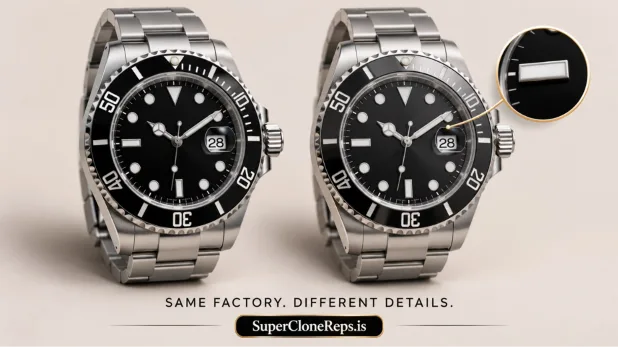
Two watches arrive in nearly identical packaging. Both are advertised as the same Rolex Submariner reference, both carry the same factory name, and both supposedly use the same movement. On paper, you would expect them to be the same watch.
Set them next to each other under a desk lamp, though, and the little differences start showing up. One dial looks a shade darker. One bezel catches light in a different way. One bracelet meets the case neatly, while the other has a bit more movement where the end links meet the lugs.
Neither watch has to be defective. They may even have come from the same production run.
That is one of the less discussed realities of super clone watches. A factory’s reputation tells you something about the general construction of a model, but it cannot promise that every finished example will look or feel identical.
The gap is not always dramatic. Sometimes you only see it with two watches side by side. Other times, a slightly misplaced marker or uneven bit of finishing changes your impression of a replica that otherwise looks convincing.
To understand where those variations come from, you have to look past the familiar factory names. Separate parts, suppliers, finishing work, assembly choices, and inspections all feed into the final watch. Small differences can enter at every stage.
The finished piece is not simply the result of a name stamped on a listing. It is a pile of individual parts brought together with more or less precision.
The Factory Name Only Tells Part of the Story
Names such as VSF, Clean Factory, ZF, APSF, and 3KF come up constantly in discussions of high-end replica watches.
Over time, certain names become attached to certain designs. You may see one factory favored for Submariner-style watches because of its movement configuration or crystal appearance. Another gets attention for the exterior finishing of a GMT-Master II or the proportions of an integrated-bracelet model.
Those reputations can be useful. They help buyers distinguish between versions that might otherwise appear identical in photographs.
Those reputations are useful up to a point. They give you a way to separate versions that look nearly identical in seller photos.
Problems start when a factory name gets treated like a universal quality score.
A manufacturer known for a convincing Submariner will not automatically make an equally convincing Daytona. Even inside one model family, one reference may have received much more development than another.
Then there is the basic question of what a factory actually makes itself.
In a setup built around specialist suppliers and outsourced components, a finished watch may contain parts made through several different production processes. The dial, crystal, bracelet, case, and movement do not necessarily come from one manufacturing source.
That alone does not signal poor quality. Component sourcing is normal across the broader watch industry. What you are really looking at is the consistency of those components and how accurately they were put together.
The term super clone has no universally accepted independent grading system behind it. It is a marketing category, not a certified measure of dimensional accuracy or mechanical quality.
Two watches carrying the same factory designation can share a general specification and still differ in visible details. Buyers lean on factory labels too hard because the label is easy to compare. The actual watch is harder to judge.
A factory name gives you context, nothing more. It cannot remove normal manufacturing variation.
For a closer look at how different generations are presented, the Rolex Explorer II collection at SuperCloneReps.is offers a useful reference point for comparing watch designs and configurations.
Production Batches Can Change Without Much Notice
Production batches are one of the clearest reasons supposedly identical watches can differ.
Manufacturing does not stay frozen in place. Suppliers change, tools need maintenance, components get revised, and production methods shift around.
A watch made months after an earlier example may include small changes that nobody formally announces.
Take the ceramic bezel on a Submariner-inspired watch. An earlier run may have a particular surface finish or numeral appearance. A later one might use a revised insert with a slightly different color, engraving depth, or level of reflectivity.
Both can still be sold under the same factory name and reference number.
Dials change this way too. A revised printing process might sharpen the lettering. Another coating or finishing step can alter the apparent shade. Applied markers may change shape, or their surface treatment may look a little different.
Some revisions are deliberate improvements. Others come from a new component source or plain process variation.
For you, the annoying part is that replica-watch descriptions rarely identify batch changes. A website may keep showing photos of an older version after a new run has arrived. A dealer may use the same factory and movement language even after exterior parts have changed.
You can end up opening a newly delivered watch and wondering why it looks a little different from an older review. That does not prove the factory attribution is wrong. It does make the production period relevant.
Comparing separate batches as if they all represent one fixed specification leads to bad conclusions. A factory can improve a detail, change it for the worse, or simply make it look different without changing the listing title at all.
Dial Manufacturing Is More Sensitive Than It Looks
The dial takes up a small part of the watch, yet it carries most of its visual identity.
An inexpensive watch and a carefully finished mechanical watch can use the same basic dial layout. The separation usually comes down to small details and how cleanly they were executed.
Text printing is an obvious example. Letters that look sharp in a normal product photo can show uneven edges under magnification. Ink application, printing alignment, and surface preparation all affect the result.
The differences become particularly noticeable on designs that rely on a clean, restrained dial.
Minimal designs expose those differences quickly. A black Submariner-style dial leaves very little room for decoration to distract you. The applied hour markers, hands, minute track, and printed text all sit in clear, fixed positions.
If one marker sits slightly out of alignment, the eye may notice the imbalance even without identifying its exact cause.
When one marker is slightly out of line, your eye may catch the imbalance before you can say exactly what is wrong with it.
Dial color adds another variable. Black does not look identical across every surface. Coatings and finishing methods change how much light a dial absorbs or reflects.
One black dial may look deep and even, while another goes a little gray under direct light. Blue and green dials are touchier still. Their apparent color can change a lot with the viewing angle and the light hitting them.
That is why two watches photographed in different conditions may look less alike than they really are. Product photos can make a green dial seem nearly black, then a bright outdoor shot makes the same watch look much lighter.
Applied markers have their own set of variables. They must be made, finished, filled with luminous material, and attached to the dial. Slight differences in placement, surface treatment, or lume filling carry through to the completed watch.
A factory may make a broadly convincing dial while allowing small differences from one example to the next. You may see a watch that looks excellent in a studio image and a little less refined under ordinary room lighting. That is not always a dramatic failure. It is still part of what separates one individual watch from another.
Why the Same Bezel Can Look Different on Two Watches
Bezels reveal a lot on modern luxury sports watches because they catch light from so many directions. Tiny differences in finish become obvious faster than you might expect.
On a ceramic-bezel design, the final look depends on the material surface, polishing, engraved numerals, the filling process, and how consistent the finished insert is. A polished ceramic bezel may look nearly black in soft light, then become much more reflective under a hard directional lamp.
It creates a strange comparison problem. Two very similar bezels can photograph differently because the lighting changed. Two inserts that seem identical in photos can show real differences once they sit side by side.
Look closely at the engraving. The numerals and minute markers should have consistent depth, shape, and spacing. If the engraving or filling varies, certain markings may look brighter, heavier, or less crisp than the rest.
A GMT-Master II-inspired bezel complicates the issue because it usually involves two colors. The color break, reflections across the insert, and numeral appearance all contribute to the effect. A small color shift can stand out more outdoors than it ever would in a controlled product photo.
Alignment is another variable. The bezel assembly has to sit correctly against the dial and case. Even a well-made ceramic insert can look wrong if the installation or indexing is fractionally off.
A bezel that sits just slightly misaligned pulls your attention away from otherwise careful finishing. The quality of the separate parts only gets you so far; the assembled watch still has to look right.
Case Finishing Is Not Always Uniform
A watch case can have accurate overall dimensions and still look less refined than another example. The difference is usually in the finishing.
The difference often lies in how the surfaces have been finished.
Think about a steel sports-watch case with brushed lugs and polished sides. The brushing should have a consistent grain, while the polished areas need clean, defined boundaries. If polishing softens an edge too much, the case loses some of the geometry that gives the original design its character.
The effects are subtle, but they are real. One case may have crisp transitions between its surfaces. Another can show slightly rounded edges or uneven brushing close to the lugs. Both watches may measure almost identically.
Finishing involves tooling, abrasives, pressure, and human- or machine-controlled work. Changes in any of those conditions affect the completed component. A case shape with sharp lines gives you fewer places to hide a mediocre finish.
The design being reproduced also determines how visible the differences become.
A rounded sports-watch case can disguise minor inconsistencies better than a design built around crisp angles. The Audemars Piguet Royal Oak makes a good example. Its case combines angular geometry, broad brushed surfaces, polished bevels, and an integrated bracelet.
If the transitions between those surfaces are off, the whole watch starts looking less convincing. You do not need a caliper to see it.
The Patek Philippe Nautilus creates a different challenge. Its wide case surfaces and distinctive side profile make thickness and finishing central to the overall impression. Two replicas with similar measurements can feel quite different because one received cleaner finishing work.
A factory name cannot tell you which individual case got the better finishing operation. You only find that out by looking at the actual component.
Bracelet Differences Often Appear Before Dial Differences
The bracelet gets treated as an afterthought too often, even though it makes up a large part of the watch’s physical presence on your wrist.
A bracelet changes how a watch looks, feels, and moves. On a three-link sports bracelet, you are dealing with link finishing, edge treatment, articulation, clasp construction, and the fit of the end links against the case. Each one is a separate manufacturing or assembly job.
A bracelet may use the advertised material and roughly the expected dimensions while still having different tolerances from another example. One may articulate smoothly and feel compact. Another may have more side-to-side movement or uneven resistance from link to link.
The second bracelet is not automatically unusable. Still, the difference becomes obvious if you handle both watches.
End-link fit deserves a close look. Those links connect the bracelet to the case, and their shape governs the transition between the two. A small gap or uneven alignment interrupts the flow immediately.
Integrated-bracelet designs make this even more noticeable because the bracelet is part of the watch’s architecture, not just something attached between the lugs.
Clasp finishing varies too. Edges should feel comfortable, polished surfaces should look consistent, and the closure should work predictably. A clasp is a small thing until you are opening it every day.
Two watches with nearly identical dials can leave completely different impressions in your hand because the bracelets do not feel equally refined. Frontal photos leave out much of that story, which is why judging super clone watches from dial shots alone is a pretty incomplete exercise.
Assembly Can Introduce Differences Even When the Parts Match
Imagine two watchmakers receiving an identical set of components: the same case, dial, hands, bezel, bracelet, and movement. In theory, their finished watches should be indistinguishable.
In practice, the assembly process introduces another level of variation.
Assembly adds another layer of variation.
The dial needs to sit correctly. Hands need proper clearance and alignment. The movement has to be secured in the case, while the crown and stem need to operate properly. The crystal, bezel, caseback, and seals must also be fitted.
Every step has tolerances, and small deviations add up.
A dial may be rotated only slightly relative to the case. Its applied markers can be properly aligned on the dial itself, yet the completed watch may still look imperfect against the bezel. A date disc may sit a bit high or low in its window. The hands may have the right shape but fail to line up exactly at a reference position.
Those are assembly differences, not necessarily flaws in the underlying component designs. Still, they are visible differences on the finished object.
A well-made watch relies on cumulative precision. A box of accurately manufactured parts does not automatically become a flawless watch once someone puts it together. With a compact mechanical object full of visible alignment points, minor variation has a way of becoming surprisingly noticeable.
Movement Variation Is Not Always Visible
Appearance is what you notice first, but mechanical differences can exist even when two watches look nearly identical.
Two examples may use the same advertised movement architecture and perform differently. Mechanical movements contain interacting components whose behavior depends on assembly, lubrication, adjustment, component condition, and manufacturing tolerances.
A movement may be running when it leaves production without being regulated to the same standard as another unit. You may notice the difference in timekeeping, power reserve, winding feel, or the operation of a specific function.
On a simple three-hand watch, casual handling may not reveal much. Complicated designs create more room for inconsistency. A GMT movement adds setting and display requirements. A mechanical chronograph brings in components that start, stop, and reset elapsed time.
If an adjustment is off, those functions can behave differently from one example to another. A chronograph hand that does not return exactly to zero is hard to ignore once you have seen it.
Movement decoration is not a substitute for functional inspection. A rotor or bridge can resemble the intended design while the mechanical behavior underneath is different.
Timegrapher measurements give you rate, amplitude, and beat-error readings under particular conditions, but they are performance snapshots. They do not guarantee future reliability.
Identical caliber descriptions do not promise identical movement behavior. Two watches can look equally convincing from the outside and give you noticeably different ownership experiences.
The Difference Between a Production Flaw and an Acceptable Variation
Not every visible difference deserves to be called a defect.
Manufacturing tolerances exist because perfect dimensional consistency across every part and process is unrealistic. A slight variation in brushing or dial shade may fall within the expected range for a particular production method. A visibly tilted marker or a chronograph hand that will not reset correctly points to a more serious quality issue.
Severity and function are what separate the two.
Aesthetic differences are subjective as well. You may prefer a dial with a slightly warmer appearance, while somebody else sees that same effect as less accurate than a cooler version. Some collectors fixate on date magnification or bezel alignment. Others care much more about bracelet comfort and movement reliability.
The reference itself changes the calculation. A minor change on a heavily decorated dial may disappear into the design. Put that same deviation on a minimal dial and it can become the first thing you see.
Enthusiast discussions also have a habit of enlarging photos until every tiny inconsistency takes over the conversation. Magnification helps identify defects, but it can badly distort their importance in ordinary use.
A mark visible only at extreme magnification may barely affect how the watch looks on your wrist. Meanwhile, a bracelet that feels uncomfortable or a crown that behaves inconsistently may matter much more, despite being difficult to show in a photo.
The useful assessment balances visual accuracy, function, and normal handling. You do not need to pretend a small cosmetic issue is invisible, but you also do not need to judge every watch at the scale of a macro photograph.
Why Product Photographs Can Make Comparisons Misleading
Photography causes a huge amount of confusion in replica-watch comparisons.
Small changes in lighting, camera angle, exposure, and image processing make the same watch look quite different. A polished case reflects whatever surrounds it. Change the surroundings and you change the reflected shapes.
A black dial looks darker under soft lighting. Strong illumination can bring out a gray cast or a surface texture that was invisible before. Ceramic bezel colors shift in photos too, especially on designs with more than one color.
Camera angle changes proportions. A watch shot slightly from above may seem to have shorter lugs or a smaller dial. A low angle exaggerates thickness. Focal length and perspective also change the visual relationship between the case and bracelet.
Online comparisons need to account for those conditions. Two images from different sellers are a weak basis for judging minor differences in color or finish.
Catalog images add another problem. A retailer may use promotional photography that represents a model rather than the exact watch available for shipment. Those images are useful for identifying the broad configuration, but they cannot establish the condition of one individual piece.
The more informative approach uses comparable lighting, consistent angles, and photos of the actual examples you are considering. A short video can add context for reflections and moving components. Even then, photos and videos remain limited representations of a physical object.
They should support an assessment, not replace it entirely.
Use them as part of the assessment, not as the whole thing.
Why One Submariner Can Look More Convincing Than Another
The Rolex Submariner is a practical way to see how several minor differences can combine.
Picture two replicas advertised as the same 126610LN reference from the same factory. Both have a black dial, ceramic bezel, steel bracelet, and the same stated movement family. At first glance, they look nearly identical.
On the first watch, the date sits neatly centered beneath the magnifier. The bezel markings line up consistently, and the transition from case to bracelet looks controlled. The second has a slightly different dial tone, a bezel that is a fraction off, and an end link that does not sit as neatly against the case.
Each detail is small. Together, they alter the visual balance.
The first example may look more carefully assembled even though both belong to the same general product version. Then the movement might tell a different story. The second watch could be better regulated and keep more consistent time over several days.
Which one is better? The better question is what you are assessing.
If exterior accuracy is your priority, the first may be the more appealing watch. If functional behavior decides it, the second may have the edge. General factory rankings do not settle that question. You have to compare the actual watches rather than assume every unit from one manufacturer is equivalent.
The Daytona Makes Production Consistency Harder to Judge
The Daytona adds another layer because of the chronograph mechanism.
A conventional three-hand watch gives you relatively few visible functions. A Daytona-inspired chronograph has several registers, pushers, and a central chronograph seconds hand. Their positions and behavior are part of the watch’s identity.
Two replicas can share an advertised movement family and look almost identical in still photos, yet one may show cleaner chronograph engagement or more precise hand resetting.
Subdial printing varies too. The markings are small, so inconsistencies can hide until you inspect them closely. Contrast, surface finish, and hand alignment all affect the impression of the dial.
The bezel creates further variation through engraving, polishing, and tachymeter-scale alignment. Case thickness and pusher placement influence the exterior as well.
A minor issue in one of those areas may seem unimportant on its own. Stack several of them together and one watch starts looking more convincing than another.
With complicated watches, quality rarely comes down to one component. It depends on how well the movement, dial, hands, pushers, and case work together.
Why Quality Control Matters More Than Factory Reputation Alone
Factory reputation tells you about a general product line. Quality control concerns the individual watch in front of you.
A factory may be known for accurate case proportions or a convincing dial construction. That reputation does not establish that a particular piece was assembled or adjusted correctly.
An inspection can catch some differences introduced during manufacturing. Visible checks may show misaligned markers, uneven finishing, bezel-positioning issues, or poor bracelet fit. Functional checks can tell you about winding, setting, date changes, GMT operation, or chronograph behavior, depending on the model.
Timegrapher readings offer limited information about movement performance under controlled conditions. None of this gives you a complete guarantee. A photograph cannot reveal internal component condition. A short functional demonstration cannot prove years of reliability. Water resistance needs appropriate testing; you cannot assume it from the design being copied.
Still, looking at the specific watch gives you more useful information than a factory’s general reputation. Product identification and individual inspection serve different purposes.
For readers researching these differences, the watch collections and buying resources at SuperCloneReps.is offer a starting point for exploring model references, factory versions, and the technical details commonly discussed in super clone watch comparisons.
The factory label helps establish what a watch is supposed to be. Examining the finished piece tells you how closely that particular example meets those expectations.
Can the Most Expensive Version Still Have Imperfections?
Price and manufacturing consistency are related, but they are not interchangeable.
A more expensive watch may use a different movement, more elaborate finishing, or components that cost more to make. It may also command a premium because of limited availability, market demand, or seller pricing.
None of that guarantees flawless assembly.
A relatively expensive replica can still have a slightly misaligned bezel or an imperfect date display. A less expensive example may have unusually good external alignment even if its movement or finishing specification is less ambitious.
This is why evaluating only the asking price can lead to misleading conclusions.
Judging only by the asking price leads you in the wrong direction. Price describes a commercial transaction. It is not a complete measure of quality.
It makes more sense to separate the factors. Materials and movement architecture tell you what the watch is designed to contain. Finishing and assembly determine how well the physical parts come together. Regulation and testing offer some indication of functional performance.
Each contributes to quality differently. The highest price does not guarantee the best individual example in every category.
The Limits of Trying to Find a Perfect 1:1 Watch
The phrase 1:1 super clone watches suggests a level of equivalence that is difficult to establish.
Matching the dimensions of a genuine watch does not automatically reproduce the original manufacturer’s materials, finishing processes, movement tolerances, or quality-control standards. Strong visual similarity is different from mechanical and manufacturing equivalence.
There are also practical limits to judging accuracy from photographs.
Photos also put real limits on how accurately you can judge a watch. A piece may look convincing on a wrist or in a casual image, then show clear differences beside a genuine example. A movement can have a similar layout without matching long-term performance or replacement-part support.
Technically complicated designs bring compromises that may not show up on the exterior. That is especially relevant to replicas marketed as exact copies of luxury chronographs or highly complicated mechanical models. More functions make appearance alone a worse way to judge quality.
Trademarked counterfeit watches may be subject to legal restrictions, customs seizure, or other consequences depending on the jurisdiction. Manufacturing quality does not change their legal status or make them authorized products of the original brands.
Terms such as super clone, 1:1, and premium replica are commercial language, not substitutes for independently verifiable specifications or guarantees of identical construction and performance.
What Production Variation Reveals About the Replica Watch Market
Differences between watches from the same factory show how much the finished product depends on execution.
A factory name can identify a recognizable model family or design approach. It can shape expectations about proportions, movement configuration, and available components. It cannot account for every variation introduced during component production, finishing, assembly, and adjustment.
Some inconsistencies come from different production batches. Others come from individual component tolerances or the way the parts were fitted together. Photography exaggerates some of those differences and hides others.
A bracelet that feels a little loose will not always show up in a product image. A dial that appears gray under harsh light may look perfectly black in normal use.
So the conversation needs to move past simple claims that one factory makes perfect watches and another does not. Manufacturing consistency is separate from the strength of an underlying design.
A factory can develop a convincing reproduction of one reference and still send out individual watches with uneven finishing or assembly. A model that gets less attention in enthusiast discussions may occasionally turn up as a well-finished individual example.
Once you separate factory reputation from the quality of the specific piece, the market becomes easier to read. The factory name matters as a starting point. The finished object is where the details either come together or do not.
Final Thoughts
Two super clone watches from the same factory can look different for plenty of reasons. Production batches change, component suppliers vary, finishing is not perfectly consistent, and assembly adds another layer of tolerances.
Some differences jump out right away. Others only appear under magnification, changing light, or extended handling.
The most convincing watch is not necessarily the one with the longest specification sheet or the best-known factory designation. It is the individual example where the case, dial, bezel, crystal, bracelet, and movement have come together most consistently.
Minor variation is not automatically a defect. Mechanical products have tolerances, and visual preferences differ. Factory reputation should be treated as context rather than a final verdict.
For anyone trying to make sense of the growing market for super clone watches, that distinction is useful. The factory may set the design and broad production approach, while the finished watch shows how successfully those intentions were carried out.
Sometimes the gap between a convincing replica and an ordinary-looking one comes down to no single dramatic flaw. It is the accumulation of small details that were handled a little more carefully.