
Which Google Ads Campaign Is Best for Your Business? 7 Types Explained:
More impressions and more clicks don’t automatically mean more money. You can have both and still finish the month without much money.
Choosing the right Google Ads campaign types for your business is equally important, as each campaign is designed to achieve different advertising objectives.
Google Ads now handles a lot on its own: it manages bids, finds customers and even builds the ads. Search results are shifting too, which is why looking only at clicks and impressions no longer tells you much.
The businesses that do well with paid search tend to keep an eye on three things:
- How much they spend on ads.
- How much revenue those ads bring in.
- How much profit is left once advertising costs are paid.
This guide covers how to tell whether your ads are really working, how to stop wasting budget, and what to look for if you decide to bring in an expert or agency to manage your Google Ads.
7 Types of Google Ads Campaigns and How to Use Them
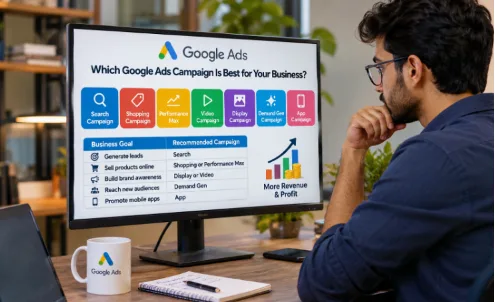
Google Ads offers several campaign types, each built for a different goal. Knowing what each one does makes it much easier to pick the right one for your business.
- Search campaigns show text ads when people search for products or services like yours. They suit lead generation and capturing demand that already exists.
- Performance Max campaigns let Google’s AI place your ads across its channels to find potential customers. They are a good fit if you want sales or leads from Google’s wider advertising network.
- Shopping campaigns display product images, prices and store details on Google Shopping and in eligible search placements. They are the natural choice for e-commerce stores.
- Display campaigns put visual banner ads on websites and apps. They work well for brand awareness and remarketing. – In a few months this campaign type will not serve anymore/sunset and it will be converted to Demand gen.
- Video campaigns reach people through video ads on YouTube and other eligible video sites, which makes them useful for awareness and product demos.
- Demand Gen campaigns use visual ads across YouTube, Discover and Gmail to build interest and reach new audiences.
- App campaigns promote mobile apps and drive installs or in-app actions. They are made for app developers and for companies that deliver their service through an app.
Which Google Ads Campaign Is Best for Your Business?
| Business goal | Recommended campaign |
| Generate leads | Search |
| Sell products online | Shopping or Performance Max |
| Build brand awareness | Display or Video |
| Reach new audiences | Demand Gen |
| Promote mobile apps | App |
The right pick depends on your objectives, your audience and the budget you have to work with. Try not to choose by clicks or impressions; choose by the results your business actually cares about.
Advertising Revenue Model: What Each Metric Really Tells You
CPC, CPM, CPA and CPL describe how you pay, while ROAS shows what came back. Pick one metric per goal, then check it against your business data.
| Your goal | Steer by | Check against | Watch out for |
| Online sales | ROAS | Gross margin, contribution profit, returns | Revenue is not profit |
| B2B or service lead | CPL, then cost per qualified lead | Lead-to-customer conversion rate, customer value | Cheap, unqualified leads |
| Bookings or sign-ups | CPA | Revenue per conversion, customer lifetime value | All conversions treated equal |
| Awareness, remarketing | CPM | Reach, frequency, brand search lift | Exposure is not action |
| Traffic | CPC | Conversion rate | Click quality |
How Google Ads and Search Engine Marketing Drive Revenue
A Google Ads campaign is a tool, not a strategy. What it’s for depends on your objective:
- Sales: Search and Shopping capture existing demand, so steer by ROAS.
- Leads: Use Search campaigns and, where possible, import CRM stages as offline conversions. Steer by cost per qualified lead.
- Demand creation: Video, Demand Gen and remarketing reach people before they start searching. Judge them on assisted conversions and branded search growth.
Give each campaign one job and judge it on that job alone. It keeps your Google PPC advertising reports honest.
Practical Strategies to Improve Advertising Profitability
Start with a five-minute account health check.
| Check | Where to look | Healthy sign | Red flag |
| Conversion tracking | Conversion settings | Revenue and Leads actions are primary | Page views or every click counted |
| Structure | Campaign list | Brand and non-brand split; high and low margin split | One campaign mixing everything |
| Search terms | Search terms report | Mostly buyer-intent queries | Irrelevant terms eating spend |
| Landing page | Click your own ad Headline through Google ads interface. | answers the query | Generic homepage |
| AI features | Campaign settings | AI Max tested against a suitable control | Switched on account-wide, untested |
| Reporting | Platform vs CRM | Gaps explained | Never reconciled |
If you find two or more red flags, fix the basics before you raise the budget.
Why Search Still Anchors a Google Ads Campaign Strategy
The benefits of Google Search Ads come down to four things:
- Intent: people are already looking for what you sell.
- Control: you choose the queries, locations and budget.
- Measurability: results connect to revenue or leads, not just clicks.
- Fast feedback: performance data arrives quickly enough to act on.
Together, these make Search the easiest campaign type to tie back to revenue or leads, which is why it tends to anchor the rest of the account.
2026 Trends: AI, Automation and Changing Search Behaviour
- US market: Digital advertising revenue reached nearly $300 billion in 2025, up 13.9% (IAB/PwC, as reported).
- Global: Worldwide advertising spending is expected to reach $1.34 trillion in 2026, an increase of 11.9%. Social, search and retail media are expected to account for 66.4% of that (WARC).
- Automation: Using Google’s 2025 data, AI Max typically drives 14% more conversions or value at a similar CPA or ROAS. That figure is vendor-reported, so test it yourself (Google).
- Search behaviour: Google has widened ad eligibility inside AI Overviews and AI Mode, which makes click paths harder to predict (Search Influence).
What this means: competition for high-intent queries is growing. A good Google Ads campaign strategy for 2026 treats AI features as something to test and measure, judges success on revenue rather than click-through rate, and keeps control of branded keywords and negative keywords.
Five Habits That Make Paid Search More Efficient and Profitable
There are a few simple habits that improve results and profitability in a paid search campaign:
- Set targets based on profit margin not on industry norms.
- Bidding on offline conversion data and value-based.
- Review search terms and negative keywords monthly, especially after expanding match types.
- Run AI features as experiments with a control, not as account-wide switches.
- Fix the landing page before you raise the budget.
At some point, keeping up with campaign structure, tracking and testing can become too much for an in-house team.
Whether you build that capability internally or bring in a search engine marketing service, the test is the same: can you tie spending to revenue you can verify in your own finance data?
Conclusion: From Choosing the Right Google Ads Campaign to Sustainable Revenue
Choosing the right Google Ads campaign starts with your business objectives, your audience and your budget. Search, Shopping, Performance Max, Display, Video, Demand Gen and App campaigns each have a different job to do.
Picking the campaign is only the first step, though. What decides whether it pays off is measuring what you spend, tracking conversions that mean something and checking the results against real revenue.
Good Google advertising was never about getting the most clicks or impressions. It’s about matching the campaign to the goal, measuring what matters and turning ad spend into revenue that lasts.