
The evolution of Mahindra: from utility vehicles to future mobility
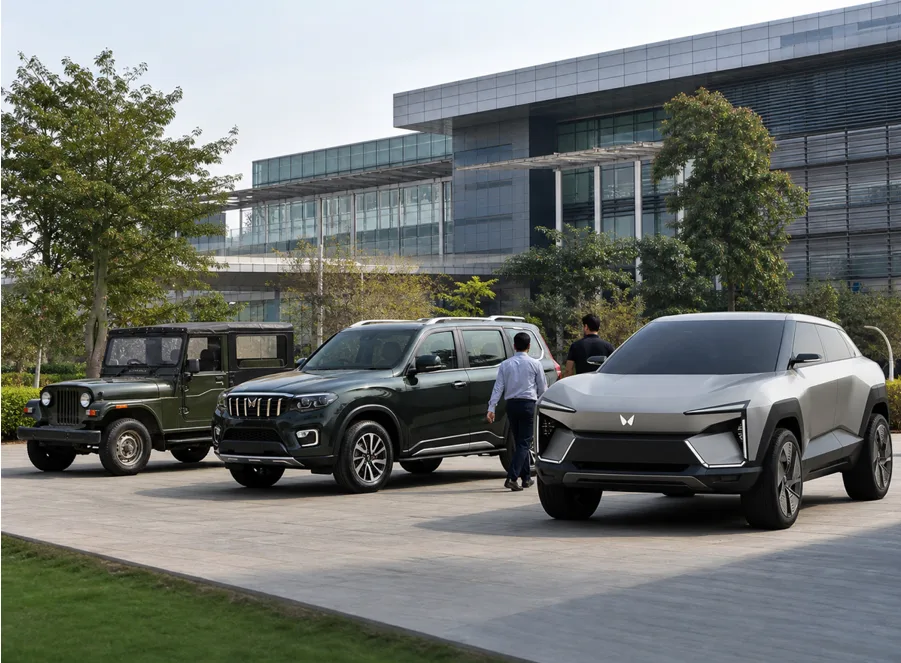
Few Indian carmakers have rewritten their own reputation as thoroughly as Mahindra. The badge once meant a utilitarian diesel workhorse on a village road, bought for durability, not desire. It now sits on coupe-styled electric SUVs with screens running the full width of the dashboard. That shift didn’t happen by accident. Understanding the steps behind it tells you a lot about what these vehicles are actually like to own.
The workhorse years still shape the brand
Mahindra started by assembling Willys Jeeps for Indian conditions. That engineering DNA stuck for decades. The brief was blunt: ladder-frame chassis, long-travel suspension, low-stress diesel engines that tolerated poor fuel and could be fixed by a roadside mechanic with a basic set of spanners.
The Bolero became the template, a boxy utility vehicle that farmers, contractors and taxi operators bought because it simply refused to die. Not glamorous. Completely reliable.
Then came the Scorpio in 2002, developed largely in-house. That car proved Mahindra could design a full SUV rather than adapt someone else’s. It kept the body-on-frame layout but wrapped it in a cabin families were genuinely happy to sit in for four hours on a state highway.
Buyers checking the Scorpio N On Road Price today are looking at a vehicle that shares a nameplate with that original and almost nothing else. The current car runs a new frame, independent front suspension, a considerably stiffer structure, and petrol engines alongside the diesels. Same badge. Different beast entirely.
How a utility maker learned passenger car engineering
The real pivot was the XUV500 in 2011. Moving to monocoque construction changed the whole development process, and the scale of that change is easy to underestimate.
Instead of bolting a body onto a separate frame, engineers had to design crumple zones, load paths and torsional stiffness into a single welded shell.Refinement stopped being an afterthought. It became a measurable target.
Cabin noise and ride quality improved sharply across that decade as a result. The company also built the supporting infrastructure: a large research campus near Chennai, technical centres overseas, design input from the Italian styling house it acquired. Modern platform thinking followed. Body-on-frame vehicles still handle sustained abuse and serious off-roading better, but they carry more weight and rarely match a monocoque for refinement or handling precision. Neither approach is superior. They answer different questions, and the question you are actually asking should drive the decision, not the spec sheet.
Born electric means starting from a blank sheet
The electric shift required another rethink entirely. Converting a petrol car to batteries usually means squeezing cells wherever space allows, which raises the floor and eats into boot volume.
Born-electric architecture works the other way round. The battery pack sits flat in the floor and doubles as a structural member, motors mount near the axles, and the absence of a transmission tunnel frees the entire cabin floor. Push the wheels towards the corners and you can offer a long wheelbase without making the car unwieldy in city traffic.
The Mahindra XEV 9E uses that skateboard layout to package a coupe roofline over a genuinely flat-floor interior. Most people think the real EV risk is performance. That is only half the story. The part that actually matters long-term is battery management: degradation, thermal stress across an Indian summer, and what the warranty actually covers.
Owners get caught out by this more often than you would expect. They assume battery warranty means protection against capacity fade, when it only covers outright failure. Those two are not the same thing.
What the shift means for someone buying now
Two questions worth asking before anything else: where does the car sleep at night, and how far does it travel in a typical week? Someone without fixed parking or reliable charging will struggle with an EV regardless of how good the vehicle itself is. Someone doing predictable city and suburban runs with home charging will spend a fraction of what petrol costs over the same distance. Frequent long highway drives across rough roads still favour a diesel ladder-frame SUV, which is why those models remain in production rather than being quietly phased out. Urban families with occasional highway use are better served by a monocoque petrol SUV, or an electric one depending on their charging situation. Before signing anything, run these checks:
- Visit the nearest workshop and confirm how many trained EV technicians are on staff, not how many service outlets exist on paper.
- Ask what a home charger installation costs, including wiring and any electrical panel upgrade, as this regularly surprises buyers.
- Take a test drive on a broken road rather than a smooth showroom loop, because suspension tuning varies noticeably between models built on the same platform.