
Why Do Hospitals Still Use Fax Instead of Email in 2027?
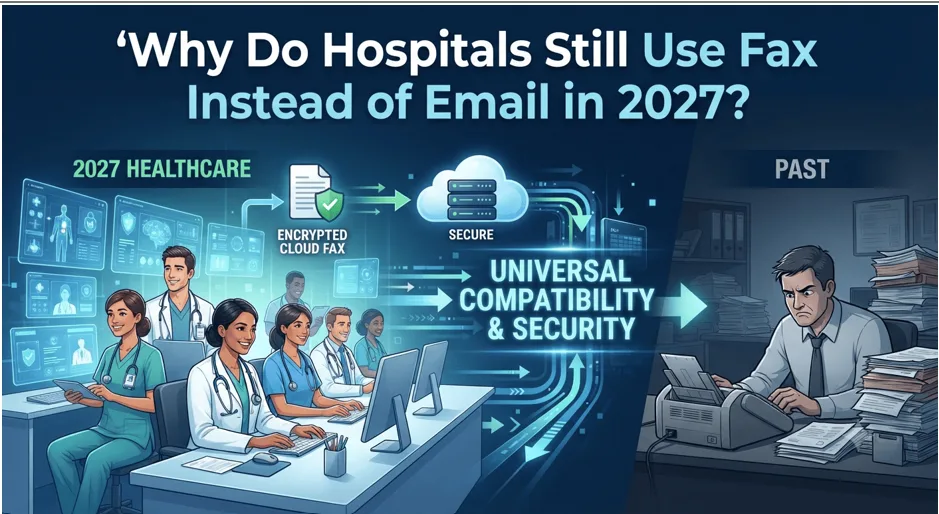
Hospitals still use fax instead of email in 2027 because standard email lacks built-in encryption, audit trails, and universal Electronic Health Record (EHR) interoperability required under federal privacy laws. Modern healthcare facilities rely on encrypted cloud faxing—not legacy paper machines—to exchange Protected Health Information (PHI) securely across disconnected clinics, labs, and insurers without risking data breaches.
Despite rapid advancements in artificial intelligence, telemedicine, and cloud computing, fax remains the backbone of medical communication. For patients accustomed to instant messaging and mobile banking, seeing a doctor’s office request a faxed referral or lab order can feel outdated. Yet behind the scenes, healthcare organizations face strict regulatory mandates, fragmented software ecosystems, and escalating cybersecurity threats that make standard email an unacceptable liability.
1. Standard Email Poses Major HIPAA and Cybersecurity Risks
Under the Health Insurance Portability and Accountability Act (HIPAA), healthcare providers are legally required to safeguard Protected Health Information both in transit and at rest. Standard consumer and enterprise email protocols were never engineered with healthcare compliance in mind.
When a clinic sends an unencrypted email containing lab results or diagnostic images, that message passes through multiple external servers where it can be intercepted, misdirected via autocomplete errors, or exposed if an inbox is compromised. Furthermore, email remains the primary entry vector for healthcare ransomware and phishing campaigns. In contrast, dedicated healthcare fax transmission operates over encrypted, point-to-point channels backed by signed Business Associate Agreements (BAAs) and tamper-proof delivery logs.
2. The EHR Interoperability Gap Across Healthcare Networks
While most hospitals and outpatient clinics have digitized internal patient charts, external communication between separate organizations remains deeply fragmented. Hundreds of competing Electronic Health Record platforms exist across hospitals, independent specialists, diagnostic laboratories, and retail pharmacies—and most do not communicate natively with one another.
As healthcare systems navigate evolving EHR and cybersecurity demands, fax serves as the universal common denominator. Regardless of which EHR vendor a rural clinic, insurance payer, or regional hospital uses, every facility can send and receive a fax without custom API engineering or complex IT integrations.
| Communication Factor | Standard Email | Modern Healthcare Cloud Fax
|
| Default Encryption | Often unencrypted in transit unless manually configured | 256-bit AES encryption enforced automatically |
| HIPAA Compliance & BAA | Not included on standard email accounts | Signed BAA and strict access controls included |
| Cross-Network Compatibility | Requires matching secure portals or plug-ins | Universal delivery to any hospital, lab, or pharmacy |
| Legal Audit Trail | Limited server logs; easily altered or deleted | Timestamped transmission receipts and compliance logs |
3. Analog Machines Are Gone—Cloud Faxing Has Replaced Them
The biggest misconception about hospital faxing in 2027 is that clinicians are still standing beside physical machines feeding paper sheets into a dial tone. Traditional analog faxing carried its own compliance hazards, such as sensitive patient charts sitting unattended in open output trays or staff accidentally misdialing numbers.
Today, forward-looking health systems have replaced physical hardware with cloud infrastructure. Adopting a modern healthcare faxing service such as iFax by Amplify allows hospitals and clinics to eliminate paper trays altogether. Clinicians send and receive faxes directly from their desktop, mobile device, or EHR dashboard. Incoming referrals, prior authorizations, and diagnostic reports are automatically digitized, indexed, and routed into the appropriate patient chart—eliminating the risk of sensitive pages sitting unattended on an office printer.
4. Pairing Cloud Faxing with Digital Patient Intake
While cloud faxing governs secure institution-to-institution record exchange between doctors, insurers, and pharmacies, healthcare organizations also need a frictionless way to interact directly with patients prior to appointments.
Instead of asking patients to print, sign, and scan intake packets at home, clinics pair encrypted record routing with HIPAA-compliant healthcare e-signatures. Patients can review and sign consent forms, medical history questionnaires, and insurance authorizations from their smartphones in minutes. Once signed, those records flow seamlessly into the clinic’s digital workflow—cutting front-desk bottlenecks and reducing appointment delays.
5. Legal Admissibility and Audit Trails in Clinical Care
In medical malpractice defense, insurance audits, and regulatory reviews, proving when a record was sent and who received it is just as important as the medical data itself. Standard email delivery receipts are notoriously unreliable and frequently blocked by recipient mail servers.
Cloud fax platforms automatically generate detailed, timestamped transmission confirmations verifying successful delivery to the recipient’s endpoint. These immutable audit trails satisfy strict compliance frameworks—including HIPAA, SOC 2, and ISO 27001 standards—giving hospital compliance officers complete visibility over every outbound and inbound document.
Frequently Asked Questions (FAQs)
Is faxing still HIPAA compliant in 2027?
Yes. Faxing remains fully HIPAA compliant when transmitted over encrypted cloud fax platforms that provide a signed Business Associate Agreement (BAA), role-based access controls, and secure audit logs.
Why can’t doctors just use encrypted email portals instead?
Encrypted email portals often require recipients—such as busy pharmacies, insurance adjusters, or external specialists—to create separate logins and passwords to view a single message. Cloud faxing delivers documents directly into existing clinical workflows with zero login friction.
Do hospitals still use physical fax machines?
Most large health systems and modern outpatient clinics have replaced physical fax machines with cloud fax software that connects directly to their Electronic Health Record (EHR) systems.
The Future of Hospital Document Exchange
Hospitals will not abandon fax in 2027 because fax itself has evolved. By shedding physical paper and copper phone lines in favor of encrypted, EHR-integrated cloud platforms and digital patient intake tools, healthcare providers get the best of both worlds: the universal reliability of fax paired with modern cybersecurity and automation.