
Want More Than Glorified Daycare? 6 Picks for the Best Summer Camp in Los Angeles
Finding the best summer camp in Los Angeles should feel exciting, not exhausting. Yet most search results skip past staff screening, emergency plans, and surprise fees, leaving you with more questions than answers.
We’ve pored over accreditation files, county inspection reports, and hundreds of parent reviews so you don’t have to. This guide spotlights six camps that openly share four must-haves: verified safety steps, real skill-building programs, clear age groups, and transparent pricing.
These finalists cover the range (overnight adventure, classic outdoor day camp, ocean-confidence training, hands-on STEAM, a true performance-stage experience, and a sliding-scale nonprofit) so you can match each child’s interests with the right format.
Skim the quick-compare table or dive into the detailed profiles below; either way, you’ll walk away with evidence-backed options instead of brochure fluff.
How we chose camps that do more than fill the day
What counted most
We dropped any camp with a fuzzy safety plan on the very first pass. The remaining candidates faced an eight-factor, 100-point rubric:
- Safety, accreditation, and public transparency (20 pts). Active ACA accreditation covers more than 300 health, program, and risk-management standards in each review cycle, plus fingerprint-based background checks and a readable emergency plan.
- Program depth and choice (20 pts). Proof that campers master a skill, build a project, or perform for an audience by week’s end.
- Staff ratios and qualifications (15 pts). Posted counselor-to-camper numbers and current First Aid/CPR cards.
- Age progression (10 pts). Clear tiers so first-timers and teens never end up in the same group.
- Los Angeles logistics (10 pts). Practical commute distance, bus service, or flexible day-by-day scheduling.
- Value and cost transparency (10 pts). Public fee sheets or tiered pricing that spell out meals, transport, and gear.
- Inclusion and accessibility (5 pts). Scholarships, aides, dietary accommodations, or identity-affirming policies.
- Reputation and review signal (10 pts). Multi-platform ratings plus recent inspection history.
We deducted points whenever safety details, ratios, or pricing were buried or missing.
Why day and overnight camps need different expectations
Day camps run like a sprint. Because you handle medication, homesickness, and bedtime at home, we weighted commute sanity, stable peer groups, and clear pickup logistics more heavily.
Overnight programs resemble a marathon. After drop-off, counselors become first responders and midnight comforters around the clock. One overnight program that publishes all those specifics is Pali Adventures; its safety page lists a 24-hour wellness center staffed by registered nurses, staff carrying radios at all times, a doctor on call, and the nearest hospital just seven miles away.
Six Los Angeles summer camps at a glance
If you prefer the snapshot first, scan the table below. You can compare format, age range, accreditation, staffing, and pricing signals in one pass, then jump to the deep-dive profiles that follow.
| Camp | Best for | Format | Ages | Accreditation / oversight | Published ratio | Price transparency | Official site |
| Pali Adventures | Camper-designed overnight skill building | Overnight | 6-16 | ACA-accredited; WAIC member | ~3 campers : 1 adult | Not publicly listed | paliadventures.com |
| Tumbleweed Day Camp | Classic outdoor day camp | Day | Pre-K-8 | ACA-accredited | 14 campers : 2 adults | Rates published, bus fare included | https://www.tumbleweedcamp.com/ |
| Aloha Beach Camp | Ocean skills & flexible dates | Day | 4-14 | ACA-accredited | 5 campers : 1 adult (1 : 1 in beginner surf) | Rates published, gear & bus included | https://www.alohabeachcamp.com/ |
| Camp Galileo | Finished STEAM projects | Day | K-8 | Criminal-background checks; no ACA claim | 10 : 1 (K-3) / 12 : 1 (Gr 4-8) | Rates published, sliding-scale aid available | https://galileo-camps.com/ |
| Performing Arts Workshops | Real performance outcome | Day | 6-14 | Criminal-background checks; no ACA claim | 10-12 : 1 | Rates published, production costs included | https://www.performingartsworkshops.com/ |
| Camp Bob Waldorf | Inclusive overnight community | Overnight | Gr 2-12 | ACA-accredited | 2-3 adults per cabin | Tiered pricing, all core expenses included | https://campbobwaldorf.org/ |
1. Pali Adventures: best for camper-designed overnight skill building
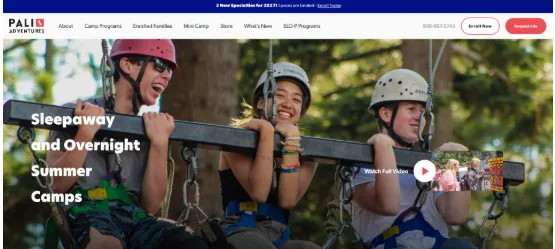
Pali Adventures overnight summer camp website homepage screenshot
Why it stands out
Set in Running Springs, California in the San Bernardino Mountains, about a 90-minute drive east of Los Angeles, Pali offers 27 specialties across three tracks: Adventure, Creative and Performance. Juniors (8-12) and Seniors (13-16) spend each morning in a single specialty (for example Flying Trapeze, Motorsports, Hollywood Stunts, Movie Make-Up, DJ Camp or Broadcasting) then branch into electives such as archery or the high-ropes course in the afternoon. Campers finish the week having caught a trapeze bar or edited a broadcast segment, not just “tried” an activity.
How safety and staffing are documented
- ACA accredited and a WAIC member, so the camp files annual compliance reports and completes peer reviews that cover more than 300 standards.
- Every seasonal staff member clears LiveScan fingerprint checks through the Department of Justice and completes roughly two weeks of pre-season training that includes First Aid, CPR and AED certification.
- Overall supervision averages about three campers per adult. A registered nurse staffs the health center around the clock, with a local physician on call.
- Wildfire, earthquake and severe-weather drills run each session, turning evacuation routes into routine rather than rhetoric.
- The program is all-inclusive: meals, lodging, activities and specialties carry no extra fees.
How the age tiers work
- Mini Camp (6-8): Guided rotations introduce multiple activities with no single specialty choice at this stage.
- Juniors (8-12): Campers select one specialty for the week while counselors coach confidence.
- Seniors (13-16): Older campers dive deeper into a chosen specialty and may add leadership tracks.
Freedom expands as readiness grows, so younger participants avoid feeling overwhelmed.
Who it fits best and what to confirm
This camp suits children eager to unplug and design their own overnight adventure. Before you enroll, check that a one-week session fits your calendar, make sure your camper is ready for a full week away from home and review the current specialty list at https://paliadventures.com/
2. Tumbleweed Day Camp: best for a classic outdoor day camp
Why it stands out
Across 100 wooded acres in the Santa Monica Mountains, Tumbleweed runs ropes courses, swimming, archery, hiking and hands-on crafts, giving Los Angeles children outdoor time without an overnight stay. Campers move in small steady groups (about 14 campers with two counselors). The size lets shy participants gain confidence while energetic campers test leadership skills. Daily buses leave Westside, Valley and Mid-City pick-up spots, and the ride usually stays under an hour each way.
Safety, grouping and logistics
- ACA accredited, meeting more than 300 program and risk-management standards and filing annual compliance reports.
- Staff complete fingerprint-based background checks plus First Aid and CPR training before camp starts.
- Groups average one adult for every seven campers, so counselors can spot issues early.
- Tuition covers transportation and daily snacks, with no extra charge for core activities.
Best fit and trade-off
Tumbleweed suits children who crave tree-climbing freedom yet sleep best at home. The rotation model offers wide exposure to outdoor skills but less deep specialization, so future trapeze artists or film makers may move to a focused camp in later seasons.
3. Aloha Beach Camp: best for ocean skills and schedule flexibility
Why it stands out
Aloha turns Zuma Beach into a working classroom where certified lifeguards teach campers to read rip currents, stand on a surfboard and paddle kayaks through small swells. Skills build in “sets” instead of worksheets, so children leave with real ocean confidence. Families can enroll day by day or reserve a full week, and camp buses depart several Los Angeles pick-up spots each morning. The ride reaches Malibu’s shoreline in roughly an hour, then returns by dinner with gear already rinsed.
Waterfront safety and staffing
- ACA accredited; counselors hold both ocean-lifeguard and CPR credentials.
- Supervision averages about five campers per adult and shifts to one-to-one when beginners first paddle out.
- Malibu County lifeguards patrol the break, and staff run daily briefings on swell, tide and heat conditions.
- The camp supplies wetsuits, rash guards and soft-top boards, so equipment meets safety standards.
Best fit and trade-off
Aloha suits children who want true surf skills yet need flexible scheduling. The program builds wave judgment, not sleep-away stamina, so families who want both can add an overnight camp later in the summer.
4. Camp Galileo: best for STEAM projects with a finished result
Camp Galileo STEAM projects summer camp website homepage screenshot
Why it stands out
Camp Galileo runs each day like a design lab. Younger campers might wire simple circuits for a glowing cardboard city, while older groups build earthquake-resistant towers and test them on a “shake table.” Friday show-and-tell sessions ask participants to explain what worked, what failed, and how they iterated. Outdoor games and messy art breaks clear minds between builds and keep creativity fresh.
With sites in the Westside, San Fernando Valley, and South Bay, most families keep the commute short. Published supervision ratios average 10 : 1 in grades K-3 and 12 : 1 in grades 4-8, giving inventions room to grow without leaving hot-glue guns unattended.
Staffing, safety, and access
- Criminal-background checks, reference calls, and multi-stage interviews come before staff training on health, emergency response, and open-ended project facilitation.
- First Aid and CPR-certified site directors circulate throughout the day.
- Galileo does not claim ACA accreditation; oversight relies on local licensing plus the company’s internal safety program.
- Scholarships may offset up to 90 percent of tuition for qualifying families, and approved aides can attend at no charge.
Best fit and trade-off
Camp Galileo attracts builders and tinkerers who ask “What if?” until the answer sits in their hands. Because it runs only during the day, families seeking an overnight challenge will need a separate program. Some locations need packed lunches or charge additional fees for extended care, so verify site-specific details before you register.
5. Performing Arts Workshops: best for creating a real performance
Why it stands out
Performing Arts Workshops (PAW) swaps casual sing-alongs for a true curtain-up moment. Depending on the track, campers cast, rehearse and stage a full musical or create a debate showcase, photography portfolio or actor’s reel. Because the program ends with a public performance, children practise lines, blocking and backstage etiquette alongside creative risk-taking. A no-audition policy mixes first-timers with seasoned performers, and multiple Los Angeles County sites plus one- to four-week sessions give families flexibility without losing project depth.
Instructor qualifications and class size
- Directors recruit working actors, dancers and debate coaches who pass criminal-background checks and train in child supervision and emergency response before camp starts.
- Groups average 10-12 campers per instructor, allowing individual feedback on choreography, delivery and camera technique.
- Tuition covers sets, costumes, microphones and other production costs, so you avoid mid-session add-on fees.
- PAW does not claim ACA accreditation; oversight comes through local licensing and the company’s internal safety protocols.
Best fit and trade-off
This program fits children who thrive on rehearsal and applause, and families who see a finished show or media reel as proof of growth. Outdoor mileage is limited, so campers who crave long hikes or high-ropes elements will find richer options at a traditional outdoor camp.
6. Camp Bob Waldorf: best for inclusive overnight access
Why it stands out
About 15 miles from downtown Los Angeles, nonprofit Camp Bob Waldorf runs a tiered tuition model that adjusts fees to family income, keeping overnight camp accessible without cutting classic experiences such as cabin living, a challenge course, archery, swimming, arts and leadership games. Counselors weave discussions of inclusion and respect into hikes and campfires, helping friendships cross neighborhoods and school districts.
Safety, medical care and financial access
- ACA accredited, with annual compliance reports and periodic on-site peer review.
- All counselors pass fingerprint-based background checks and safeguarding training before moving into cabins, and two or three adults reside in each bunkhouse.
- A registered nurse staffs the health center around the clock, with a local physician on call for escalations.
- Tiered fees cover meals, lodging, gear and core activities, limiting surprise costs during sessions that usually last one to two weeks.
Best fit and trade-off
Camp Bob Waldorf fits families who value community building and need flexible tuition close to home. Programming is intentionally broad, so if your camper wants a deep dive into a single specialty, such as motorsports or film production, one of the focused camps earlier in this guide may suit better.
What parents should ask before they pay
Accreditation and background checks
The American Camp Association (ACA) reviews more than 300 health, safety and program standards in each accreditation cycle and keeps an online database you can search. An active listing confirms the camp files annual compliance reports and meets the 2025 rule for yearly criminal-background checks on returning seasonal staff.
Ask how screening reaches beyond counselors to nurses, kitchen crews and contracted specialists. Fingerprint checks each season, reference calls and an in-person interview help catch red flags a database can miss.
Staffing ratios give a second view into oversight. Overnight cabins should never have fewer than two adults on duty, while day programs need enough supervisors to watch every part of a ropes course or surf break. Camps that post exact numbers, such as three campers per counselor or 14 campers with two adults, make accountability clear. Vague answers mean you should keep looking.
Emergency, medical and environmental plans
The 2025 Camp Mystic flood drew national attention after investigators found the site lacked a written evacuation map and clear staff authority to use it. Since then, many parents have begun asking for proof, not promises, of readiness. A strong plan should:
- Name the staff member who can order an evacuation and note drill frequency (at least once per session for wildfire and earthquake in most ACA-accredited programs).
- Address local hazards (wildfire, earthquake, flash flood, extreme heat and smoke) and spell out how schedules change when the heat index tops Cal/OSHA’s 95 °F trigger or the Air Quality Index rises above 151.
- Guarantee a licensed medical professional on site at all hours for overnight camps, with backup power to keep refrigerated medications safe during outages.
- Include redundant communication channels, such as satellite phones or two-way radios, in case cell towers fail.
Camps that publish these details let families judge readiness before sending a deposit.
Total cost, phones and photo consent
Hidden surcharges can erase a camp’s headline rate. A complete fee sheet should list meals, lodging, transportation, laundry, gear rental, extended care, specialty materials and any camp-store deposit. National ACA survey data showed average weekly prices rising about 20 percent in 2025, mostly from transportation and activity add-ons, which underscores the need for line-item clarity.
Most premium programs restrict phones to build community. The best pair that rule with set contact windows: scheduled emails, letters or counselor-facilitated calls keep homesick campers supported and parents informed. Camps that ban devices without another contact plan leave families in the dark.
Starting 1 January 2027, California AB 2007 requires youth programs to get written permission before posting any identifying photo or video of a camper. Enrollment cannot depend on signing that release. Camps already prepared offer a clear opt-out form and explain how they keep non-consenting children out of marketing images.
Frequently asked questions about Los Angeles summer camps
What is the best summer camp format for a first time camper?
Readiness often matters more than a birthday. Child development specialists point to three signals:
- Your child handles basic hygiene (showering and dressing) without reminders.
- They feel comfortable asking an unfamiliar adult for help and can wait briefly.
- Real curiosity shows up, such as packing a bag, watching orientation videos or asking practical questions about camp life.
When these signs appear, many families start with a local day program like Tumbleweed or a one-week overnight “mini” session at Pali Adventures. Shorter stays let children practise independence while keeping homesickness risks low, especially when they help choose the camp.
How can parents tell whether a summer camp is safe?
Credible programs show their safeguards. An active listing in the American Camp Association database confirms compliance with more than 300 standards and proves that yearly background-check reports are on file. Camps should also share:
- A written emergency plan that names the staff member who can call an evacuation and lists drill schedules for wildfire, earthquake and other local hazards (many accredited camps run at least one full drill each session).
- Current staff credentials: fingerprint-clearance dates, CPR cards and lifeguard licenses for waterfront programs, plus the name of the on-site medical professional.
- Published counselor-to-camper ratios, especially for higher-risk blocks such as climbing walls or surf lessons.
- Local oversight proof, such as a county health permit stamped “in compliance.”
Up-to-date documents let families judge real systems instead of slogans.
How much does summer camp in Los Angeles cost?
Recent ACA market snapshots, compiled with booking platform Sawyer, show California day camp prices from about $100 to $200 a day, while overnight programs often top $1,000 for a one-week session. That figure rose roughly 20 percent between 2024 and 2025. Broad ranges hide add-ons, so you gain by studying a full fee sheet instead of headline tuition.
Key cost pieces usually appear in seven line items: tuition, meals (for day camps), transportation, gear or specialty materials, extended care hours, laundry or linen service (overnight) and a camp store deposit or spending account. Pali Adventures does not publish pricing publicly and families must contact the camp directly. Camp Bob Waldorf uses tiered fees tied to family income, and day camps like Tumbleweed and Aloha post public rates that change with session length and optional services.
Comparing the full package, then checking for scholarships, tiered pricing or sibling discounts, gives a clearer sense of value than any single sticker price.
Conclusion
No single camp fits every family. The six programs covered here (specialty overnight, classic outdoor day, ocean skills, STEAM projects, performance arts and tier-priced community overnight) show how Los Angeles parents can match a child’s curiosity and readiness with a format that also respects the budget. Review each camp’s published safety measures, staff ratios and full fee sheet, and you turn marketing claims into facts you can verify. When children help choose from the shortlist, they are more likely to arrive eager, engage fully and return home with stories that last well beyond summer.