
Why Edge AI Teams Are Moving From SBCs to SoMs
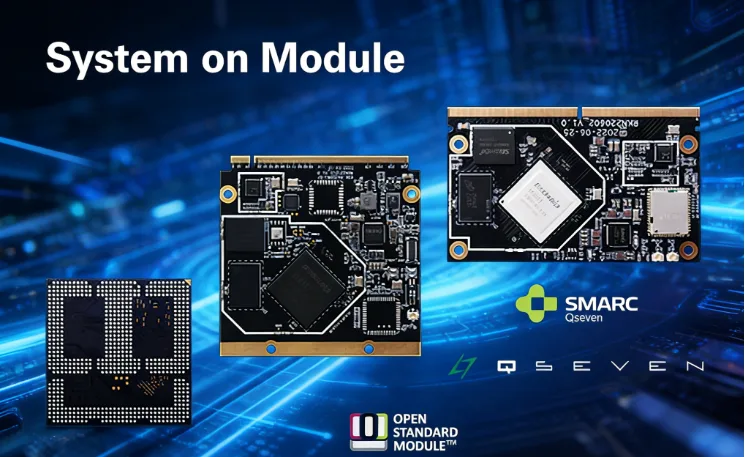
Single-board computers (SBCs) have been the go-to building block for embedded projects for a long time. They’re simple, self-contained and fast to get running. Kiosks, automation terminals and early machine vision systems were built on them, and plenty still are.
But when edge AI projects grow from a few dozen units to thousands, SBCs start to show their limits. That’s when many teams switch to system-on-modules (SoMs).
What SBCs do well
An SBC puts the CPU, memory, storage and I/O on one board. That gives you:
- Fast time to market
- A simple hardware design
- Low engineering effort up front
For a prototype or a fixed-function device, that’s hard to beat.
Where they get stuck: rigidity
The same thing that makes an SBC easy also locks you in. Once the board is designed, the mix of compute, I/O and integration is mostly fixed. Every new product variant tends to need:
- A new board revision
- New layout validation
- Another certification round
- Reworked I/O
Here’s a concrete case. A retail analytics camera needs one set of ports and camera inputs. An industrial inspection station needs a different set. With SBCs, you often end up with two separate hardware projects.
How a SoM is different
A system-on-module separates the computer from the rest of the system. The module carries the processor, memory, core system functions and baseline connectivity. Then you design a carrier board that handles everything specific to your product:
- Industrial interfaces and application-specific I/O
- Power and mechanical design
- Anything else your deployment needs
Think of the SBC as a finished product, and the SoM as a building block. One module can go into a vending machine controller, a vision inspection system, an industrial HMI and an energy monitor. Only the carrier board changes each time.
Integration is easier
An SBC comes with a fixed set of interfaces. If your project needs something it doesn’t have, such as an industrial bus or a special control signal, you add an expansion board. That means more wiring, a bigger enclosure, more places for things to fail, and more maintenance later.
With a SoM, the interface work moves into the carrier board, where you can tailor it to the exact deployment. You only build what you need.
Lifecycle is easier too
Edge AI systems don’t stay still. Software gets updated, hardware gets revised, and environments change. With SBCs, hardware and system design are tightly tied together, so changes are harder.
SoMs let you change things at different layers:
- Upgrade compute by swapping the module
- Change interfaces at the carrier board
- Update software without redesigning hardware
When an SBC is still the right answer
SBCs aren’t obsolete. They still make sense for:
- Low-volume deployments
- Fixed-function devices
- Cost-sensitive designs
- Simple control applications
A quick rule of thumb: if you’re making one product in modest volume, start with an SBC. If you’re building several products on the same core, or planning thousands of units, look hard at a SoM.
Where Geniatech fits
Geniatech makes both, so the choice can follow your project rather than the other way round. Its modules cover NXP, Rockchip, Renesas and other ARM platforms in OSM, SMARC and Qseven form factors, and its boards are available off the shelf or customized. If you need AI acceleration on top, its edge AI computing products are the place to start.
Whichever way you go, decide before the first board layout is frozen. Changing the architecture later costs far more than choosing well now.