A Buyer’s Guide to Choosing a Container Vulnerability Scanner
Your scanner fired 1,200 findings last Tuesday. By Friday, your team had triaged 40. The other 1,160 are in a backlog nobody believes in. That is not a security problem. That is a tooling problem.
Choosing the right container vulnerability scanning tool is less about what a vendor says it detects and more about what your team can actually act on. This guide helps security architects and DevSecOps leads run a disciplined evaluation before signing a contract.
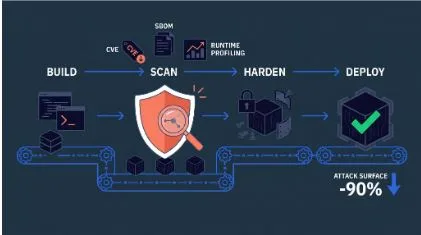
DevSecOps container scanning pipeline from build through harden to deploy, with CVE, SBOM, and runtime profiling labels
Why Most Scanners Fall Short
Every mature scanner matches a CVE against a package version. The hard part is telling you whether that CVE is exploitable in your workload, then helping you fix it.
Most tools stop at the report. Your engineers spend hours separating theoretical risk from real exposure. That is triage theater.
Criteria Checklist
1. Exploitability Context, Not Just CVE Count
A scanner that returns 800 findings is not twice as good as one that returns 400. Ask how the tool distinguishes installed packages from packages actually executed at runtime. Runtime profiling focuses attention on exploitable risk instead of theoretical exposure.
Cost if absent: Engineers waste most of their week on findings that will never be exploited.
2. Automated Remediation
Detection without remediation shifts all the work to your team. The best tools close the loop: identify the vulnerability, then apply a fix – removing unused packages or swapping in a hardened base image. Automated container security remediation is what separates a reporting tool from a security tool.
Cost if absent: Mean time to remediate stays high. Audit findings repeat every quarter.
3. SBOM Generation and Accuracy
An SBOM is now a contractual requirement for many government and enterprise contracts. Your scanner should output a machine-readable SBOM (CycloneDX or SPDX) tied to each image digest. Missing transitive dependencies or language-ecosystem packages (npm, pip, go modules) will fail an audit.
4. CI/CD and Registry Integration
A scanner that only runs on demand is a spot-check, not a security control. Effective container image security requires scans at every image build and registry push, with policy gates that block deploys on critical findings. Verify native support for your registry (ECR, GCR, ACR, Harbor) and CI system.
Cost if absent: Vulnerable images reach production between audit cycles.
5. Compliance Reporting and Noise Reduction
Regulated industries need output mapping to FedRAMP, FIPS 140-2, STIG, CIS Benchmarks, or SOC 2. Ask for a sample compliance report against a framework you already use.
False positives compound the problem. A scanner unaware of vendor-patched packages (Red Hat backports, Debian security patches) will overcount every time. Ask for its false-positive rate on a benchmark image set.
Comparison and Decision Framework
Container vulnerability scanner 6-criteria evaluation matrix: strong indicators vs common gaps for exploitability context, remediation, SBOM accuracy, CI/CD integration, compliance reporting, and noise reduction
Score each candidate 1-3 during evaluation.
| Criterion | “Strong” looks like | Common gap |
|---|---|---|
| Exploitability context | Runtime profiling per workload | Static CVE match only |
| Automated remediation | Hardened image output, no code changes | Remediation advice only |
| SBOM accuracy | Catches transitive + language-ecosystem deps | OS packages only |
| CI/CD integration | Native plugins, policy gates, dev feedback | Manual scan or webhook |
| Compliance reporting | Per-framework reports, audit-ready | Raw finding export |
| Noise reduction | Vendor-patch awareness, dispute tracking | Raw NVD match only |
A tool that scores 3 on detection but 1 on remediation is a detection-only tool. Any single-digit score on remediation should be a hard gate.
How to Run a 30-Day Evaluation
Week 1 – Baseline. Run every candidate against three images: a public base (Alpine or Debian), an internal application image, and a known-CVE image you control. Record finding counts and time to first report.
Week 2 – Pipeline test. Integrate the top two candidates into a staging pipeline. Count manual steps. A tool needing custom scripts to fit your pipeline will need custom scripts to maintain forever.
Week 3 – Remediation test. Ask each tool to remediate your known-CVE image. A 50%+ attack-surface reduction from a single pass is a reasonable baseline expectation.
Week 4 – Compliance dry run. Generate a compliance report and walk it through a mock audit. If your compliance lead can use it without a translation layer, the tool passes.
Frequently Asked Questions
What is the difference between a container vulnerability scanner and an SCA tool?
SCA tools analyze open-source dependencies in source code during development. A container vulnerability scanner operates on a built image, examining every layer including the OS. The scope is broader and the timing is later in the pipeline. You likely need both.
How often should container images be scanned?
Scan on every image build and every registry push. Schedule weekly re-scans of production images even when no new build occurred, because new CVEs are published daily against unchanged packages.
Can a scanning tool also reduce the attack surface, or only report on it?
Some tools go further than reporting. For example, RapidFort combines scanning with runtime profiling and automated hardening to remove unused components from images, cutting the attack surface by up to 90% without any code or OS changes. Most scanners on the market stop at the report. Make automated remediation an explicit criterion so the capability gap shows up before you sign.
What should I look for in a scanner for FedRAMP or FIPS compliance?
Look for a tool that natively maps findings to NIST 800-53 controls and produces a report your ATO team can consume directly. Confirm it supports FIPS-validated base images and flags packages not approved under your ATO.
Closing
The cost of a weak scanner is not a failed audit. It is the 11 months before the audit when your team ships vulnerable images because signal-to-noise is too low to act on.
Teams that select on detection coverage alone end up with an accurate list of things they cannot fix. The criteria above surface tools that complete the job: find the risk, focus on exploitable exposure, and close the loop with remediation.
Weight remediation at least as heavily as detection. The right tool makes your backlog smaller every week, not larger.