
A Modular Sectional Sofa Solves the Room You Already Have
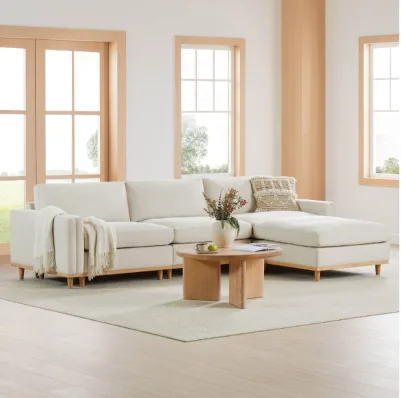
Almost every living room has the same hidden problem: a sofa that looks right against one wall and awkward from everywhere else. The room is wide but shallow, or long and narrow, or split by a doorway that makes a conventional three-seater into a traffic barrier. People respond by buying a smaller sofa and then adding chairs, which solves nothing and adds clutter. The other response is to buy bigger and accept that one corner is now permanently unreachable.
A modular sectional is the third option, and it is the one that most rooms actually want. Because the pieces come apart, the shape is negotiable. You can wrap a corner that would otherwise sit empty, open the seating toward the light, or leave one side loose so it can be moved when guests arrive. This is not a gimmick; it is a different way of thinking about what a sofa is. Instead of a fixed object the room must accommodate, it becomes a set of parts the room can define.
Forget the Showroom Configuration
The sectional on the showroom floor is arranged to fill a showroom, not your living room. It is almost always an L or a U sized for a space far larger than yours, which is why so many people bring home a sectional and discover that it dominates the room it was meant to serve. Before you look at models, sketch your own floor plan. Mark the walls, the windows, the door swings, and the path people walk from the hallway to the kitchen. That path is the most important line on the drawing, because a sectional that blocks it will be resented no matter how comfortable it is.
Then mark where you actually want to sit. Not where a sofa would traditionally go, but where the good view is, where the evening light falls, where you can see the television without turning your head. A modular sectional sofa earns its keep when the seating follows those points instead of the walls. If the best spot for a seat is the middle of the room, a chaise module can anchor it; if the room opens to a dining area, an L can divide the two zones without a wall.
Read the room’s true shape
Square rooms reward an L that leaves one corner open, because a U in a square room turns the seating into a box. Long rooms do better with an L placed across the short dimension or a straight run that faces a focal point, with a chaise at one end to break the monotony. Rooms with a fireplace or a large window on one wall usually want the open side of the sectional facing that feature rather than the open side facing the room’s center. The goal is a shape that leaves the floor readable from the doorway: you should be able to see how to move through the space without a diagram.
Count the seats you will really use
A five-piece sectional seats five people in theory. In practice, households of two use two seats and stack laundry on the rest. Honest counting prevents the oversized purchase that makes a room feel small. If you host often, a corner plus two open-ended seats is more useful than a fully closed U, because open ends let people join a conversation from the side instead of climbing over cushions.
Choose Modules Like Building Blocks
What separates a good modular system from a bad one is not the number of pieces but whether the pieces are genuinely interchangeable. Check that corner units, armless chairs, chaises, and ottomans all share the same seat height and depth, and that the connectors are sturdy enough to hold the shape when someone leans on an open end. A system that only works in the layout pictured in the catalog is not modular; it is a sectional with extra steps.
Decide what belongs at the ends
The end pieces set the character of the whole arrangement. A chaise adds lounging but consumes depth, which matters in a narrow room. An ottoman is the most flexible option because it can sit at the end, float in the middle as a coffee table substitute, or be pushed against the sofa as an extension for movie nights. An open armless end keeps sightlines clean and makes the sectional feel less like a wall. In small rooms, choose the ottoman and let the room breathe; in large rooms, a chaise on each side can make a generous seating island.
Plan for reconfiguration
Modular furniture is often sold on the promise that you can rearrange it later, and that promise is only worth something if the pieces are light enough to move and the connectors survive being undone. Test this mentally. Can one person shift a module to vacuum underneath it? If not, the layout you choose today is the layout you will live with, so choose it carefully. It also helps to leave a few inches between the sectional and the wall so cables, vents, and cleaning are not blocked.
Comfort Lives in the Fill
The way a sectional feels after two years has less to do with the cover than with what is inside the cushions. Foam alone is firm and durable but can feel rigid; foam wrapped in fiber or feather is softer at first touch while keeping its structure. Pure feather is luxurious and needs regular fluffing, and it can flatten under daily use if the core is not supportive. Sit for at least ten minutes and then stand up. Cushions that spring back immediately tend to hold their shape; those that stay dented are telling you something about the months ahead.
Seat depth deserves the same scrutiny. A deep seat invites lounging but leaves shorter sitters with their feet dangling, while a shallow seat supports upright conversation. If the household disagrees, look for a system where the seat depth is fixed but the back cushions are loose enough to adjust, or add a firm throw pillow behind the lumbar of the people who need more support. Back height matters for the same reason: low backs look modern and suit long rooms, but if you want to lean your head back, confirm the modules offer enough rise or a headrest accessory.
Fabric, Family, and the Years Ahead
A sectional gets more contact than any other piece of furniture in the house, so fabric should be chosen for the household rather than for a photograph. Tight-weave performance fabrics resist spills and pet claws and clean up with water and mild soap, which is the practical answer for families with young children or animals. Textured weaves hide wear and crumbs. Velvet and chenille feel wonderful and show every imprint, so they suit adults who treat the sofa gently. Leather handles spills well and develops a patina, but it is cold in winter and can be scratched by determined claws.
Also look for storage built into the modules, which turns dead volume under the seat into a home for blankets and remotes and keeps the room from filling with baskets. Brands such as CHITA LIVING tend to design around these practical concerns, pairing modular flexibility with fabrics that can survive daily life, which is the sensible place to spend the budget. Reversible and removable covers are a bonus: being able to wash a cushion cover rather than replace a whole module changes how long a sectional stays in service.
Lighting and the Space Behind the Couch
A sectional often becomes the longest uninterrupted line in a room, and what sits behind it decides whether that line feels finished or abrupt. A low console with a lamp, a narrow shelf of books, or a single tall plant can give the back of the seating a second purpose, and a console also solves the small problem of where phones and cups go when the coffee table is full. Keep any piece behind the sofa shallow enough to leave a walkway, since a console that blocks the only path around the seating defeats the purpose of an open plan.
Lighting follows the same logic. A sectional invites long evenings, and a single ceiling fixture will make a long seat feel like a room with one dim sun. Two or three light sources at different heights — a floor lamp at one end, a table lamp on the console, a small lamp beside the chaise — let the group be lit in sections as people use it. That arrangement is also more forgiving when one person wants to read and another wants to doze, which is the quiet reality of how modular seating gets used in most homes.
Assembly and the First Week
Delivery is part of the purchase, not an afterthought. Confirm the door widths, hallway turns, and elevator dimensions before ordering, because a sectional that cannot reach the room is an expensive return. Once the pieces are in place, connect them, leave the tools out for a few days, and try the layout with your actual routines. Move one module, live with it for a week, move it again if needed. The advantage of modular seating is that this experimentation is cheap, and the best layout is usually not the one you drew on paper but the one you discover by walking through the room every night.
The Shape That Fits the Life
A sectional is not better because it is large or because it wraps a corner. It is better when its shape comes from the room and the people in it. That means sketching the floor plan before shopping, choosing modules that can genuinely move, and treating comfort as a question of fill and proportion rather than looks.
Get those things right and the sectional stops being a compromise between seating and space. It becomes the piece the room was missing, one that holds a conversation, a film, and a lazy Sunday without fighting the architecture. The room you already have is the only one worth designing for.