A Simple Guide to Planning Your Academic Timeline
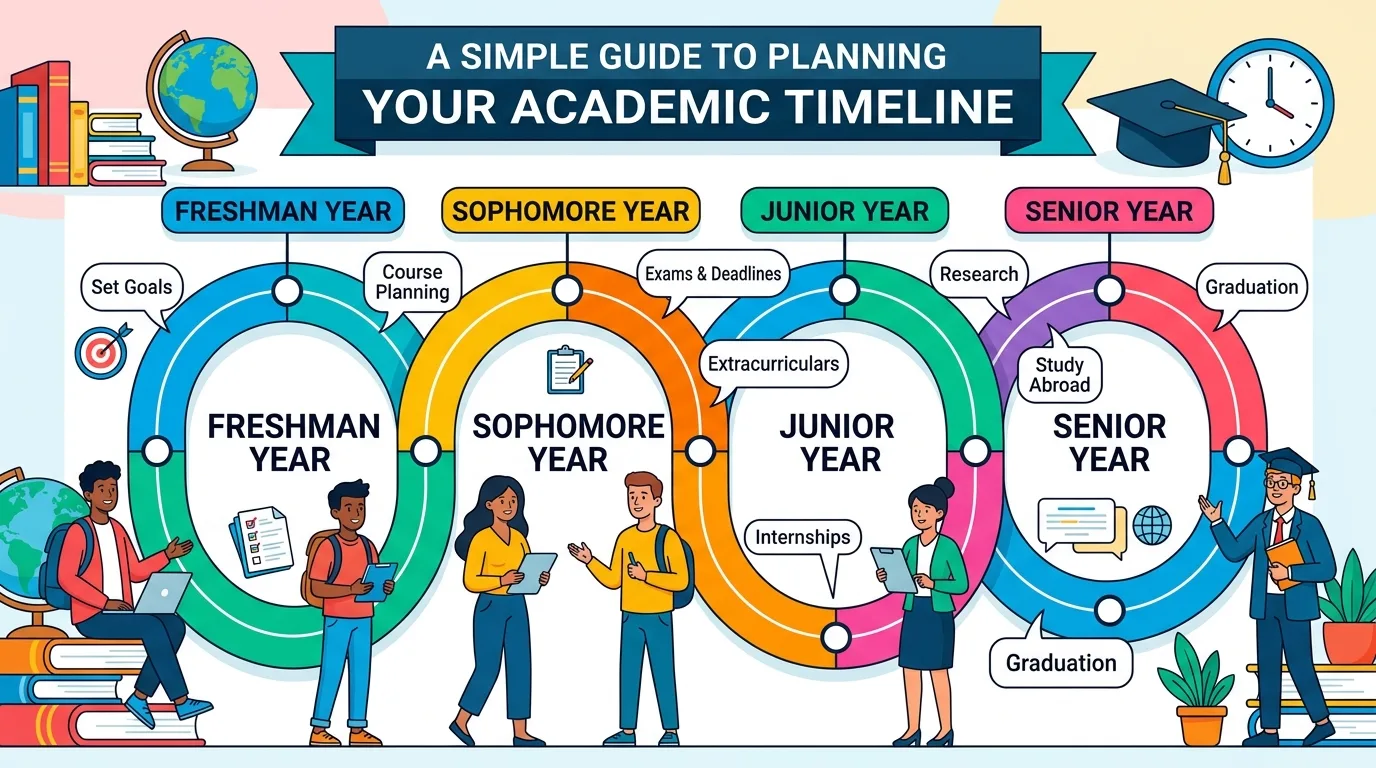
Planning your academic timeline doesn’t have to be hard. You don’t need a wall full of notes or a complex spreadsheet. What you need is a clear view of where you are now, what you still need to complete, and when each step should happen.
An academic timeline helps you plan classes, exams, applications, internships, projects, and graduation. It can also help you spot problems early. A missed course, failed class, transfer, or change of major can add time to a degree if you don’t adjust your plan.
Whether you’re in high school, starting college, or already working toward a degree, a simple timeline gives you a better idea of what comes next.
What Is an Academic Timeline?
An academic timeline is a planned schedule that shows the main steps in your education from your current point to graduation.
It can include:
- Current grade or year of study
- Required courses
- Credit hours
- Exams and major projects
- Application deadlines
- Internships or work placements
- Study terms and breaks
- Expected graduation date
- Plans after graduation
Think of it as a road map for your education. You don’t need to predict every detail years ahead. The goal is to create a useful plan that you can update as things change.
A good timeline should match your actual degree requirements, course load, and school calendar.
Why Should You Plan Your Academic Timeline?
Many students focus only on the next class or next exam. That’s fine for daily study, but it can make long-term planning harder.
A timeline lets you see the bigger picture.
For example, imagine you’re taking a four-year bachelor’s degree. You may need general education classes, major courses, electives, and a final project. Some courses may also have prerequisites, meaning you must pass one course before taking another.
If you don’t plan those courses in the right order, you may reach your final year and discover that you still need a class that isn’t offered until the following term.
That is one reason degree planning matters.
A timeline can help you:
- Stay on track with credit requirements
- Avoid last-minute course problems
- Plan internships and work experience
- Prepare for graduate school
- Estimate your graduation year
- Adjust your plan after setbacks
- Manage school costs over time
Step 1: Find Your Current Starting Point
Before planning ahead, write down where you are today.
For a high school student, this might be your current grade. For a college student, it may be your current year, semester, or number of completed credits.
Also record any factors that may affect your schedule. These can include transfer credits, repeated courses, part-time study, summer classes, or a planned break.
Be honest about your current position. A timeline only works when it starts with accurate information.
Example
Suppose you’re a college student who has completed 48 credits in a degree that requires 120 credits.
You have:
120 total required credits
48 completed credits
72 credits remaining
That gives you a starting point for the rest of your plan.
Your school’s degree audit is especially useful here. A degree audit compares your academic record with the requirements for your degree and can show which requirements you’ve met and which are still open.
Step 2: Check Your Degree Requirements
Don’t build your academic plan from memory.
Look at your current course catalog, degree page, student portal, or degree audit. Requirements can include specific courses, total credits, major courses, general education classes, GPA rules, and other conditions. University degree audit systems commonly track different types of requirements rather than just counting total credits.
Make a simple list of what remains.
For example:
General education: 9 credits
Major courses: 24 credits
Electives: 12 credits
Final project: 3 credits
Your own degree may use a different structure, so follow your institution’s official rules.
This step is where many students find hidden requirements. A student might have enough total credits but still be missing a required class or minimum major credit count.
Step 3: Work Backward From Graduation
Once you know what you need, set a target graduation term.
Then work backward.
Ask:
What courses must I finish before the final term?
Which classes have prerequisites?
Which required courses are only offered in certain terms?
Do I need an internship, thesis, project, placement, or exam?
Are there minimum GPA or residency rules?
This approach makes the plan more realistic.
A Simple Four-Year Example
Suppose a student starts a four-year bachelor’s degree in fall 2026 and follows the normal full-time path without interruptions.
A basic plan could look like this:
2026 to 2027: First-year courses and general education
2027 to 2028: Second-year courses and introductory major work
2028 to 2029: Upper-level major courses and electives
2029 to 2030: Final major courses, project, and graduation steps
A standard program length gives you a rough target, but your actual date depends on your course choices, school calendar, completed credits, and degree rules. Graduation calculators also treat results as estimates rather than official graduation decisions.
Step 4: Track Credits, Not Just Years
Years of study can give you a quick estimate, but credits give you a better picture of progress in many college programs.
Let’s say your degree needs 120 credits and you’ve completed 60. You have 60 credits left.
If you normally complete 30 credits per academic year, your simple estimate would be:
60 ÷ 30 = 2 years remaining
That points to a two-year estimate.
But don’t stop there. Check whether the remaining classes fit your plan. A student may have enough credits left for two years but still need a prerequisite sequence that takes longer.
Course availability matters too. A required class may only run once a year.
Step 5: Estimate Your Graduation Year
Once you know your starting year and study length, you can estimate your graduation year.
For a simple degree plan:
Graduation Year = Start Year + Program Length
For example:
2026 + 4 = 2030
A student who starts a four-year program in 2026 could expect to finish in 2030 under a standard, uninterrupted plan.
For high school, a common estimate uses the number of grades remaining:
Graduation Year = Current School Year + (12 – Current Grade)
A student in grade 10 during 2026 would have about two school years left, giving an estimated graduation year of 2028. This type of formula assumes normal grade progression and a standard school structure.
When you need a quick estimate, you can use a graduation year calculator. If you’re trying to calculate Graduation Year, enter the details that match your situation, such as your current grade, college start year, degree length, or completed credits.
Step 6: Build Time Into Your Plan for Delays
A good academic timeline should leave some room for change.
Students don’t always move through school at the same pace. You may repeat a class, change majors, transfer schools, reduce your course load, take summer classes, or take a gap term.
These changes don’t mean your academic plan has failed. They mean it needs an update.
For example, suppose your original plan estimated graduation in 2030, but you change your major and need two extra courses. Your new estimate may move to 2031.
Write the change into your timeline and review the remaining requirements. Don’t keep using an old graduation date just because it was your first plan.
Step 7: Add Key Milestones
Your academic timeline should include more than classes.
Add important dates such as:
Academic Milestones
Track registration periods, exams, major assignments, internships, thesis work, and final projects.
Career Milestones
Add internship searches, career fairs, resume updates, job applications, and networking events.
Postgraduate Plans
If you want to attend graduate school, add entrance tests, application deadlines, recommendation requests, and document preparation.
Graduation Tasks
Check your university’s rules for applying to graduate. Some institutions ask students to meet with an advisor before the final term, while others require a formal graduation application by a set deadline.
Don’t wait until your final weeks to check these steps.
A Simple Academic Timeline Template
You can create a basic plan like this:
Current status: 60 of 120 credits completed
Target graduation: Spring 2030
Remaining credits: 60
Year 1:
Complete core courses and required prerequisites.
Year 2:
Finish upper-level major courses, electives, and final requirements.
Final term:
Complete remaining credits, confirm degree requirements, submit graduation paperwork, and prepare for work or further study.
Review this plan at the start of every term.
How Often Should You Update Your Academic Plan?
Check your timeline at least once each semester or term.
A quick review can answer three useful questions:
- What did I complete?
- What do I still need?
- Does my expected graduation date still make sense?
Your degree audit and academic advisor can help confirm whether your plan matches your institution’s rules. Degree audit systems can also help students project how future courses may apply toward their degree.
Common Academic Timeline Mistakes
The most common mistake is planning only by calendar years.
A four-year label doesn’t tell you whether the required courses are available when you need them. Another mistake is ignoring prerequisites. You can also run into trouble by assuming every course counts toward your degree simply because you earned the credit.
Your timeline should follow your official degree requirements, not a generic plan found online.
Another common issue is treating an estimated graduation year as a guarantee. A calculator can give you a useful target, but your school or university confirms the actual requirements and graduation status.
Final Thoughts
Planning your academic timeline is really about knowing what comes next.
Start with your current grade, year, or completed credits. Check your official degree requirements. Work backward from your target graduation date. Track prerequisites, course availability, credit hours, and key deadlines. Then review your plan each term and make changes when your situation changes.
A simple timeline can make a long degree feel much easier to manage. It can also help you answer practical questions, such as how many credits you need, whether you’re on track, and when you might graduate.
Your first estimate doesn’t need to be perfect. It needs to be clear, realistic, and easy to update.