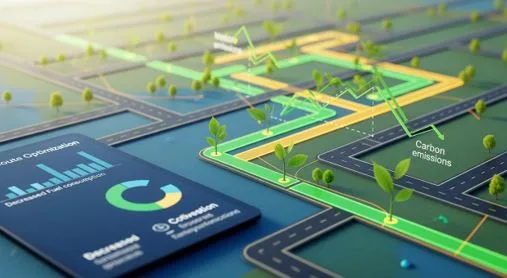
Achieving Sustainability with Route Optimization
The best route optimization software doesn’t just make your delivery routing better for drivers and customers.
It can also help make your entire delivery company more sustainable through better efficiency.
This is an obvious win-win. Taking your parcels and packages on the most efficient routes gets them to the doorsteps faster and in such a way that helps to protect the planet.
Why sustainability matters in Australian delivery services logistics
Australia’s geography and transport networks present both challenges and opportunities when it comes to sustainability.
Distance and fuel consumption
Long travel distances are a reality for many Australian fleets, particularly those servicing regional and outer metropolitan areas.
Without efficient route planning, vehicles can quickly rack up excess kilometres, increasing fuel use and emissions.
Luckily route optimization helps to minimise these inefficiencies by ensuring every kilometre driven contributes to a productive outcome that only technology can achieve easily.
Customer satisfaction is becoming harder to realise
More customers are paying attention to how goods and services are delivered.
Transparent communication, reliable ETAs and responsible operations are increasingly part of the customer experience.
Businesses that can demonstrate efficient, well-managed delivery operations are better positioned to build trust and long-term relationships.
Efficiency supports long-term growth
Sustainable operations are often more efficient operations, so reducing waste like fuel usage and idle time allows businesses to scale without majorily jumping up costs or causing a negative environmental impact.
What route optimization really means
Route optimization goes beyond choosing the shortest path between two points as it really focuses on designing the most efficient overall plan for a fleet.
Multiple variables, one smart plan
Modern route optimization considers a wide range of factors, including delivery windows, service times, vehicle capacity, driver availability and traffic conditions.
By balancing these variables, businesses can create routes that make better use of time and resources.
Continuous improvement towards operational efficiency through data
Optimised routes improve over time as systems learn from historical data.
Patterns such as recurring delays or consistently efficient routes inform future planning, leading to ongoing gains in efficiency and sustainability.
Reducing emissions through smarter routing
One of the most directly obvious and powerful sustainability benefits of route optimization is reduced emissions.
Fewer kilometres on the road
When routes are planned efficiently, vehicles travel fewer unnecessary kilometres. This reduction directly lowers fuel consumption and emissions across the fleet.
Over weeks and months, even small reductions per route can add up to significant environmental benefits.
Less idling and congestion impact
Poorly planned routes often lead to excessive idling and time spent in congested areas. Optimised routing avoids peak traffic where possible and sequences stops to keep vehicles moving efficiently.
Reduced idling not only lowers emissions but also supports better vehicle health.
Better fuel efficiency and operating costs
Fuel efficiency and sustainability are closely linked. But the costs of lower fuel are obvious to those even outside of logistics.
Immediate cost savings
By reducing distance travelled and time spent on the road, route optimization delivers immediate fuel savings.
These savings can be reinvested into other areas of the business or used to support further efficiency initiatives.
Protecting vehicles and assets
Efficient routing reduces strain on vehicles. Less stop-start driving and fewer unnecessary trips contribute to lower maintenance costs and longer vehicle lifespans.
This smarter use of assets supports both financial and environmental sustainability.
Improving last-mile efficiency with route planning software
The last mile is often the most resource-intensive part of the delivery process. route optimization brings significant sustainability benefits here.
Smarter stop sequencing
Optimised stop sequencing ensures drivers visit locations in the most efficient order. This reduces backtracking and unnecessary travel between stops.
Fewer failed deliveries
Accurate ETAs and better route planning reduce missed deliveries. Fewer re-deliveries mean fewer trips and lower overall emissions.
Building a more sustainable logistics future
Achieving sustainability in logistics does not rely on a single change. It comes from a series of smarter decisions that improve efficiency over time.
route optimization sits at the centre of this approach.
By reducing kilometres travelled, lowering fuel consumption and supporting better use of people and assets, it delivers practical sustainability benefits that also make strong business sense.
For Australian logistics and field service businesses, route optimization offers a clear path towards more efficient, responsible and future-ready operations.